

Speed of Trust
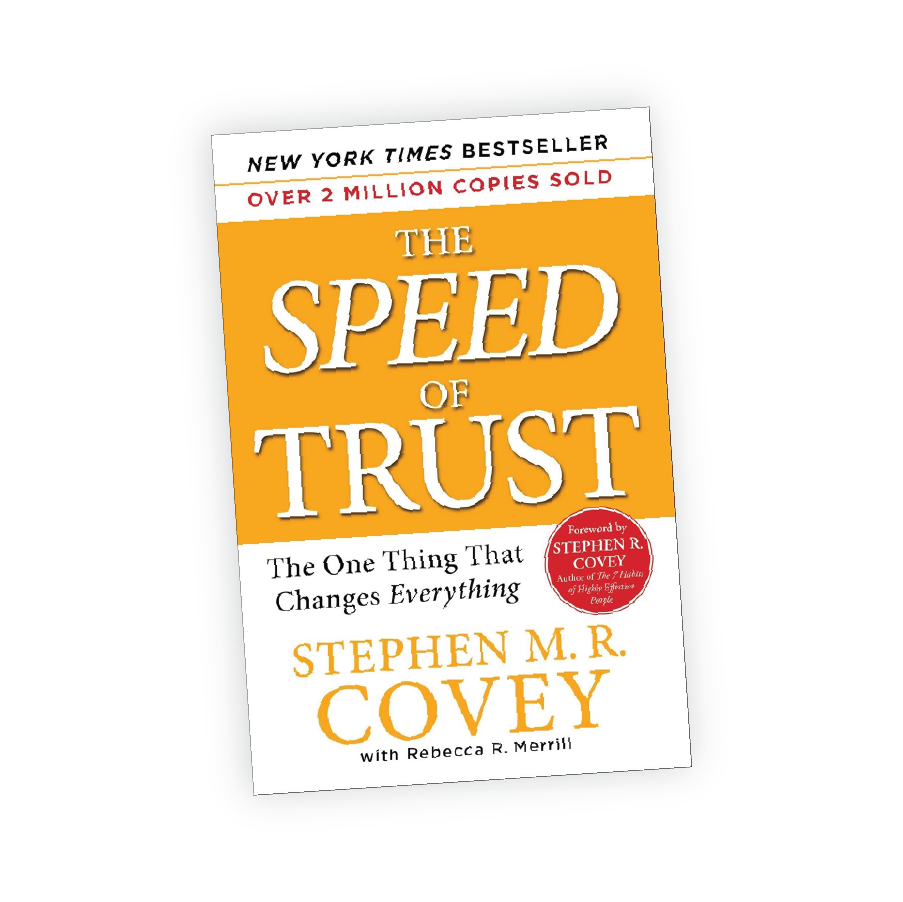
Number of Pages: 384
Estimated Read Time
Slow Reader: 25 Hours 36 Minutes
Average Reader: 12 Hours 48 Minutes
Fast Reader: 6 Hour 24 Minutes
Estimated Listen Time: 12 Hours 13 Minutes
Amazon Description
From Stephen R. Covey’s eldest son comes a revolutionary new path towards productivity and satisfaction. Trust, says Stephen M.R. Covey, is the very basis of the new global economy, and he shows how trust—and the speed at which it is established with clients, employees and constituents—is the essential ingredient for any high–performance, successful organization.
For business leaders and public figures in any arena, The Speed of Trust offers an unprecedented and eminently practical look at exactly how trust functions in our every transaction and relationship—from the most personal to the broadest, most indirect interaction—and how to establish trust immediately so that you and your organization can forego the time–killing, bureaucratic check–and–balance processes so often deployed in lieu of actual trust.
Overview
Trust is a function of two things: character and competence
Character
Your integrity
Your motive
Your intent
Competence
Your capabilities
Your skills
Your results
Your track record
The 4 Cores of Credibility
Integrity
Intent
Capabilities
Results
The 5 Waves of Trust
Self Trust
Relationship Trust
Organizational Trust
Market Trust
Societal Trust
13 Behaviors
Character
Talk straight
Demonstrate respect
Create transparency
Right Wrongs
Show loyalty
Competence
Deliver results
Get better
Confront Reality
Clarify expectations
Practice accountability
Both
Listen first
Keep commitments
Extend trust
The One Thing That Changes Everything
The One Thing That Changes Everything, page 1.
There is one thing that is common to every individual, relationship, team, family, organization, nation, economy, and civilization throughout the world – one thing which, if removed, will destroy the most powerful government, the most successful business, the most thriving economy, the most influential leadership, the greatest friendship, the strongest character, the deepest love.
On the other hand, if developed and leveraged, it is the one thing that has the potential to create unparalleled success and prosperity in every dimension of life.
Yet it is the least understood, most neglected, most underestimated possibility of our time.
That one thing is trust.
And, in every situation, nothing is as fast as the speed of trust, the rate at which it can develop (or disintegrate).
And, contrary to popular belief, trust is something you can do something about.
In fact, you can get good at creating it!
Nothing Is as Fast as the Speed of Trust
“If you’re not fast, you’re dead.” – Jack Welch
You can do something about trust. In fact, by learning how to establish, grow, extend, and restore trust, you can positively and significantly alter the trajectory of this and every future moment of your life.
Getting A Handle On Trust
So what is trust? Simply put, trust means confidence.
The opposite of trust – distrust – is suspicion.
When you trust people, you have confidence in them – in their integrity and their abilities.
We have all had experiences that validate the difference between relationships that are built on trust and those that are not. The difference is not small; it is dramatic.
Take communication. In a high-trust relationship, you can say the wrong thing, and people will get your meaning. In a low-trust relationship, you can be very measured, even precise, and people will still misinterpret you.
We judge ourselves by our intentions and others by their behaviors. Because of this, one of the fastest ways to restore trust is to make and keep commitments – even very small commitments – to ourselves and others.
The Economics of Trust
Here’s a simple formula that will enable you to take trust from an intangible and unquantifiable variable to an indispensable factor that is both tangible and quantifiable.
Trust always affects two outcomes – speed and cost.
When trust goes down, speed will always go down and cost will always go up.
When trust goes up, speed will also go up and costs will go down.
During a 360 feedback process, a group of leading organizations asked their employees, “Do you trust your boss?” These companies learned that the answer to this one question is more predictive of team and organizational performance than any other question they might ask.
The Trust Tax
The serious practical impact of the economics of trust is that in many relationships and interactions, we are paying a hidden low-trust tax right off the top – and we don’t even know it!
Unfortunately, low-trust taxes don’t conveniently show up on your income statement as a “cost of low-trust.” But just because they are hidden doesn’t mean they’re not there.
Once you know where and what to look for, you can see these taxes show up everywhere – in organizations and relationships. They’re quantifiable. And they’re often extremely high.
In some situations, you may have even had to pay an “inheritance tax” when you stepped into a role that was occupied by someone who created distrust before you.
If you step in as a new leader in a low-trust culture, it’s possible that you’re being taxed 30, 40, 50 percent, or more for something you didn’t even do.
The Trust Dividend
Just as the tax created by low trust is real, measurable, and extremely high, so the dividends of high trust are also real, quantifiable, and incredibly high.
When trust is high, the dividend you receive is like a performance multiplier, elevating and improving every dimension of your organization and your life.
High trust materially improves communication, collaboration, execution, innovation, strategy, engagement, partnering, and relationships with all stakeholders.
The Hidden Variable
For most people, trust is hidden from view. They have no idea how present and pervasive the impact of trust is in every relationship, in every organization, in every interaction, and every moment of their life.
Once a leader puts on their “trust glasses” and see what’s going on under the surface, it immediately impacts their ability to increase their effectiveness in every dimension of life.
The traditional business formula says that strategy times execution equals results.
S x E = R
(Strategy times Execution equals Results)
But there is a hidden variable to this formula: trust – either the low-trust tax, which discounts the output, or the high-trust dividend which multiplies it:
(S x E) T = R
([Strategy time Execution] multiplied by Trust equals Results)
The ability to establish, grow, extend, and restore trust with all stakeholders – customers, business partners, investors, and coworkers – is the key leadership competency of the new global economy.
As yourself: Is my organization paying taxes or receiving dividends? And what about me – am I a walking tax or a walking dividend?
You Can Do Something About This!
You Can Do Something About This!, page 27.
“As you go to work, your top responsibility should be to build trust.” – Robert Eckert, CEO, Mattel
How Trust Works
Trust is one of the most powerful forms of motivation and inspiration.
People want to be trusted. They respond to trust. They thrive on trust.
Trust is a function of two things: character and competence. Both are vital.
Character includes your integrity, your motive, and your intent.
Competence includes your capabilities, your skills, your results, and your track record.
You might think a person is sincere, even honest, but you won’t trust that person fully if he or she doesn’t get results.
And the opposite is true. A person might have great skills and talents and a good track record, but if he or she is not honest, you’re not going to trust that person either.
While it may come more naturally for us to think of trust in terms of character, it’s equally important that we also learn to think in terms of competence.
Recognizing the role of competence helps us identify and give language to underlying trust issues that are otherwise hard to put a finger on.
Character is a constant; it’s a necessary ingredient for trust in any circumstance.
Competence is situational; it depends on what the circumstance requires.
Once you become aware that both character and competence are vital to trust, you can see how the combination of these two dimensions is reflected in the approach of effective leaders and observers everywhere.
People might use different words to express the idea, but if you reduce the words to their essence, what emerges is a balance of character and competence.
The 5 Waves of Trust
If you think the problem is “out there,” that very thought is the problem.
Your boss, your division leader, your CEO, your board, your spouse, your children, your friends, and your associates may all have problems as far as trust is concerned, but that does not mean that you are powerless!
You probably have no idea how powerful you can be in changing the level of trust in any relationship if you know how to work “from the inside out.”
The key is in understanding and learning how to navigate the “5 Waves of Trust.” The 5 Waves:
Illustrate the interdependent nature of trust.
Illustrate how trust works from the inside out.
Define the five levels in which we establish trust.
Form the structure for understanding and making trust actionable.
The First Wave: Self Trust
The key principle underlying this wave is credibility.
Deals with the confidence we have in ourselves:
Our ability to set and achieve goals.
Our ability to keep commitments.
Our ability to walk our talk.
Our ability to inspire trust in others.
The Second Wave: Relationship Trust
The key principle underlying this wave is Consistent Behavior.
Shows how to establish and increase the “trust accounts’ we have with others.
Introduces the 13 Trust Building Behaviors common to high-trust leaders around the world.
The net result is a significantly increased ability to generate trust with all involved to enhance relationships and achieve better results.
The Third Wave: Organizational Trust
The key principle underlying this wave is alignment.
Alignment helps leaders create structures, systems, and symbols of organizational trust that decrease or eliminate seven of the most insidious and costly organizational trust taxes, and create seven huge organizational trust dividends.
The Fourth Wave: Market Trust
The underlying principle behind this wave is reputation.
It’s about your company’s brand (as well as your personal brand), which reflects the trust customers, investors, and others in the marketplace have in you.
This material will help you not only improve your personal brand and reputation as an individual, but it will also help improve your organization’s brand and reputation in the marketplace.
The Fifth Wave: Societal Trust
The principle underlying this wave is contribution.
This wave is about creating value for others and for society at large.
By contributing or “giving back,” we counteract the suspicion, cynicism, and low-trust inheritance taxes within our society.
See/Speak/Behave
The purpose of this book is to enable you to see, speak, and behave in ways that establish trust, and all three dimensions are vital.
This book will give you a pair of “trust glasses” that will allow you to see trust in an entirely different and exciting way – a way that will open your eyes to the possibilities and enable you to increase trust on every level.
It will give you the language to speak about trust.
This book will give you the language to name the underlying issues and describe those issues and talk about and resolve them.
This book will help you develop the behaviors that establish and grow trust – particularly, the 13 Behaviors of high-trust people and leaders worldwide.
These three dimensions are interdependent, and whenever you affect a change in one dimension, you affect a change in all three.
The First Wave: Self Trust
The First Wave: Self Trust, page 41.
The first wave – Self Trust – is where we learn the foundational principle that enables us to establish and sustain trust at all levels.
That principle is credibility, or believability.
The good news is that we can increase our credibility, and we can increase it fast, particularly if we understand the four fundamental “cores.”
Two of these cores deal with character and two with competence.
What gives trust its harder, more pragmatic edge is the recognition that competence is as vital to trust as character is, and that both are within our ability to create or change.
As we develop these four cores, we increase our personal credibility. We then have the foundation from which we can establish and sustain trust in all relationships in life.
The Four Cores of Credibility
The First Wave – Self Trust – is all about credibility.
It’s about developing the integrity, intent, capabilities, and results that make you believable, both to yourself and to others.
The first two cores deal with character; the second two with competence. All four are necessary for self-trust.
Most people you interact with will not recognize these 4 Cores of Credibility as parts of a greater whole.
They won’t realize that your credibility has four dimensions and that you can rate high in some and low in others.
They only see the whole – either you have credibility or you don’t.
Why it’s important to understand the 4 Cores:
They will help you understand your own credibility and focus on areas where you need to improve.
They will give you the wisdom to know how to behave and establish trust.
They will give you the judgement to learn how to extend “Smart Trust” to others.
Core 1: Integrity
What most people think about when they think of trust.
Integrity includes honesty, it’s much more.
It’s Integratedness.
It’s walking your talk.
It’s being congruent, inside and out.
It’s having the courage to act in accordance with your values and beliefs.
Core 2: Intent
This has to do with our motives, our agendas, and our subsequent behavior.
Trust grows when our motives are straightforward and based on mutual benefit.
Intent means caring not only for ourselves, but for everyone we interact with, lead, or serve.
Core 3: Capabilities
These are the abilities we have that inspire confidence – our talents, attitudes, skills, knowledge, and style.
They are the means we use to produce results.
Capabilities also deal with our ability to establish, grow, extend, and restore trust.
Core 4: Results
Results refer to our track record, our performance; Getting the right things done.
If we don’t accomplish what we are expected to do, it diminishes our credibility.
On the other hand, when we achieve the results we promise, we establish a positive reputation of performing, of being a producer…and our reputation precedes us.
Tree Metaphor
One way to visualize the importance of all 4 Cores of Credibility is through the metaphor of a tree:
Integrity is below the surface; it’s the root system out of which everything else grows.
Intent becomes somewhat more visible. It is the trunk that emerges from beneath the surface into the open.
Capabilities are the branches. They are the capacities that enable us to produce.
Results are the fruits – the visible, tangible, measurable outcomes that are most easily seen and evaluated by others.
Visualizing the 4 Cores of Credibility in this way will enable you to see the interrelatedness of all four and the vital importance of each.
It will also help you see credibility as a living, growing thing that can be nurtured.
Core 1 – Integrity
Core 1 – Integrity, page 59.
The tree metaphor visualizes integrity as the root. Even though it’s underground and invisible, it is vital to the nourishment, strength, stability, and growth of the entire tree.
To have integrity only – and not the other three cores – is to be a “nice guy,” maybe even a thoroughly honest person, but one who is useless. Honest but irrelevant.
Defining Integrity
To most people, integrity means honesty.
Honesty includes not only telling the truth, but leaving the right impression. It’s possible to tell the truth and leave the wrong impression.
Certainly, integrity includes honesty, but there are at least three additional qualities that are equally vital:
Congruence
“Integrity” come from the same Latin root as the words “integrated and “integer.”
A person has integrity when there is no gap between intent and behavior…when he/she is whole, seamless, the same – inside and out. This is often referred to as “congruence.”
Congruence – not compliance – is what ultimately creates credibility and trust.
People who are congruent act in harmony with their deepest values and beliefs.
Congruent people walk their talk.
Humility
Integrity also includes humility.
In his book, Good to Great, Jim Collins observed, “All the good-to-great companies have Level 5 leadership at the time of transition.” Collins characterizes “Level 5” leadership as, “self-effacing, quiet, reserved, even shy – these leaders are a paradoxical blend of personal humility and professional will.”
A humble person is more concerned about what is right than about being right, about acting on good ideas than having the ideas, and about embracing new truths than defending an outdated position.
Being humble does not mean being weak. It means recognizing the principle and putting it ahead of the self. It means standing firmly for principle, even in the face of opposition.
Humble people also realize clearly that they do not stand alone, but rather on the shoulders of those who have gone before, and that they move upward only with the help of others.
The opposite of humility is arrogance and pride.
Courage
Integrity also includes the courage to do the right thing – even when it’s hard.
How to Increase Integrity
Make and Keep Commitments to Yourself
There is absolutely nothing you can do that will increase integrity faster than learning how to make and keep commitments to yourself.
In the Second Wave – Relationship Trust, we will talk about the power of making and keeping commitments to others. But there’s no way you will be able to do that effectively if you haven’t first learned to make and keep commitments to yourself.
As you consider how you might step up your ability to make and keep commitments to yourself, let me suggest a few important things to keep in mind:
Don’t make too many commitments.
Differentiate between a goal, a direction, a focus, and an actual commitment.
When making a commitment, clearly understand that you are pledging your integrity.
Treat a commitment you make to yourself with as much respect as you do the commitments you make to others.
Do not make commitments impulsively.
When keeping your commitment becomes hard, you have two choices: You can change your behavior to match your commitment, or you can lower your values to match your behavior. One choice will strengthen your integrity; the other will diminish it and erode your confidence in your ability to make and keep commitments.
Stand for Something
If you’re going to have integrity you have to have a core, something to which you must be true.
You need to have a center. You need to have identified values.
You need to know what you stand for and you need to stand for it, so that others know, too.
An excellent way to identify the values you want to stand for is to go through some kind of purpose – or values-clarification process.
Be Open
Openness is vital to integrity. It takes both humility and courage.
A good way to increase integrity is to work on being open.
“He who cannot change the very fabric of his thought will never be able to change reality, and will never, therefore, make any progress.” – Anwar Sadat
To be open inspires credibility and trust, to be closed fosters suspicion and mistrust.
As you evaluate your openness, you might ask yourself:
Do I believe that the way I see the world is 100% accurate?
Am I honestly willing to listen to and consider new viewpoints and ideas?
Do I seriously consider differing points of view, and am I willing to be influenced by them?
Do I believe there may be principles that I have not yet discovered? Am I determined to live in harmony with them, even if it means developing new thinking patterns and habits?
Do I value – and am I involved in – continual learning?
To the degree to which you remain open to new ideas, possibilities, and growth, you create a trust dividend; to the degree you do not, you create a trust tax that impacts both your current and future performance.
Core 2 – Intent
Core 2 – Intent, page 73.
“In law, a man is guilty when he violates the right of another. In ethics, he is guilty if he only thinks of doing so.” – Immanuel Kant
Important issues we’re dealing with when we talk about intent.
Intent matters.
It grows out of character.
While we tend to judge ourselves by our intent, we tend to judge others by their behavior.
We also tend to judge others’ intent based on our own paradigms and experience.
Our perception of intent has a huge impact on trust.
People often distrust us because of the conclusions they draw about our actions.
It is important for us to actively influence the conclusions others draw by “declaring our intent.”
As illustrated in the tree metaphor, intent is represented by the trunk – partly unseen underground, partly visible above.
While our motives and agendas are deep inside in our own hearts and minds, they become visible to others through our behaviors and what we share with others.
What is Intent?
No discussion of intent would be complete without talking about three things: motive, agenda, and behavior.
Motive
Motive is your reason for doing something.
It is the “why” that motivates the “what.”
The motive that inspires the greatest trust is genuine caring – caring about people, caring about purpose, caring about the quality of what you do, caring about society as a whole.
Motive matters, and the motive of caring will do more than anything else to build credibility and trust.
If you don’t care – and you don’t want to care – that’s fine. But you need to understand that you will pay a tax because of it! Whatever you say or do will take more time and it will cost more because you will not gain the credibility and trust that comes from caring.
You also need to understand that if you act like you care when you truthfully don’t, ultimately – if not immediately – you will have a “comeuppance” and the tax will be even greater. Few trust taxes are higher than those attached to duplicity, particularly regarding motive.
Agenda
Agenda grows out of motive.
It’s what you intend to do or promote because of your motive.
The agenda that generally inspires the greatest trust is seeking mutual benefit:
Genuinely wanting what’s best for everyone involved.
You genuinely want to see others win.
You recognize that life is interdependent, so you seek out solutions that build trust and benefit all.
The opposite of a mutual benefit agenda is a self-serving agenda:
A self-serving agenda may get results, but you need to ask yourself: Are these the best possible results I could be getting? And: Are these results sustainable over time?
Sooner or later, you will pay a huge tax, and your approach will not be sustainable.
Instead of building credibility and trust, you’re creating roadblocks of suspicion and distrust.
Behavior
Typically, behavior is the manifestation of motive and agenda.
The behavior that best creates credibility and inspires trust is acting in the best interest of others.
When we do so, we demonstrate the intent of caring and the agenda of seeking mutual benefit.
It’s easy to say “I care” and “I want you to win,” but it is our behavior that demonstrates whether or not we mean it.
How To Improve Intent
Examine and Refine Your Motives
It’s human tendency to assume we have a good – or at least justifiable – intent.
How can we get down to the deepest level to examine our motives, discover why we do what we do, and change what needs to be changed?
Soul-searching questions:
Are my actions motivated by genuine caring and love?
Am I really seeking the best interest of the other person?
Am I humble enough to admit if I am wrong?
Am I trying to impose my will on the other person?
Am I sincerely listening to what the other has to say?
Am I genuinely open to their influence?
Do I understand where they are coming from?
Or, am I more focused on explaining my point of view, being right, or getting my way?
Do I genuinely want what’s best for us both?
Do I know what constitutes a “win” for the other person?
Declare Your Intent
Declaring your intent and expressing your agenda and motives can be very powerful, particularly if your behavior is being misinterpreted or misunderstood by others.
Declaring your intent is valuable as a means of establishing trust in a new relationship.
The main reason why declaring intent increases trust is that it signals your behavior – it lets people know what to look for so they can recognize, understand, and acknowledge it when they see it.
Choose Abundance
Abundance means that there is enough for everybody.
The opposite – scarcity – says that there is only so much to go around, and if you get it, I won’t.
While scarcity may be a reality in some areas (sports, forced grading curves), in most of the important things in life, such as love, success, energy, results, and trust – abundance is not only a reality, it is an attractor and generator of even more.
Core 3 – Capabilities
Core 3 – Capabilities, page 91.
“If you don’t like change, you’re going to like irrelevance even less.” – General Eric Shinseki, U.S. ARMY Chief of Staff
The first dimension of competence is capabilities.
Capabilities are the talents, skills, knowledge, capacities, and abilities we have that enable us to perform with excellence.
Going back to the tree metaphor, capabilities are the branches that produce the fruits or results.
Capabilities are vital to creating credibility – both personally and organizationally.
You can have integrity and good intent, and even a record of producing good results in the past, but at the end of the day – in this rapidly changing knowledge worker economy – if you don’t have current capabilities, you will not have credibility. You’ll be irrelevant. You’ll be taxed. You won’t get the dividends of trust.
An example of someone who has the other three cores – but not capabilities – would be someone who is honest and caring and produces the results necessary to be promoted to a new level of responsibility that he doesn’t have the competence to handle. This is the Peter Principle – promoting people to the level of their incompetence.
The main message here for both individuals and organizations is that to remain credible in today’s world, we need to constantly improve our capabilities.
It’s vital to reinvent yourself every three years to significantly upgrade your skill set and knowledge. This will help you remain relevant with the ability to make new contributions in a world of constant change.
TASKS
One way to think about the various dimensions of capabilities is to use the acronym “T.A.S.K.S.”:
Talents: Our natural gifts and strengths.
Attitudes: Our paradigms – our ways of seeing, as well as our ways of being.
Skills: Our proficiencies, the things we do well.
Knowledge: Our learning, insight, understanding, and awareness.
Style: Our unique approach and personality.
These are all parts of what we call our capabilities. They are our means to produce results.
Here are some questions to consider…
Talent:
What are my unique strengths and talents?
What is the highest and best use of my talents?
How can I better maximize the talents I have?
What talents might I have that I have not yet developed?
Attitude:
What are my attitudes about work?
What are my attitudes about life?
What are my attitudes about learning?
What are my attitudes about myself, my capabilities, and my opportunities to contribute?
Are there more productive attitudes and paradigms I could embrace that would help me create better results?
Skill:
What skills do I currently have?
What skills will I need in the future that I do not currently have?
To what degree am I constantly upgrading my skills?
Knowledge:
What is my current level of knowledge in my specific field?
What am I doing to stay current?
What other areas of knowledge am I pursuing?
Style:
How effective is my current style in approaching problems and opportunities and interacting with others?
Does my approach facilitate or get in the way of accomplishing what needs to be done?
What can I do to improve how I go about doing things?
Matching T-A-S-K-S to Tasks
The end here is to develop our TASKS and match them to the tasks at hand – to create the best possible alignment between our natural gifts, passions, skills, knowledge, and style and the opportunity to earn, contribute, and make a difference.
In Good to Great, Jim Collins talks about the importance of having “the right people on the bus” and “the right people in the right seats.” As a leader, you want to have capable people in your organization, but you also want to create the right match between a person’s specific capabilities and the job you are asking that person to do.
Smart companies engage in practices such as competency modeling, training, mentoring, and coaching to help ensure that those who are promoted have the TASKS that will help them establish the credibility they need to succeed.
The attitude and habit of continuous improvement is one of the prime differentiators between companies that remain relevant and succeed and those that fall by the wayside in today’s global economy.
How to Increase Your Capabilities
Run With Your Strengths (and with Your Purpose)
The idea here is to identify your strengths (whether they be Talents, Attitudes, Skills, Knowledge, or Style), and then focus on engaging, developing, and leveraging what’s distinctly yours.
Feed strengths, starve weaknesses. We make our weaknesses irrelevant by working effectively with others so that their strengths compensate for our weaknesses.
Keep Yourself Relevant
You need to be engaged in lifelong learning.
Know Where You’re Going
At the end of the day, people follow those who know where they are going.
To know where you are going and to have the capabilities to get there is another way of demonstrating competence.
Competence, coupled with character, creates a credible leader whom others will follow.
“The people you lead want to know where you are going.” – Christopher Galvin, Chairman and CEO, Motorola
Trust Abilities
While character is constant, competence is situational. It depends on what the circumstance requires.
There are a few areas of competence that are vital in every situation, and “trust abilities” are at the top of the list.
“Trust Abilities” are basically what this book is all about – your ability to establish, grow, extend, and restore trust.
Your technical abilities are taxed dramatically – sometimes even becoming irrelevant – in direct relation to your trust abilities.
Even considering how important technical abilities are with regard to trust, I am convinced that the most important thing you can get out of this chapter is the awareness of the supreme importance of trust abilities.
Core 4 – Results
Core 4 – Results, page 109.
“You can’t create a high-trust culture unless people perform.” – Craig Weatherup, CEO, PepsiCo
Results matter! They matter to your credibility. They matter to your ability to establish and maintain trust with others.
Returning once again to the metaphor of the tree, the results are the fruits – the tangible, measurable end purpose and product of the roots, trunk, and branches.
To have the other three cores without results is like having a barren tree. It won’t create credibility, no matter how strong the other cores may be. And it won’t inspire confidence because the tree doesn’t produce what it was intended to produce.
Bottom line, without results you don’t have credibility. People don’t trust you because you don’t get things done. You may have excuses. You may even have good reasons. But at the end of the day, if the results aren’t there, neither is the credibility and neither is the trust. It’s just that simple; it’s just that harsh.
On the other hand, if you are getting results but you’re violating one of the other three cores – say you get the numbers but in a way that violates integrity, your production will not be sustainable, nor will the fruit be good. It won’t create long-term credibility and trust.
You simply can’t get a sustainable yield of good fruit if the results are severed from the character roots.
Four categories of people:
Deliver results, and live the values – They should be retained and promoted.
Neither deliver results nor live the values – They should be let go.
Live the values but achieve low results – Trained, coached, and moved to another role. If they don’t improve, they must be let go.
High results but poor in living the values – They need to learn to live within the company’s values or be let go.
Results – Past, Present, and Future
There are three indicators by which people evaluate results:
Past Performance – Your track record, your reputation, the things you’ve done, and the results you’ve already achieved.
Current Performance – How you are performing today.
Anticipated Performance – How people think you will perform in the future.
Our credibility comes not only from our past results and our present results but also from the degree of confidence others have in our abilities to produce results in the future.
The bottom line, whether you’re dealing with restoring trust or establishing it in the first place, is that it is results that will convert the cynics.
“What” and “How”
In considering results, you always need to ask two critical questions:
What results am I getting?
How am I getting those results?
Most people only ask the “what.” They have no idea that the answer to the “how” may be hurting them.
For example, suppose you get your team to hit the numbers, but in the process, you create an adversarial win-lose competition between team members, push them until they reach burnout, and take all the credit for your team’s performance. What’s going to be the attitude of those team members the next time you challenge them to hit the numbers? Will it be easier – or harder – for you to get those results?
That’s why you have to ask the question: How am I getting the results? The “how” can generate huge roadblocks to future results – or it can grease the skids.
I am convinced that concerning results, the “how” matters every bit as much as the “what.”
Defining Results
On Wall Street, I learned that “results” are the bottom line and the connection between results and credibility are often brutal.
Off Wall Street, however, I’ve learned that wisdom suggests that we sometimes look at “results” in other ways.
As Robert S. Kaplan and David P. Norton point out in The Balanced Scorecard, there are multiple stakeholders and measures that serve as indicators of the sustainability of financial results.
Even when the observable results appear to be negative, you can still make huge progress in increasing your self-trust and self-confidence by recognizing, defining, and evaluating yourself on results that are not only positive, but are, perhaps, even more important in the long run.
Communicating Results
In creating credibility with others, it’s not just the results that count; it’s people’s awareness of the results.
It’s important to be able to appropriately communicate results to others.
How to Improve Your Results
Take Responsibility for Results:
Take responsibility for results – not activities.
Simply taking responsibility for results will build credibility and trust – sometimes even when the results are not good.
Expect to Win:
We tend to get what we expect – both from ourselves and others.
When we expect more, we tend to get more; when we expect less, we tend to get less.
Having a mindset with expectations of winning increases our odds of winning. It helps us get better results. And better results help us increase our credibility and self-confidence, which leads to more positive self-expectancy, and then more winning – and the upward cycle continues.
Finish Strong:
Results are all about finishing.
Beginners are many; finishers are few.
Whenever possible, finish, and finish strong.
The Second Wave – Relationship Trust
The Second Wave – Relationship Trust, page 125.
“You can’t talk yourself out of a problem you’ve behaved yourself into.” – Stephen R. Covey
“No, but you can behave yourself out of a problem you’ve behaved yourself into…and often faster than you think.” – Stephen M.R. Covey
The Second Wave – Relationship Trust- is all about behavior… consistent behavior.
It’s about learning how to interact with others in ways that increase trust and how to avoid interacting in ways that destroy it.
More specifically, it’s about the 13 Behaviors that are common to high-trust leaders and people throughout the world. These behaviors are powerful because:
They are based on principles that govern trusting relationships.
They grow out of the 4 Cores.
They are actionable.
They are universal.
Behavior Matters
The truth is that in every relationship what you do has a far greater impact than anything you say.
You can say you want to engage in a win-win negotiation, that your company puts the customer first, that people are your most important asset, that you will comply with the rules, that you won’t engage in unethical practices, that you will keep commitments, that you will deliver results…
You can say all of these things, but unless you do them, your words will not build trust; in fact, they will destroy it.
Good words have their place. They signal behavior. They declare intent. They can create enormous hope. When those words are followed by validating behavior, they increase trust, sometimes dramatically.
On the other hand, when the behavior doesn’t follow or doesn’t match the verbal message, words turn into withdrawals
You Can Change Behavior
Some people say you can’t change behavior. But there is clear evidence to indicate that people can and do change behavior – sometimes dramatically – and that doing so often produces extraordinary results.
The difference between those who change their behavior and those who don’t is a compelling sense of purpose.
When your purpose is to accomplish results in a way that builds trust, suddenly the behaviors that build trust are no longer just nice “to-do’s”; they become powerful tools that enable you to enjoy rich, satisfying relationships, greater collaboration, and shared accomplishments.
If you’re not a caring person now – but you desire to be a caring person – then go out and behave in caring ways. Just do what caring people do. It may take time, but as you do these things, you can behave yourself into the kind of person you want to be.
Building Trust Accounts
As you work on behaving in ways that build trust, one helpful way to visualize and quantify your efforts is by thinking in terms of “Trust Accounts.“
By behaving in ways that build trust, you make deposits. By behaving in ways that destroy trust, you make withdrawals.
The” balance” in the account reflects the amount of trust in the relationship at any given time.
One of the greatest benefits of the Trust Account metaphor is that it gives you language to talk about trust.
It’s also valuable because it helps you become aware of several important realities:
Each Trust Account is unique.
All deposits and withdrawals are not created equal.
What constitutes a “deposit” to one person may not to another.
Withdrawals are typically larger than deposits.
Sometimes the fastest way to build trust is to stop making withdrawals.
Recognize that each relationship has two trust accounts.
Things to Keep in Mind
As we move into the 13 Behaviors, I’d like to call your attention to a few ideas that will help you with understanding and implementation:
All 13 Behaviors require a combination of character and competence.
The first five flow initially from character.
The second five flow from competence.
The final three flow from an almost equal mix of character and competence.
Generally, the quickest way to decrease trust is to violate a behavior of character.
Generally, the quickest way to increase trust is to demonstrate a behavior of competence.
It’s possible to take any one of these behaviors to the extreme. And any strength pushed to the extreme becomes a weakness.
These 13 Behaviors work together to create balance. For example, “Talk Straight” must be balanced by “Demonstrate Respect.”
Along with each behavior, I will note the principles upon which it is based. I will also give the opposite and the counterfeit for each behavior. It’s these opposites and counterfeits (often unrecognized) that create the biggest withdrawals.
As you think about behaving in ways that build trust, keep in mind that every interaction with a person is a “moment of trust.” The way you behave in that moment will either build or diminish the trust within the relationship.
Behavior #1: Talk Straight
Summary: Behavior #1 – Talk Straight
Be honest.
Tell the truth.
Let people know where you stand.
Use simple language.
Call things what they are.
Demonstrate integrity.
Don’t manipulate people or distort facts.
Don’t spin the truth.
Don’t leave false impressions.
Behavior #1: Talk Straight
“Talk Straight” is honesty in action.
It’s based on the principles of integrity, honesty, and straightforwardness.
“Talk Straight” means two things: Tell the truth and leave the right impression.
It’s possible to tell the truth and to leave the wrong impression.
Leaving the right impression means communicating so clearly that you cannot be misunderstood.
The opposite of Talk Straight is to lie or deceive. Such behavior creates a huge tax on interactions – either immediately or later when the deception is discovered.
Most people do not flat-out lie – at least not blatantly. Instead, they engage in the counterfeit behaviors of Talk Straight:
Beating around the bush
Withholding information
Double-Talk
Flattery
Positioning
Posturing
The granddaddy of counterfeit behaviors is “spinning” communication to manipulate the thoughts, feelings, or actions of others.
Another dangerous counterfeit is “technically” speaking the truth but leaving a false impression. This is mincing words and legally splitting hairs.
The Impact on Speed and Cost
According to a 2005 Mercer Management Consulting study, only 40% of employees trust that their bosses communicate honestly.
Instead of talking straight, much organizational life is filled with spin. This creates what I call a “spin tax,” and is one of the main reasons why trust is low in many organizations.
Sometimes entire cultures are held hostage by a downward cycle of spin and posturing. This diminishes trust and creates an additional “withholding tax” where people withhold information and keep things “close to the vest.”
As a result, companies often have three meetings instead one:
The Premeeting – to prepare and position.
The Meeting Itself – The “Spin and Withholding” meeting.
The Meeting After the Meeting – The smaller meeting where the real discussion happens and the real issues are aired.
When a culture is caught up in a downward cycle of spinning and withholding, it requires great courage to Talk Straight.
When people do have the courage to Talk Straight, amazing things happen. Communication is clear. Meetings are few, brief, and to the point. Trust increases. Speed goes up. Cost goes down.
When Talk Straight is Taken to Far
Like all of the other behaviors, Talk Straight can be taken too far.
While Straight Talk is vital to establishing trust, it needs to be tempered by skill, tact, consideration, and good judgment.
The key to optimization is to make sure that each behavior is at its highest point of connection with the 4 Cores.
When you blend courage (Integrity) with a mutually beneficial agenda (Intent), with the ability to address situations directly (Capabilities), and focus on building trust (Results), you have the discernment that enables you to Talk Straight in a way that significantly increases trust.
Improving Your Ability to Talk Straight
Ask yourself: What keeps me from talking straight?
Is it fear of the consequences?
Fear of being wrong?
Fear of hurting others’ feelings?
Is it a desire for popularity?
Become aware of your conversation:
In the middle of an interaction, stop and ask yourself, Am I talking straight – or am I spinning?
If you’re spinning, figure out why.
Learn to get to your point quickly:
Avoid giving long prologues or excessive context
The personal discipline of talking straight helps create precision of language, an economy of words, and a lack of spin.
Involve other people:
Tell them, “I’m trying to improve my ability to Talk Straight in my communications with others. Would you be willing to help me by giving me feedback to let me know how I’m doing in my relationship with you?”
Behavior #2: Demonstrate Respect
Behavior #2: Demonstrate Respect, page 144.
Summary: Behavior #2 – Demonstrate Respect
Genuinely care for others.
Show you care.
Respect the dignity of every person and every role.
Treat everyone with respect, especially those who can’t do anything for you.
Show kindness in the little things.
Don’t show fake caring.
Don’t attempt to be “efficient” with people.
Behavior #2 Demonstrate Respect
“You can judge a person’s character by the way he treats people who can’t help or hurt him.” – Anonymous
There are two critical dimensions to this behavior:
Behave in ways that show fundamental respect for people.
Behave in ways that demonstrate caring and concern.
Demonstrate Respect is based on the principles of respect, fairness, kindness, love, and civility.
The overarching principle, however, is the intrinsic worth of individuals – the importance of each human being as a part of the human family.
The opposite of Demonstrate Respect is not respecting other people. This is commonly experienced as showing disrespect.
The opposite also includes not showing people you care – either because you don’t care, or because you don’t know how or don’t want to take the time to do it.
The counterfeit of Demonstrate Respect is to fake respect or concern, or most insidious of all, to show respect and concern for some (those who can do something for you), but not for all (those who can’t).
The Little Things
Demonstrate Respect is a clear example of the disproportionate impact of the “little things” in building Trust Accounts.
The Bottom Line
While Demonstrate Respect may come across as a “soft” behavior to some, I contend that it absolutely has a direct relationship to trust and therefore to the bottom line.
Why is it that only 42% of employees believe that management cares about them at all? In too many cases, though management might talk about it, management does not fundamentally behave in ways that demonstrate respect, and as a result, employees do not trust management.
When employees believe that their managers don’t care, how willing will they be to give their best? To be innovative? To collaborate? On the other hand, how quick are employees to complain, criticize, unionize, and strike?
Trust Tips
With Demonstrate Respect on the bell curve, it becomes obvious that the behaviors on the left – which demonstrate too little concern – often derive from issues of Integrity (insufficient humility), Intent (too much ego; not caring enough), or Capabilities (not knowing how to demonstrate caring or respect).
Excessive behaviors on the right – including overprotectiveness, jealousy, pandering, and unproductive worry – may come from issues of Intent (more focus on self than on acting in what is someone’s best interest), Capabilities (attitude and style), and Results (taking too much responsibility; not being sensitive to the effects of the behavior).
Improving Your Ability to Demonstrate Respect
Apply the “Waiter Rule”:
Treat everyone with respect, especially those who can’t do anything for you.
Think about specific things you can do to show others you care about them:
Call people.
Write thank-you notes.
Give acknowledgment.
Send e-mails of concern.
Try to do something each day to put a smile on someone’s face.
Never take existing relationships for granted:
Avoid the common tendency to put more energy into new relationships and assume people in existing relationships know you care.
There is probably a greater need for demonstrations of concern in existing relationships than in new relationships.
Behavior #3: Create Transparency
Behavior #3: Create Transparency, page 152.
Summary: Behavior #3 – Create Transparency
Tell the truth in a way people can verify.
Be genuine.
Be open and authentic.
Err on the side of disclosure.
Operate on the premise of “What you see is what you get.”
Don’t have hidden agendas.
Don’t hide information.
Behavior #3 Create Transparency
Creating Transparency is about being open.
It is about being genuine and telling the truth in a way people can verify.
It’s based on the principles of honesty, openness, integrity, and authenticity.
It cleanses. It dissipates the shadows. It casts out the darkness. It enables people to see. It gives them a sense of comfort and confidence because they know nothing is being hidden.
The opposite of Create Transparency is to hide, cover, or obscure. It includes hidden agendas, hidden meanings, and hidden objectives.
The counterfeit of transparency is an illusion. It’s pretending, “seeming” rather than “being,” making things appear different than they are.
Building Trust Fast
More and more in our global economy, transparency is gaining recognition as a critical value in high-trust organizations.
Transparency will usually establish trust fast.
Particularly when trust is low, people don’t trust what they can’t see. By opening things up, you assure people there’s nothing to hide.
From the standpoint of speed and cost, transparency makes enormous sense. You don’t have to worry about hidden agendas. You don’t have to second-guess. You don’t have to waste time and energy trying to maintain an appearance. You don’t have to keep up with which approach you took with which person.
Many companies create transparency with their employees using what is known as “Open Book Management” – opening up their financial statements for the entire company to see.
Creating transparency also creates buy-in.
Trust Tips
In Create Transparency, as in all of the behaviors, there must be responsible balance. Good, common sense would tell you that you don’t talk about confidential matters, private conversations, or other things you don’t have a right to talk about.
Irresponsible transparency, unbalanced by other behaviors such as Demonstrate Respect, can create too much transparency too quickly and can shock the system.
Most often, Irresponsible transparency comes from a lack of one or more of the following:
Humility (Integrity)
Mutual Benefit Agenda (Intent)
Trust Abilities and Leadership Skills (Capabilities)
Appropriate Definition of and Sensitivity to Outcomes (Results)
On the other end of the spectrum, though, why would you limit appropriate transparency? Why would you withhold information? Why would you not put all of your objectives on the table?
Failure to create transparency usually indicates a lack of honesty or courage (Intent), a hidden rather than open agenda (Intent), or a lack of Trust Ability to discern the importance of transparency and create it (Capabilities).
Improving Your Ability to Create Transparency
Ask yourself, “Am I withholding information that should be shared? If so, why?” Think about the tax you may be paying as a result.
If you’re in a position of leadership at work, rate the transparency of your organization with regard to your various stakeholders. Ask yourself, if I was more transparent, what difference would it make? Look for ways to appropriately increase transparency – and trust dividends!
Behavior #4: Right Wrongs
Behavior #4: Right Wrongs, page 158.
Summary: Behavior #4 – Right Wrongs
Make things right when you are wrong.
Apologize quickly.
Make restitution where possible.
Practice “Service Recoveries.”
Demonstrate personal humility.
Don’t cover things up.
Don’t let pride get in the way of doing the right thing.
Behavior #4 Right Wrongs
Right Wrongs is more than simply apologizing; it’s also making restitution. It’s making up and making whole. It’s taking action. It’s doing what you can to correct the mistake…and then a little more.
In business, Right Wrongs includes “service recoveries” or rectifying mistakes made with customers – hopefully so well that customers are not only satisfied, but are also given incentives to develop an even greater loyalty to the company.
Humility and Courage – or Ego and Pride?
Right Wrongs is based on the principles of humility, integrity, and restitution.
The opposite of Right Wrongs is to deny or justify wrongs, to rationalize wrongful behavior, or to fail to admit mistakes until you are forced to do so. It involves ego and pride. It’s being humbled by circumstances instead of by conscience.
The counterfeit of Right Wrongs is to cover up. It’s trying to hide a mistake, as opposed to rectifying it.
In the case of Right Wrongs, the counterfeit creates a double trust tax, one tax when you make the mistake, and another – usually far greater tax – when you try to cover it up and get caught.
The reality is that everyone makes mistakes. The issue isn’t whether you will make them, it’s what you will do about them. It’s whether you will choose the path of humility and courage or the path of ego and pride.
The Bottom Line
Right Wrongs powerfully affects the bottom line.
People are more likely to sue when they are mad. People stay mad when they are owed an apology and don’t get one. Giving a heartfelt apology in many cases takes the sword out of people’s hands.
When you’re on the other end – when someone else has wronged you – there are important things you can do to help Right Wrongs and build trust. By being forgiving, for example, you enable others to more easily apologize and make restitution to you.
Acknowledging your own mistakes gives freedom to others to do the same, which is extremely ennobling and enabling for a culture.
Trust Tips
If your behavior is too far to the left of the bell curve – if you’re not going far enough in righting wrongs – you may want to work on honesty, humility, courage (Integrity), caring (Intent), or alignment between behavior and desired outcomes (Results).
If you’re too far on the right – apologizing too profusely or apologizing repeatedly for the same mistakes – you may want to work more on congruence (Integrity), motivation (Intent), or on judgment that comes from strengthening and blending all 4 Cores.
Improving Your Ability to Right Wrongs
The next time you make a mistake, pay attention to your response.
Are you trying to ignore it? Justify it? Cover it up?
Or, are you quick to admit it and do what you can to make restitution?
Give some thought to your past. Are there wrongs that haven’t been righted?
The next time someone has wronged you, be quick to forgive.
Behavior #5: Show Loyalty
Behavior #5: Show loyalty, page 165.
Summary: Behavior #5 – Show Loyalty
Give credit freely.
Acknowledge the contributions of others.
Speak about people as if they were present.
Represent others who aren’t there to speak for themselves.
Don’t bad-mouth others behind their backs.
Don’t disclose others’ private information.
Behavior #5 – Show Loyalty
To Show Loyalty is a way to make huge deposits in the Trust Account – not only to the person you show loyalty to but also to everyone who becomes aware that you do it.
Show Loyalty is based on the principles of integrity, loyalty, gratitude, and recognition.
There are many ways to show loyalty – big and small – but in this chapter, we are going to focus on two dimensions: giving credit to others, and speaking about people as though they were present.
Give Credit to Others
One important way to Show Loyalty is to give credit to others AND to acknowledge them for their part in bringing about results.
By giving credit, you not only affirm the value of an individual’s contribution, you also create an environment in which people feel encouraged to be innovative and collaborative and to freely share ideas.
Jim Collins’s “the window and the mirror” metaphor:
When things go well you look through the window; you look at everyone out there and all they did to contribute, and you give them credit, recognition, acknowledgment, and appreciation.
When things don’t go well you look in the mirror; you don’t look out there and blame and accuse others; you look at yourself.
The opposite of giving credit is to take the credit yourself.
The counterfeit of giving credit is to be two-faced: to appear to give credit to someone when they’re with you, but then downplay their contribution and take all the credit yourself when they’re not there.
Don’t just give credit where credit is due. Give credit abundantly.
Speak About Others as if They Were Present
The opposite of this behavior is selling people out or not representing them fairly when they’re not in a position to do so themselves.
The counterfeit of this behavior, which is equally destructive, is sweet-talking people to their faces and bad-mouthing them behind their backs.
When someone leaves the company, do not bad-mouth them in front of your current employees.
Interestingly, people who talk about others behind their backs often seem to think that it will build some kind of camaraderie and trust with those who are there. But the exact opposite is true. When you talk about others behind their backs, it causes those who are present to think that you’ll bad-mouth them when they’re not there.
“To retain those who are present, be loyal to those who are absent.” – Stephen R. Covey
When You Have To Talk About People
So, what happens when you are in a situation where your job involves talking about people?
The difference between showing loyalty and not showing loyalty is in intent.
If the purpose was to improve the performance or the relationship, and if the conversation was fair and respectful toward the person, then I could feel that I was showing loyalty.
Trust Tips
On the left side of the bell curve, you behave in ways that show loyalty only in minimal ways.
Perhaps you’re loyal as long as it’s convenient.
Maybe you show some degree of loyalty, but not to the extent that you’re willing to take a firm stand when others disagree.
On the right-hand side of the curve, you might behave in ways that appear to be extremely loyal to someone at the moment but are not loyal to their future well-being or principles.
Integrity (particularly courage and congruence), Intent (motive and behavior), and Capabilities (trust abilities) play a big role in helping you stay in the area of maximization.
Improving Your Ability to Show Loyalty
The next time you’re in a conversation where people start bad-mouthing someone who’s not there, consider your options:
You can participate.
You can leave.
You can stay but remain silent.
You can say something positive about the person to try to balance out the conversation.
Or you can say, “I don’t feel comfortable talking about this person like this when he/she is not here. If we have a concern, let’s go talk to this person directly.”
The next time you work with others on a project, go out of your way to give credit freely. Help create an environment in which everyone’s contributions are recognized and every person is acknowledged. Give credit generously.
Behavior #6: Deliver Results
Behavior #6: Deliver Results, page 172.
Summary: Behavior #6 – Deliver Results
Establish a track record of results.
Get the right things done.
Make things happen.
Accomplish what you’re hired to do.
Be on time and within budget.
Don’t overpromise and underdeliver.
Don’t make excuses for not delivering.
Behavior #6 – Deliver Results
People frequently ask me, “If you want to establish a relationship with a new client, what is the one thing you can do to build trust fastest?” Without hesitation I reply, “Deliver Results!” – Stephen M.R. Covey
Results give you instant credibility and instant trust. They give you clout. They clearly demonstrate that you add value, that you can contribute, and that you can perform.
With Deliver Results, we move from behaviors that are based primarily on character to those based primarily on competence.
This behavior grows out of the principles of responsibility, accountability, and performance.
The opposite of Deliver Results is performing poorly or failing to deliver.
The counterfeit is delivering activities instead of results.
Deliver Results is how you:
Convert cynics
Establish trust fast in a new relationship
Gain flexibility and choices
Restore trust quickly when it has been lost on the competence side
Clarify “Results” Up Front
At times, I talk with people who deliver results but fail to get the response they expect. They anticipate a $1,000 deposit in the Trust Account but end up with a $10 deposit, or worse – a withdrawal. And they wonder why.
In almost every case, it’s because they didn’t take the time upfront to establish clarity around what was expected. What they considered “good” or even “great” results were only “mediocre” to the people to whom they were delivered.
In today’s economy, taking time to define results upfront is particularly vital because a large percentage of the workforce is employed in jobs where it’s often difficult to demonstrate measurable results. Thus, it’s important in each situation to define the results that will build trust, and then deliver those results – consistently, on time, and within budget.
Trust Tips
On the left side of the bell curve, you see below-expectation delivery, revealing the need to strengthen Integrity, Capabilities, and, of course, Results – most often by defining them up front.
On the right side, you see the delivery of plenty of Results, but with no consideration as to whether those results are even the ones you should be focused on (e.g., an employee working like crazy, but not on the boss’s priorities…).
Improving Your Ability to Deliver Results
The next time you plan to Deliver Results, make sure you thoroughly understand the expectation. If you really want to build trust, you have to know what “results” mean to the person to whom you’re delivering.
The next time you plan to commit to Deliver Results, stop and ask yourself if the commitment is realistic. To overpromise and underdeliver will make a withdrawal every time.
With customers or with coworkers, try to anticipate needs in advance and deliver before the requests even come. Anticipating needs will give an added dividend to the deposit in the Trust Account.
Behavior #7: Get Better
Behavior #7: Get Better, page 177.
Summary: Behavior #7 – Get Better
Continuously improve.
Increase your capabilities.
Be a constant learner.
Develop feedback systems – both formal and informal.
Act on feedback you receive.
Thank people for feedback.
Don’t consider yourself above feedback.
Don’t assume today’s knowledge and skills will be sufficient for tomorrow’s challenges.
Behavior #7 – Get Better
“The illiterate of the 21st century will not be those who cannot read and write but those who cannot learn, unlearn, and relearn.” – Alvin Toffler
“One of the reasons people stop learning is that they become less and less willing to risk failure.” – John Gardner
Technology, globalization, and the knowledge-worker economy have increased the degree of difficulty and put us in a more challenging context. To try to apply the same skills we’ve always had in this demanding new context is like trying to apply green-run capabilities on a black-diamond run [Skiing Analogy].
Unless we improve our capabilities dramatically, we’re going to be inadequate to the challenge. In today’s increasingly competitive environment, it will be very obvious.
Get Better Builds Trust
Get Better is based on the principles of continuous improvement, learning, and change.
Like Deliver Results, this behavior is an example of how one of the 4 Cores (Capabilities) can be turned directly into a powerful relationship-building tool.
When people see you as a learning, growing, and renewing person – or your organization as a learning, growing, and renewing organization – they develop confidence in your ability to succeed in a rapidly changing environment. This enables you to build high-trust relationships and move with incredible speed.
The opposite of Get Better is entropy, deterioration, resting on your laurels, or becoming irrelevant:
With the pace of change in today’s world, if you aren’t making a conscious effort to Get Better, you’re not just standing still; you’re getting farther and farther behind.
You’re becoming less and less relevant because those around you are moving rapidly ahead.
Simply staying where you are will not inspire trust; it will diminish it.
Get Better has two common counterfeits:
The first is represented by the “eternal student,” the person who is always learning but never producing.
The second is represented by author Frank Herbert’s observation: “The people I distrust the most are those who want to improve our lives but only have one course of action.” It’s trying to force-fit everything into what you’re good at doing.
How To Get Better
Seek Feedback
Seeking and effectively utilizing feedback is vital to quality improvement.
Appropriately seeking feedback and acting on it is the hallmark of learning, growing, and innovating companies.
Feedback often tells you more about the person who is giving it than about you. However, even this information can be enormously helpful in building trust because it gives you insight into the meaning others are bringing to the relationship and what behaviors make deposits in the Trust Account you share with them.
You also need to be sure to thank those giving you feedback and let them know how you plan to implement it. When people see you taking their input seriously, it not only increases their trust in you, it also creates an environment of growth and change.
As we discussed in Deliver Results, however, you need to always be responsible in following through. Otherwise, your expression of intent will create a withdrawal, and you’ll be worse off than had you not solicited feedback in the first place.
Learn From Mistakes
If you’re not willing to make mistakes, you’re not going to improve.
Often people aren’t willing to make mistakes because they’re either afraid to fail or they’re focused on looking good.
Smart people and smart companies realize that making mistakes is a part of life. They see mistakes as feedback that will help them improve, and they become proficient in learning how to learn from mistakes.
Most often it is the failures that bring about the breakthroughs and insights.
Smart leaders create an environment that encourages appropriate risk-taking and makes it safe to make mistakes.
Trust Tips
On the bell curve, Get Better most effectively involves all 4 Cores:
You need Integrity to make and keep commitments to improve.
You’re at the peak when your Intent is to improve your ability to make contributions to the lives of others.
Get Better involves Capabilities. This includes the capability to set and achieve meaningful goals and also the ability to establish, grow, extend, and restore trust.
It also involves Results. This is in terms of maximizing the input/output ratio of the effort you invest in getting better, and in the relationship between your level of focus on improvement and the results you’re trying to achieve.
Improving Your Ability to Get Better
Send out a “Continue/Stop/Start” inquiry to your direct reports, to your customers, to members of your team, or to members of your family. Ask three simple questions:
What is one thing we are now doing that you think we should continue doing?
What is one thing we are now doing that you think we should stop doing?
What is one thing we are not now doing that you think we should start doing?
The next time you make a mistake, rather than agonizing over it, reframe it as feedback. Identify the lessons from it and ways you can improve your approach to get different results next time.
If you have a leadership role in an organization, on a team, or in a safe family, take steps to create an environment that makes it safe to make mistakes. Encourage others to take appropriate risks and to learn from failures.
Behavior #8: Confront Reality
Behavior #8: Confront Reality, page 185.
Summary: Behavior #8 – Confront Reality
Take issues head-on, even the “undesirables.”
Address the tough stuff directly.
Acknowledge the unsaid.
Lead out courageously in conversation.
Remove the “sword from their hand.”
Don’t skirt the real issues.
Don’t bury your head in the sand.
Behavior #8 – Confront Reality
Have you ever been a participant in those “meetings after the meetings” – that informal discussion where smaller groups of people talk about all the things that should have been addressed in the formal meeting? How much time and money do you think was wasted because the real issues weren’t directly addressed and resolved?
“Undiscussables” – those things that get in the way of open, trusting relationships, and that no one ever dares to bring up.
Behavior #8 – Confront Reality – is about taking the tough issues head-on.
It’s about sharing the bad news as well as the good, naming the “elephant in the room,” and addressing the “sacred cows.”
As you do these things appropriately, you build trust – fast.
People know that you are being genuine and authentic.
You’re directly addressing the difficult issues that are in people’s minds and hearts; the ones that affect their lives.
Confront Reality is based on the principles of courage, responsibility, awareness, and respect.
The opposite of Confront Reality is to ignore it – to act as though it doesn’t exist.
The counterfeit is to act as though you’re confronting reality when you’re actually evading it. It’s focusing on busy work while skirting the real issues.
Speed and Cost
When you Confront Reality, it affects speed and cost in at least two ways:
First, it builds the kind of relationships that facilitate open interaction and fast achievement.
Second, instead of having to wrestle with all the hard issues on your own while trying to paint a rosy picture for everyone else, you get to engage the creativity, capability, and synergy of others in solving issues.
Ideas flow freely. Innovation and collaboration take place. Solutions come much faster and better and are implemented with the understanding, buy-in, and often excitement of others involved in the problem-solving process.
So Why Don’t We Confront Reality?
In his book, Open Book Management, veteran business writer John Case suggests the key to successful management is in treating people like adults, “when treated like adults,” he says, “people act like adults.”
Sharing the bad news as well as the good shows respect. It says to others, “You are an adult. You can handle this.“ It also says, “I value your input concerning how we make this situation better.”
You rarely gain anything by shutting out the very people who are in the best position to help you solve the problems that you face.
So why don’t people confront reality?
In some cases, they want to be popular.
They don’t want to be the bearer of bad news.
They want to avoid discomfort.
Some people don’t want to lose face. They try to avoid embarrassment.
Don’t wait to confront reality. It doesn’t get easier. It doesn’t get better. In some cases, if you don’t get the relevant information from people and act quickly, you start losing options. You find yourself in damage control.
Bottom line: Don’t be afraid to deliver bad news. Don’t feel like you have to spin everything in a positive light.
Trust Tips
The “sweet spot” for Confront Reality reflects the judgment that comes from the interaction of all 4 Cores.
On the left side of the curve, confrontation is ignored, or at best, diluted. It’s too mild to be effective.
The movement to the “sweet spot” comes by increasing courage (Integrity), improving Intent, working on trust abilities (Capabilities), and gaining confidence from experience with the Results of confronting reality.
On the right side of the curve, people are into confronting other people instead of issues – and sometimes brutally.
Improving Your Ability to Confront Reality
The next time you are reluctant to confront reality, explore your feelings:Are you hesitant because of fear of the outcome or fear of the pain?
Consider the consequences of not confronting reality.
If necessary, try to reframe your attitude toward the others involved. See them as adults who are capable of handling things as they are.
If you feel uncomfortable in a relationship, ask yourself why. Is there some issue that’s getting in the way of creating an open, high-trust relationship?
Behavior #9: Clarify Expectations
Behavior #9: Clarify Expectations, page 192.
Summary: Behavior #9 – Clarify Expectations
Disclose and reveal expectations.
Discuss them.
Validate them.
Renegotiate them if need and possible.
Don’t violate expectations.
Don’t assume that expectations are clear and shared.
Behavior #9 – Clarify Expectations
“Almost all conflict is a result of violated expectations.” – Blaine Lee, Author
Expectations and Trust
Behavior #9 – Clarify Expectations – is to create a shared vision and agreement about what is to be done upfront.
This is one of those behaviors that people rarely pay enough attention to.
I call it the behavior of prevention because if you focus on this one upfront, you will avoid heartaches and headaches later on.
In contrast, if you don’t pay the price with this behavior upfront, you will have trust issues later, and they will affect speed and cost.
Think about your own experience at work:
How much time and effort is wasted because people are not clear on expectations?
How often do people get off track on a project because leaders have not been sufficiently clear in describing the right path?
How much “poor performance” is due to a lack of clarity around what is expected?
And, what is the effect of all of this on trust?
Clarify Expectations is based on the principles of clarity, responsibility, and accountability.
The opposite of Clarify Expectations is to leave expectations undefined – to assume they’re already known, or to fail to disclose them so that there is no shared vision of the desired outcomes.
Undefined expectations cause people to guess, wonder, or assume what expectations might be.
Then, when results are delivered but not valued, everyone is disappointed, and trust, speed, and cost all take a hit.
The counterfeit of Clarify Expectations is to create “smoke and mirrors” – to give lip service to clarifying expectations, while failing to pin down the specifics (results, deadlines, or dollars and cents) that facilitate meaningful accountability.
Or it takes form as the ebb and flow of situational expectations that shift based on people’s memories or interpretations, or what is expedient or convenient at the time.
One of the reasons why the impact of Clarify Expectations is so pervasive is that in every interaction – explicitly or implicitly, understood or not understood – there are expectations. And the degree to which these expectations are met or violated affects trust.
Unclarified expectations are one of the primary reasons for broken trust. Violated expectations almost always get translated into trust issues.
Clarifying Expectations in Business
Someone once asked me why we put business agreements in writing if we trust the other party. My response is that agreements identify and clarify expectations, which actually help preserve and even enhance trust over time.
It’s a Two-Way Street
Keep in mind that clarifying expectations effectively is always a two-way street. People have to have the opportunity to push back, to help create an expectation that is realistic and will work from both points of view.
Making It Happen
Over the years I have learned several important things about clarifying expectations:
Quantify Everything:
What result?
By whom?
By when?
At what cost?
How will we measure?
How will we know when we have accomplished it?
It’s wise to look at three variables – quality, speed, and cost.
It’s almost always a choice: to get two, you have to give up one.
When clarifying expectations, understand the tradeoffs involved.
Sometimes it’s hard to clarify expectations – for example, to give someone a realistic delivery date instead of giving them a false promise of what they want to hear – it’s much better to do it up front than to disappoint them later.
Trust Tips
Reaching the “sweet spot” in Clarify Expectations takes…
Integrity (being honest and courageous about setting expectations and communicating with others).
Intent to create expectations that represent a “win” for all involved.
Capabilities, including the ability to organize the elements of the agreement, to set up accountability, and to execute with excellence.
The ability to identify the desired results in a way that everyone involved understands
If you’re on the left side of the curve, to some degree, you’re not being sufficiently clear.
If you’re on the right side of the curve, you may be too detailed, too activity-oriented, too closed to interim adjustments if needed, or too distrusting.
Improving Your Ability to Clarify Expectations
Check for clarity by asking a few simple questions:
What have you understood from this conversation?
As a result of our interaction, what do you see as your next step? What do you see as mine?
Do you feel that others are clear regarding expectations?
What can we do to make things more clear?
The next time you have a project at work, create a clear project agreement in advance:
Call everyone together and encourage them to express any ideas or concerns.
Work to come up with a clear agreement that is realistic and represents a win for all stakeholders.
Behavior #10: Practice Accountability
Behavior #10: Practice Accountability, page 200.
Summary: Behavior #10 – Practice Accountability
Hold yourself accountable.
Hold others accountable.
Take responsibility for results.
Be clear on how you’ll communicate progress – and the progress of others.
Don’t avoid or shirk responsibility.
Don’t blame others or point fingers when things go wrong.
Behavior #10 – Practice Accountability
The reason why Clarify Expectations precedes Practice Accountability is that you can practice accountability far better when you’ve clarified expectations first.
It’s hard to hold someone accountable if they’re not clear on what the expectations are.
There are two key dimensions to Practice Accountability. Leaders who generate trust do both:
Hold yourself accountable.
Hold others accountable.
Hold Yourself Accountable
Consider Jim Collins’ metaphor of the window and the mirror. Stop looking out of the window – do not look out at others to blame and accuse – but look in the mirror, to focus on your responsibility in the situation.
This behavior is built on the principles of accountability, responsibility, stewardship, and ownership.
The opposite of this behavior is to not take responsibility, to not own up, but rather to say, “It’s not my fault.”
A counterfeit is to point fingers and blame others, to say, “It’s their fault.”
Taking responsibility is powerful in building trust.
While victimization creates dependency and distrust, accountability creates independence and trust.
When people – particularly leaders – hold themselves accountable, it encourages others to do the same.
When a leader says, “I could have done better – and I should have!” it encourages others to respond, “Well, no, I was really the one who should have noticed that. I could have supported you more.”
Holding yourself accountable encourages others to be accountable for their own behavior. It also creates an environment of openness and trust.
Hold Others Accountable
In addition to holding yourself accountable, it’s important to hold others accountable.
In truth, people respond to accountability – particularly performers:
They want to be held accountable.
They feel trust grow with bosses, leaders, team members, peers, and other stakeholders as they are given the opportunity to account for performing well.
They also feel the increase in their own self-trust and self-confidence as they repeatedly make and keep performance commitments.
Performers also want others to be held accountable. They thrive in an environment where they know that everyone is expected to step up and be responsible, where they can trust that poor performers won’t just slip by.
Accountability builds extraordinary trust in the culture when people feel secure in the knowledge that everyone will be held to certain standards.
When leaders don’t hold people accountable, the opposite is true. It creates a sense of disappointment, inequity, and insecurity.
It’s not always easy to hold others accountable. Sometimes it’s really hard. But the benefits in terms of trust are incredible.
Trust Tips
On the left side of the curve, you have under-owning. This comes from the failure to accept full responsibility or follow through with accountability…or the failure to create an effective system of accountability in an organization.
To move to the “sweet spot” often necessitates strengthening character (Integrity and Intent), particularly in holding ourselves accountable.
Moving to the “sweet spot” always necessitates strengthening Competence – improving your ability to consistently define and meet personal expectations and to create accountability within a culture.
On the right side of the curve is over-owning. It’s the person who takes the blame for everything.
Improving Your Ability to Practice Accountability
Listen to your language and your thoughts:
When things go wrong and you find yourself blaming or accusing others, stop.
Draw back and ask yourself, How can I close the window and focus on the mirror?
Practice Accountability by holding your direct reports accountable for their actions:
Always clarify expectations first so that everyone knows what they’re accountable for and by when.
Allow people to evaluate themselves first against the results you’ve agreed upon (most people will be tougher on themselves than you’ll be).
Then, follow through with the agreed-upon or natural consequences of people performing (or not).
Behavior #11: Listen First
Behavior #11: Listen First, page 208.
Summary: Behavior #11 – Listen First
Listen before you speak.
Understand.
Diagnose.
Listen with your ears – and your eyes and heart.
Find out what the most important behaviors are to the people you’re working with.
Don’t assume you know what matters most to others.
Don’t presume you have all the answers – or all the questions.
Behavior #11 – Listen First
“If there is any great secret of success in life, it lies in the ability to put yourself in the other person’s place and to see things from his point of view – as well as your own.” – Henry Ford
As we look now at Behavior #11 – Listen First – we move into the final three behaviors, which require an almost equal blend of character and competence.
To Listen First means not only to really listen (genuinely seek to understand another person’s thoughts, feelings, experience, and point of view), but to do it first (before you try to diagnose, influence, or prescribe).
It’s vital to listen, to understand first. Otherwise, you may be acting on assumptions that are incorrect.
The principles behind Listen First include understanding, respect, and mutual benefit.
The opposite is to speak first and listen last – or not listen at all:
It’s focusing on getting out your agenda without considering whether others may have information, ideas, or perspectives that could influence what you have to say.
It’s ignoring other people’s need to be understood.
It’s self-focused, ego-driven behavior, and it does not build trust.
The counterfeit is pretend listening:
It’s spending “listening” time thinking about your reply and just waiting for your turn to speak.
It’s listening without understanding.
Listen First is the behavior I recommend most. It’s the starting point in almost any situation.
The Impact on Speed and Cost
Some people say that Listen First is inefficient, that it takes too much time. I couldn’t disagree more.
Listening First is highly pragmatic – it has an almost unparalleled positive impact in establishing trust, and on speed and cost.
When you Listen First, you:
Get insight and understanding you wouldn’t have had.
Make better decisions.
Show respect.
Give psychological air.
Making Deposits
One of the huge benefits of Listen First is that it helps you learn how to build trust.
It helps you understand which behaviors make deposits in a particular Trust Account and which do not.
Listen First means to listen “for” not listen “to.” When you listen to someone you are listening for what matters most to them.
Trust Tips
If you’re on the left – either not listening or not listening first – you may need to focus on humility (Integrity), a mutual benefit agenda (Intent), empathetic listening skills (Capabilities), or ensuring that the other person feels understood (Results).
Here are two keys that may be helpful to you in working on Results:
Generally, as long as a person is communicating with high emotion, he or she does not yet feel understood.
A person will usually not ask for your advice until he or she feels understood. To offer advice too early will usually stir up more emotion – or cause someone to simply ignore what you say.
If you’re on the right side of the curve – spending all your time listening and never bringing the conversation to the point of decision-making, counseling, or influencing – you may want to focus on courage (Integrity), acting in the other person’s best interest (Intent), developing decision-making and collaboration skills (Capabilities), or simply getting things done (Results).
Improving Your Ability to Listen First
Think back over your interactions with others during the past week. Think of a time when you did or didn’t Listen First. What were the results? What would have been the results if you had behaved differently?
The next time you are in a conversation, stop and ask yourself, “Have I really listened to the other person? Do I really understand how he or she feels?” If not, simply stop and do it.
In your company, take proactive steps to understand your stakeholders – both internal and external. Don’t get caught up in the illusion that you know everything or have all the right answers. Consider what you can do to ensure others that you are listening to them and making an effort to meet their concerns and needs.
Behavior #12: Keep Commitments
Behavior #12: Keep Commitments, page 215.
Summary: Behavior #12 – Keep Commitments
Say what you’re going to do, then do what you’re going to do.
Make commitments carefully and keep them.
Make keeping commitments the symbol of your honor.
Don’t break confidences.
Don’t attempt to “PR” your way out of a commitment you’ve broken.
Behavior #12 – Keep Commitments
Behavior #12 – Keep Commitments – is the “Big Kahuna” of all behaviors. It’s the quickest way to build trust in any relationship.
Its opposite – to break commitments or violate promises – is, without question, the quickest way to destroy trust.
When you make a commitment, you build hope. When you keep it, you build trust.
The counterfeit of this behavior is to make commitments that are so vague or elusive that nobody can pin you down, or even worse, to be so afraid of breaking commitments that you don’t even make any in the first place.
Keep Commitments is based on the principles of integrity, performance, courage, and humility.
It’s closely tied to other behaviors, including Talk Straight and Deliver Results.
It’s the perfect balance of Character and Competence. Particularly it involves Integrity (Character) and your ability to do what you say (Competence).
Impact on Trust
There are implicit as well as explicit commitments, and the violation of either creates huge withdrawals of trust.
Whether commitments are implicit or explicit, they will have an impact on speed and cost:
To violate them causes doubt suspicion, cynicism, and distrust that rusts the wheels of progress.
To keep them generates the hope, enthusiasm, confidence, and trust that increases momentum and lubricates the accomplishments of results.
Cultural Intelligence
By being sensitive to the nature of commitments – both explicit and implicit – in different company cultures, you will be able to build trust much more quickly than if you’re insensitive or clueless.
The Most Important Commitments of All
Making and keeping commitments to yourself is the key to success in making and keeping commitments to others. That’s where it all starts, and that’s what gives you the power and the confidence – the Self Trust – that enables you to build trust with others.
Trust Tips
If you’re on the left side of the curve in this behavior – you’re not making enough commitments or not following through very well – you may need to focus on increasing your Integrity, strengthening your mutual benefit Intent, developing the Capability to repeatedly perform this behavior and turn it into a habit, or become more aware of the trust-building Results.
If you’re on the right end – you may be overextending yourself by making too many commitments or by keeping your commitments at all costs, even when the situation changes and makes it impractical or unwise – you may need to focus on building the judgment that comes from strengthening all 4 Cores.
Improving Your Ability to Keep Commitments
In establishing a new relationship where you want to build trust fast, follow this process:
Find a value-added reason to make a commitment
Keep it
And do it again
And again
And again
Next time you make a commitment to someone at work, be sure the commitment is realistic.
Even if you have to disappoint someone, it’s far better to do it up front than to overpromise and underdeliver.
Make sure you follow through with what you’ve committed to do.
If you have to miss a deadline, attempt to renegotiate as early as possible; don’t just ignore it and be late.
Behavior #13: Extend Trust
Behavior #13: Extend Trust, page 222.
Summary: Behavior #13 – Extend Trust
Demonstrate a propensity to trust.
Extend trust abundantly to those who have earned your trust.
Extend trust conditionally to those who are earning your trust.
Learn how to appropriately extend trust to others based on the situation, risk, and credibility (character and competence) of the people involved, but have a propensity to trust.
Don’t withhold trust because there is risk involved.
Behavior #13 – Extend Trust
Behavior #13 – Extend Trust – is different from the rest of the behaviors. It’s about shifting from “trust” as a noun to “trust” as a verb.
While the other behaviors help you become a more trusted person or manager, this behavior will help you become a more trusting leader.
Not only does it build trust, it leverages trust.
It creates reciprocity; when you trust other people, other people tend to trust you in return.
Ironically, extending trust is one of the best ways to create trust when it’s not there.
The transference of trust, also known as a “trust bridge,” is when both parties independently have trust in the same individual, and that individual expresses his trust in each party to the other, the two parties are then able to transfer their trust to the other.
Don’t be gullible.
Don’t extend trust indiscriminately or unwisely.
What Happens When You Extend Trust
Extend Trust is based on the principles of empowerment, reciprocity, and a fundamental belief that most people are capable of being trusted, want to be trusted, and will run with trust when it is extended to them.
The opposite of Extend Trust is to withhold trust, which creates an enormous cost everywhere, especially in organizations.
Why does such a low percentage of employees have trust in their senior leaders? I contend that a principal reason is that senior leaders don’t trust their people and this distrust gets reciprocated.
Thus, senior leaders are actually complicit in helping produce their employees’ distrust. It becomes a vicious downward cycle: People tend not to trust people who don’t trust them.
The counterfeit of Extend Trust takes two forms:
First, extending “false trust,” or giving people the responsibility, but not the authority or resources to get a task done.
Second, extending “fake trust,” or acting like you trust someone when you really don’t. This takes the form of “snoopervising,” hovering over, or “big brothering” the person.
A Powerful Motivator
Nothing motivates or inspires people like having trust extended to them. And when it is, people don’t need to be managed or supervised; they manage themselves.
By extending trust, you:
Empower people
Leverage your leadership
Create a high-trust culture that brings out the best in people
Trust Tips
To Extend Trust takes strength in Integrity, Intent, Capabilities, and Results.
If you’re on the left side of the curve, you’re likely not extending enough trust or not extending it effectively. You may want to focus on increasing courage (Integrity), enhancing your propensity to trust (Intent), or improving your ability to clarify expectations, hold others accountable, or Extend Smart Trust in more actionable ways (Capabilities).
If you’re on the right side of the curve, you’re probably extending too much trust and getting burned.
Improving Your Ability to Extend Trust
Think about a relationship where someone doesn’t trust you. Ask yourself, could this person’s lack of trust in me, at least, in part, be a reflection on my own lack of trust in him or her?
If you’re caught in a downward spiral, try to reverse it.
Start behaving in ways that extend trust, and notice the results.
On a scale of one to ten, determine where you think you are in terms of extending trust to others.
Imagine the result of moving your performance point to the left (extending less trust)…and then to the right (extending more trust).
Identify one to two steps to improve your ability to Extend (or not overextend) Trust.
The Third Wave: Organizational Trust
The Third Wave: Organizational Trust, page 230.
You now have the trust-building tools – the 4 Cores of Credibility and the 13 Behaviors.
In this section, we will focus on the context in which you can use these tools to increase speed, lower cost, create value, and establish trust.
The Four Questions
In our work with clients – before we even talk about the 4 Cores or the 13 Behaviors – we often ask four questions:
How would you describe a low-trust organization?
How would you describe a high-trust organization?
Which description best represents your organization?
What are the results?
Participants typically say that in a low-trust organization, they see cultural behaviors such as the following:
People manipulate or distort facts.
People withhold and hoard information.
Getting the credit is very important.
People spin the truth to their advantage.
New ideas are openly resisted and stifled.
Mistakes are covered up and covered over.
Most people are involved in a blame game or are bad-mouthing others.
Water cooler talk is abundant.
There are numerous “meetings after the meetings.“
There are many “undiscussables.“
People tend to overpromise and underdeliver.
There are a lot of violated expectations, for which people try to make excuses.
People pretend bad things aren’t happening or are in denial.
The energy level is low.
People often feel unproductive tension – sometimes even fear.
People say that in high-trust organizations, they typically see different behaviors, such as these:
Information is shared openly.
Mistakes are tolerated and encouraged as a way of learning.
The culture is innovative and creative.
People are loyal to those who are absent.
People talk straight and confront real issues.
There is real communication and real collaboration.
People share credit abundantly.
There are a few “meetings after the meetings.“
Transparency is a practiced value.
People are candid and authentic.
There is a high degree of accountability.
There is palpable vitality and energy – people can feel the positive momentum.
Questions for determining the results of your organization’s behaviors:
What is it like to work in your company?
What percentage of your time is focused on the real work?
What is your ability to partner – internally? Externally?
How are “sacred cows“ dealt with?
How collaborative is your culture?
What is innovation like?
Are coworkers engaged?
How well are people able to execute the strategy?
Do people know what the organization’s priorities are?
Do the decision-makers get the data they need – unfiltered?
What are meetings like?
What about ethics… is it a matter of compliance or doing the right thing?
What is the span of control?
What kinds of systems and processes are in place?
What is the impact on speed?
What is the impact on cost?
Organizational Trust
Low organizational trust happens when people – particularly leaders – blame the behaviors of people in the organization on a low-trust environment without understanding their own responsibility to create, deploy, and maintain systems that promote an environment of high trust.
“All organizations are perfectly aligned to get the results they get.“- Organizational design expert Arthur W. Jones
“All organizations are perfectly aligned to get the level of trust they get.” – Stephen M.R. Covey
So, if you don’t have the level of trust and the high-trust dividends you want in your organization, it’s time to look at the principles of alignment.
It’s time to look at the structures and systems that communicate – far more eloquently than words – the underlying paradigms affecting cultural trust.
As a leader, you can be successful at the Self Trust and Relationship Trust levels so that people trust you as a person but then fail at the Organizational Trust level by not designing and aligning systems that promote trust.
Symbols: Manifestations or Alignment (or Lack of It)
We need to be mindful that our structures and systems are aligned with the principles that promote trust.
These systems, structures, policies, etc. are powerful organizational symbols that represent and communicate underlying paradigms to everyone in the organization.
How to Effect Organizational Change
If the symbols in your organization communicate and cultivate distrust – or less trust than you would like – go back to the 4 Cores with your organizational hat on. Ask yourself:
Does my organization have Integrity?
Do we know what we stand for?
Do our structures and systems reflect a basic paradigm of respect and trust?
Do we have a culture of honesty?
Do we have a culture of humility?
Do we listen to one another’s ideas?
Can we make and admit mistakes?
Do we have the courage to engage the tough issues?
Do our systems and structure encourage ethical behavior?
Does my organization have good Intent?
Do we have a culture of caring – for one another?
Do we have a culture of caring – for our work?
Do we have a culture of caring – for our customer?
Do we genuinely want everyone to win?
Are the systems set up to reward competition or cooperation?
Does the system encourage people to share ideas and information freely – or does it encourage people to withhold?
What are the Capabilities of my Organization?
Do we have the means to deliver value?
Do we attract and retain the Talents, Attitudes, Skills, Knowledge, and Style (TASKS) we need to compete in today’s market?
Do we have the right people in the right seats on the bus?
Are we continuously improving and innovating?
Do we reinvent ourselves, if needed?
Does My Organization Get Results?
Do we deliver what we promise?
Can people rely on us to create value and fulfill commitments?
Do we have a track record that promotes confidence?
Do clients recommend us to others?
Do we deliver results in a way that inspires?
If you find your organization lacking in any of these areas, this is the place to begin to create and build Organizational Trust.
Some of the same 4 Cores application ideas that work on the individual level will help create alignment on the organizational level as well. For example:
Integrity
Create or improve your organizational mission or values statement.
Create a culture of making and keeping commitments.
Intent
Ensure that your mission and values reflect motives and principles that build trust.
Set an example of caring.
Demonstrate respect and show concern.
Work to create systems that carry out a mutual benefit agenda.
Reward cooperation instead of competition.
Capabilities
Take steps to ensure that the structures and systems in your organization are designed to attract and retain the talent you need to be competitive.
Provide ongoing training and mentoring to ensure relevancy and satisfaction.
Make sure your information system and decision-making systems are aligned with efforts to meet organizational and customer needs.
Results
Help create shared vision concerning desired results through a system that includes cascading goals and getting everyone on the same page.
Create a “balanced scorecard,” in which results reflect meeting the needs of all stakeholders, not just owners.
Create a culture in which people have the opportunity to account for results – not activities – regularly.
Ultimately you want to make sure that your organization’s leadership paradigms are aligned with the principles that create trust.
When leaders fundamentally don’t believe people can be trusted, they create systems and structures that reflect that belief.
In turn, these systems and structures ultimately help produce the distrusting behaviors that validate the leaders’ perceptions that people can’t be trusted in the first place. It becomes a vicious, downward cycle.
The 7 Low-Trust Organizational Taxes
If you don’t have a high-trust organization, you are paying a tax, and it’s a wasted tax.
While these taxes may not conveniently show up on the income statement as “trust taxes,” they’re still there, disguised as other problems.
Below are the hidden taxes in your organization:
Redundancy
Unnecessary duplications.
Excessive organizational hierarchy.
Overlapping structures.
Paradigm: unless people are tightly supervised, they can’t be trusted.
Bureaucracy
Complex and cumbersome rules, regulations, policies, procedures, and processes.
Excessive paperwork, red tape, controls, multiple approval layers, and government regulations.
“Bureaucracy defends the status quo, long past the time when the quo has lost its status.” – Laurence Peters
Low-trust breeds bureaucracy and bureaucracy breeds low-trust. In low-trust organizations, bureaucracy is everywhere.
Politics
“Politics“ is defined as the use of tactics and strategy to gain power.
Office politics divide a culture against itself by creating the “enemy within“
Office politics generate behaviors such as withholding information, infighting, trying to “read the tea leaves,“ operating with hidden agendas, inter-departmental rivalries, backbiting, and meetings after meetings.
Disengagement
Disengagement is what happens when people continue to work at a company but have effectively quit.
They put in what effort they must to get their paycheck and not get fired, but they’re not giving their talent, creativity, energy, or passion.
Their bodies are there, but not their hearts or their minds.
There are many reasons for disengagement, but one of the biggest reasons is that people simply don’t feel trusted.
As the age-old question goes, “Which came first, the chicken (distrust) or the egg (disengagement)? It’s a self-perpetuating cycle that gradually grinds the organization to a crippled pace, or even to a halt.
Turnover
Performers like to be trusted and they like to work in high-trust environments.
High-performers feel insulted when they’re not trusted.
Unwanted turnover is expensive. On average, it cost companies one and a half to two times the annual salary to replace an exiting worker.
Churn
Churn is the turnover of stakeholders other than employees.
Employees tend to treat customers the way they are treated by management.
Fraud
Fraud is flat-out dishonesty, sabotage, obstruction, deception, and disruption.
To tighten the reins and put more controls in place, we will reduce the fraud tax only slightly, and in doing so, trigger the other six taxes, which are cumulatively far greater.
The key is to strengthen the cultural values; without them, there are not enough means to enforce compliance everywhere.
The 7 High-Trust Organizational Dividends
Increased Value
According to a 2002 study, high-trust organizations outperformed low-trust organizations in total return to shareholders by 286%.
Accelerated Growth
The research clearly shows that customers buy more, buy more frequently, refer more, and stay longer with companies and people they trust.
Enhanced Innovation
Strong cultures of innovation only thrive in an environment of high trust.
Innovation and creativity demand several important conditions to flourish, including information sharing, an absence of caring about who gets the credit, a willingness to take risks, the safety to make mistakes, and the ability to collaborate.
Improved Collaboration
High-trust company environments foster the collaboration and teamwork required for success in the new global economy.
Collaboration is different than the traditional approaches of coordination and cooperation.
Without trust, collaboration is merely cooperation.
Stronger Partnering
Relationships that rely on contract language, and not on a relationship of trust, fair far worse.
Better Execution
High-trust companies are better able than low-trust companies to execute their organization’s strategy.
It is better to have grade-B strategy and grade-A execution than the other way around.
Execution is significantly enhanced by trust.
Heightened Loyalty
High-trust companies elicit far greater loyalty from their primary stakeholders – coworkers, customers, suppliers, distributors, and investors – than low-trust companies.