

PROCESS!
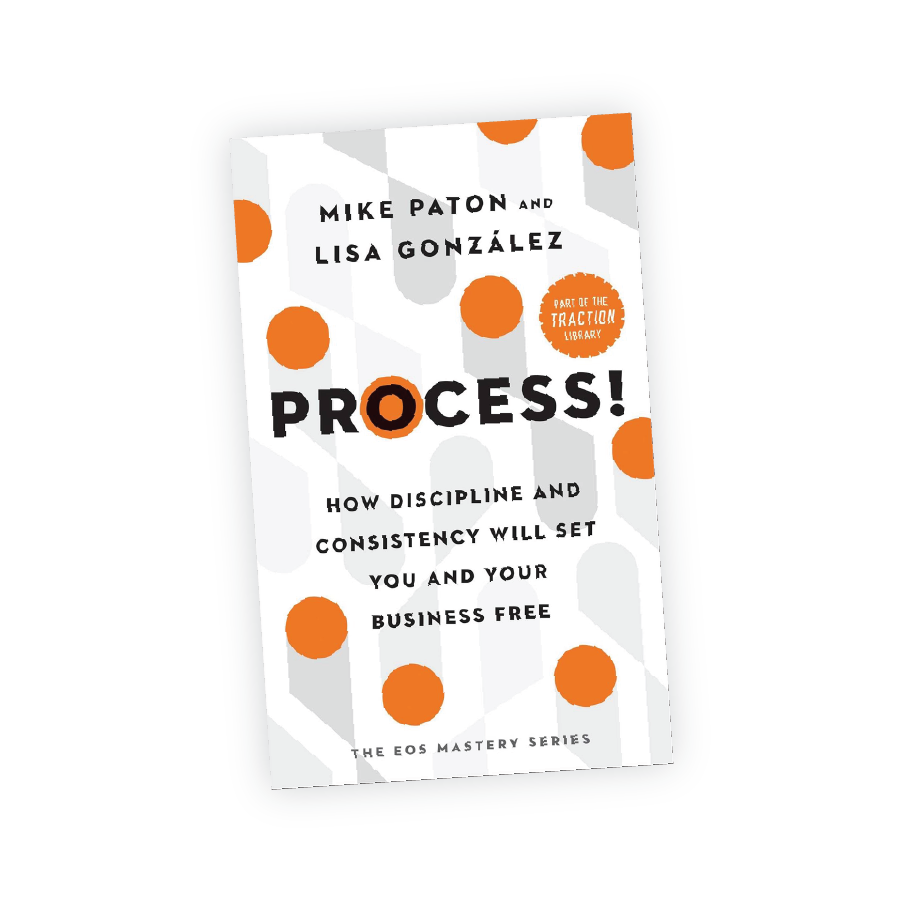
Number of Pages: 192
Estimated Read Time
Slow Reader: 3 Hours 25 Minutes
Average Reader: 2 Hours 44 Minutes
Fast Reader: 2 Hours 16 Minutes
Estimated Listen Time: 3 Hours 33 Minutes
Amazon Description
Part of the TRACTION Library, Process! proves that a high-level, 20/80 approach to getting your core processes “followed by all” will help you:
Get consistently exceptional results.
Improve and innovate as necessary.
Free yourself to live your ideal life.
If you own, run, or lead a fast-moving business, you’re likely driven by passion and a desire to be free. Many leaders mistakenly believe instilling rigor and discipline for process throughout your organizations will inhibit freedom.
They couldn’t be more wrong.
It’s when you’re stuck in the day-to-day, putting out fires and cleaning up messes, that passion turns to frustration. Freedom seems somewhere between elusive and impossible. The secret to getting unstuck is the process. This inspiring, informative field guide will prove it’s possible to establish rigor and discipline for processes while also increasing creativity, flexibility, and innovation.
Process! will help you identify a handful of core processes that make your business uniquely valuable. You’ll learn how to document and simplify the major steps in those processes so they can be done the right and best way, every time. Finally, you’ll execute a simple, step-by-step plan that is helping more than 10,000 entrepreneurs around the world consistently get the results they want.
The Right Mindset
Chapter 1 – The Right Mindset, page 1.
“Magic happens when you blend a culture of discipline with an ethic of entrepreneurship” – Jim Collins
Nearly every story of entrepreneurship begins with a passion that fuels the founder, the people, and the culture.
Every organization eventually reaches a point where passion isn’t enough.
When the entrepreneur feels stuck, their first thought is often to hire someone. But they quickly realize that hiring, training, and managing even one person requires a lot of precious time and can be exhausting.
Still feeling stuck, the entrepreneur is now exhausted, and their passion begins to fade.
This is what Larry E. Greiner refers to as “Hitting the Ceiling” in his article titled, “Evolution and Revolution as Organizations’ Grow.“
This book presents a simple and proven solution to a problem faced by nearly all fast-growing companies: inconsistent execution.
Entrepreneurs need freedom, variety, and flexibility; all of which seem to be the antithesis of Processes and Systems. And this is what the author refers to as the “Paradox of Process.”
Getting a handful of core processes documented, simplified, and followed by all will create freedom, not destroy it.
Three Anti-Process Myths of an Entrepreneur
Myth 1: Process is not in my nature
Most entrepreneurs are creators, disruptors, and challengers of the status quo.
The very idea of doing something the same way over and over again seems intolerable.
However, the actions that create consistently exceptional results are not at all obvious to most people in a growing business. Letting employees figure it out for themselves is inefficient and costly.
Myth 2: Processes take too much time
The most common issue for entrepreneurs and their leadership team is “Capacity.” There is never enough time for working in the business, let alone working on the business.
However, as the great John Wooden said, “If you don’t have time to do it right, when will you have time to do it over?”
Most entrepreneurs underestimate the time wasted due to inefficient processes and overestimate the time it takes to create and/or strengthen core processes.
Myth 3: Process destroys freedom
Many leaders fear the loss of innovation, creativity, and flexibility.
As Jim Collins describes in Good to Great, “The purpose of bureaucracy is to compensate for incompetence and lack of discipline. Most companies build their bureaucratic rules to manage the small percentage of wrong people on the bus, which in turn drives away the right people, which increases the percentage of wrong people, which increases the need for more bureaucracy.”
However, this begins to paint a false dichotomy, a logical exercise used by debaters (and con artists) to convince people that only two options exist.
Establishing a culture of discipline, which Jim Collins defines as “disciplined people who engage in disciplined thought and take disciplined action-operating with freedom within a framework of responsibilities-this is the cornerstone of a culture that creates greatness.
Why is Process Important?
Chapter 2 – Why is Process Important? page 19.
What Is A Strong Process Component?
Definition: A Process is a set of actions or operations that achieves a desired result.
A strong process component is about getting the most important things in your organization done the right and best way every time.
“Franchise Prototype: A proprietary way of doing business that successfully and preferentially differentiates every extraordinary business from every one of its competitors.” – Michael E. Gerber, The E-Myth Revisited
The Benefits
1. You’ll grow faster (and more sustainably)
When your marketing and sales processes are documented, simplified, and followed by all you will generate more leads and increase your win rate.
Also, your process discipline will help you retain and grow existing relationships.
2. You’ll attract and keep better talent
Strengthening your people processes will help your company get better at sourcing, recruiting, interviewing, hiring, onboarding, training, growing, celebrating, and rewarding your employees.
3. You’ll engage everyone in a culture of excellence
Without a strong Process Component, each person will learn their own ways of getting things done.
The failure to proactively document best practices creates inconsistencies that get embedded in the system.
Before we document our best practices, people are always reinventing the wheel.
When processes are documented, an organization can expect consistency of action, predictability of outcomes, and a foundation from which you can consistently improve each process.
4. Your customer will be happier
Core Marketing & Sales Processes create a consistent set of realistic expectations in the marketplace.
Core Operations Processes will help you consistently deliver high-quality products and great services.
Consistently meeting (and exceeding) customer expectations will help you build a strong brand.
A Customer Satisfaction Core Process will help you better understand the needs of your customer, and determine if those needs are being met.
5. You’ll have more time
Documented Core Processes help new employees get up to speed and begin contributing much faster.
Managers spend less time answering basic questions and can spend their precious time coaching, mentoring, developing people, and improving processes.
Leaders will have more time to innovate, think, strategize, plan, and lead.
6. You’ll get better at resolving issues
Having an agreed-upon way of doing things in your business will help you more quickly and accurately determine why you’re not getting the results you want.
When your team is not performing as expected, the first place to look is your processes.
7. You’ll make more money
More effective
Fewer mistakes (and waste)
More efficient
Less fire-fighting
Less regrettable turn-over
Better employee and customer retention
8. Your company will become more valuable
Documented Core Processes can have an exponential impact on the value of your business.
“If your people depend on people and not on process, your business does not have any value.” Michael Gerber, E-Myth Revisited
Put simply, what makes a business valuable is its ability to generate consistently excellent results without relying on the founder or a small group of experienced team members.
9. You’ll live a better life
When processes aren’t documented, even small issues may require an owner’s daily involvement, causing them to miss time with family, friends, and their favorite extra-curricular activities.
When your organization is a well-oiled machine and no longer needs your day-to-day firefighting, you’ll have the time, energy, and financial resources to pursue other passions.
The Costs
1. You will struggle to find and keep good people
Without a proven approach to finding, recruiting, and evaluating world-class candidates, winning the battle for the best people is nearly impossible.
Does your company have a carefully designed process for leading and managing its great people? Are your team leaders, supervisors, and managers properly trained? Or are your employees at the mercy of the individual capabilities of each unique boss?
Direct Costs: According to SHRM, companies spend 50-75% percent of an employee’s annual salary to recruit and train someone new
Indirect Costs: A business that is understaffed or full of new, inexperienced people is far less likely to meet growth goals, ship quality products on time, or deliver the service that meets the customer’s expectations.
2. Your business will stop growing
Inconsistent execution in just about any area can halt growth.
Without a Core Marketing Process, many companies struggle with reaching the right prospects, differentiating themselves from the competition, and generating qualified leads.
Without a Core Sales Process, it’s difficult for organizations to consistently win new business, build strong relationships, grow accounts over time, and/or get customer referrals.
Without a set of Core Operations Processes, it’s nearly impossible to keep those hard-earned customers happy beyond the sale.
Without a Core Finance Process, it is difficult to keep the business financially healthy.
3. Your business will fall behind and/or become obsolete
Being strong in the Process Component means regularly reviewing, updating, and improving the way the most important things are done.
Left unchecked, failing to observe long-held processes with a critical eye and make improvements as the world around you changes can put you out of business.
When an organization is dependent on people – not process – and tries to grow by adding products, services, locations, or just more people and customers, chaos ensues.
Own It
Chapter 3 – Own It, page 51.
Completing the steps outlined below takes the typical leadership team nine to twelve months to complete.
Plan on collaborating with mid-level managers, but make sure that someone on your leadership team owns and drives the project.
Include but do not expect to have your most talented employees lead the effort to document their core process.
Why?
They might be competitive and resist sharing best practices.
They may fear being fired afterward.
Their excellence may come naturally.
They may overthink the multitude of possible variations.
Their time might be better spent in the business.
Every project needs a strong leader, and for this effort, that person needs to be passionate about process and skilled at keeping your team focused and accountable.
The 3-Step Process Documenter
Chapter 4 – The 3-Step Process Documenter, page 55.
Step 1: Identify Your Handful of Core Processes
Remind everyone on the team that we are taking a 20/80 approach.
We will focus our attention on the handful of core processes – five to twelve important things you do repeatedly – which make your organization unique and valuable.
Example List of Core Processes
HR
Marketing
Sales
Acct Mgt/Cust Svc
Ops 1
Ops 2
Ops 3
Accounting
Running the Business
Special Note:
Common Question: What’s the difference between a “Proven Process” and a “Core Process”?
Answer: a “Proven Process” is part of your company’s marketing strategy. It is a 1-page visual illustration of your ideal customer experience from their perspective.
If certain activities are important enough to callout in your Proven Process, they probably deserve consideration when identifying and documenting your Core Processes.
Leadership Team “Identify Core Processes” Exercise:
Take 5 quiet minutes and record your own list.
Compile a list on a whiteboard.
Starting with the first item on the list, ask, “Is this one of our Core Processes?”
If “Yes” ask “What Should we call it?”
If “No” ask “Is this a major step in some other core process?”
If “Yes” decide which other core process it belongs to and draw a line to the relevant core process.
If “No” cross out the item.
Go to the next item on the list and repeat the steps, begin by asking “Is this one of our Core Processes?”
When you finish the prioritization exercise, you will end up with a list of core processes on the whiteboard that look something like this:
«PICTURE»
Important: Once your team has decided on the core processes, get the team to agree on what you are going to call each of them, forever.
To complete step one of the 3-Step Process Documenter, ask a member of your team to turn the final list from the whiteboard into a table of contents for the manual, share drive, and/or video library that – someday soon – will house your handful of documented simplified core processes.
Step 2: Document and Simplify Each Core Process
At the same meeting, and as a team:
Identify a Core Process Champion for the Company.
Decide which core processes should be documented first.
Decide which seat in your Accountability Chart will own the core process.
Decide who is going to take ownership of documenting and simplifying each core process.
Decide what the final product should look like.
Decide when each core process will, as well as the entire project, be completed.
Update your 3-Year Picture and 1-Year Plan and publicly commit to your team’s core process goals.
Once the project team has created a draft of a documented and simplified core process, the project leader and/or the core process seat owner presents it to the leadership team for review, revision, and approval.
What should the final process documentation look like? That’s up to the team.
Documents
Workflow Diagram
Series of images
Infographics
Checklists
Videos
Etc.
Special Notes:
Make sure the team agrees on the timeline for documenting, simplifying, and getting each core process approved by the leadership team.
When a company running on EOS wants to strengthen its Process Component, that broader initiative often shows up as one of the three to seven goals in the 1-Year Plan.
With priorities for the year set, leadership team members are reminded every 90 days to prioritize the Rocks that will achieve the company’s goals for the year.
So each quarter, documenting, simplifying, and getting core processes approved by the leadership team might be a company or individual rock.
This core process journey typically takes companies between nine and twelve months to complete.
Documentation
Don’t just do something, stand there!
Begin the documentation journey with one simple step. Simply observe.
“To acquire knowledge, one must study; but to acquire wisdom, one must observe.” – Marilyn vos Savant
The best way to start documenting and simplifying a core process is by taking time to truly understand it, from start to finish.
If you try to fix or optimize everything the first time you observe it, you’ll never see the big picture
The first thing you’ll notice is whether a consistent way of doing it already exists.
As you observe, keep asking yourself:
What seems to be working?
What’s not working?
Does that happen every time or just occasionally?
Feel free to take notes, make drawings, take pictures, record a video, etc.
At the end of the documentation ask yourself:
What is the objective of this process? (and how can we measure it?)
What’s the first (and last) step of this process?
Are we consistently getting the results we want?
What are the keys to the success of this process?
What causes problems?
“If you can’t explain it simply, you don’t understand it well enough.” – Albert Einstein
Document and Simplify:
Keep this at a high level.
Stay focused on the major steps.
A major step is one of the five to twenty-five things you need to get right every time.
For each major step, briefly explain the who, what, when, where, and how with a series of sub-steps (some people call these Standard Operating Procedures (SOPs)).
About two to five bullets for each major step.
Think one-page checklist, not a three-ring binder.
Document the basics and build from there (over time).
Pro Tips: Completing Step 2
Use an EOS tool call “Getting What You Want”:
Begin with the desired end in mind.
Ask yourself, “What Do I Want from this Process?”
State the desired outcome clearly, simply, and specifically.
Work backward, recording only the steps that must be done well in order to produce the desired outcome.
This tool can help you identify leading indicators – those activity-based numbers that predict the final results of the process.
Leadership Team Review and Approve
Draft a documented, simplified core process to share with your leadership team.
Meet with the leadership team to thoroughly review and approve the draft core process.
This is an essential step for three reasons:
To get the process right
The most experienced and knowledgeable group in the company.
Many core processes span multiple departments.
Ask questions, poke holes, and suggest improvements.
“None of us are as smart as all of us.” – One Minute Manager
To be 100% on the same page
To drive change and accountability, you’ll need to rely on the support of your fellow leaders.
When they are included and committed, they’ll join you in driving accountability.
To Save Time
When a team is aligned behind a core process with measurements, it saves time in the future when getting to the root causes of issues in the business.
Leadership Team Review Meeting
Share the documented and simplified core process with each member of the leadership team one week before the meeting.
Ask everyone to come prepared with questions, comments, and issues.
At the meeting, walk through the process one step and sub-step at a time.
Answer questions and resolve issues.
Conclude the meeting with a marked-up copy of the process and a deadline for producing a final copy.
Step 3: Package (Make Them Easy to Find and Use)
Now that you’ve documented, simplified, and approved your core processes, the next step is rolling them out to the entire organization.
Some people roll them out all at once.
Others roll them out one core process at a time.
Find the right format, medium, or platform by asking yourself:
“What format or medium best fits this kind of work?”
“How, when, and where will my people be using these tools?
“Are they in the office? Or in the field?”
“Are they at a desk in front of a screen all day? Or out in the field working with their hands?”
“Is a document best? Or a checklist on a smartphone or tablet?”
“Is it a document they can read better? Or is it a video they can watch over and over again?”
Many organizations have turned to video content with a video library:
YouTube
Vimeo
PlaybookBuilder
Trainual
Whale
In the end, pick the tool and platform most likely to be simple, practical, and useful to the people who will be following the process every day.
Make them easy to find
Now that you’ve selected the right format, platform, or medium, make these valuable tools easy to find and use.
Locate them as close to where the work is being done as possible.
Organize each process so that employees can quickly and reliably access exactly what they’re looking for.
The answer here depends on how the process was packaged and how and where the work is being done.
The final step in this process is giving your “blueprint” or “operating model” a name – something accurate, memorable, and maybe even compelling:
[Our Company] Way
[Our Company] Playbook
The FBA Checklist
Chapter 5 – The FBA Checklist, page 95.
To begin consistently getting the results you want, you must permanently change the way people do things in your business.
Completing a four-step checklist and then repeating that checklist is all that is required.
The Four-Step Checklist
1. Train
Train every employee who performs one or more steps in a core process.
Everyone must have a chance to walk through the process, ask clarifying questions, and even push back or poke holes.
When your team truly understands each step in the process as well as the big picture, they’ll be more likely to help you move forward rather than dig their heels in.
If you and your team have a regular Meeting Pulse (weekly L10), you may be able to complete the initial training without adding another meeting.
A growing number of companies use online training programs with robust learning management systems to track progress.
Be patient, old habits die hard.
Training Industry Magazine explains, that training alone won’t change behavior, largely due to something called the “forgetting curve.”
Studies suggest we forget up to 90 percent of new information within 30 days, and 70 percent of that loss happens within the first 24 hours.
Two great ways to reinforce training, increase retention, and truly change behaviors are the next two steps in the FBA Checklist – measure and manage.
2. Measure
“If you cannot measure it, you cannot improve it.” – Lord Kelvin
Measure performance to ensure people are doing things right, doing them often enough, and getting the desired results.
As Leadership Team, we must determine which steps in each process to measure and exactly what type of measurement makes sense for each step:
Compliance – Are we doing it the right way?
Frequency – Are we doing it often enough to get the desired result?
Outcome – Are we getting the desired result?
The Company Scorecard:
Leadership Teams of companies running on EOS spend five minutes each week reviewing a company scorecard.
Great scorecards contain 5-15 leading indicators that predict future results.
As a result, leaders can react quickly to off-track measurables rather than waiting for the results to come in at the end of the month or quarter.
A Leading Indicator is an activities-based number that when repeated properly, produces a desired result.
Since a Core Process, by definition, is a series of steps/activities that produce a desired result, the major steps/activities in each process become a great candidate for measurables on a weekly scorecard.
IDS off-track measurables first.
Therefore, many companies discover that strengthening their company’s Process Component also helps strengthen their Company’s Data Component.
3. Manage
“Effective leadership is putting first things first. Effective management discipline, carrying it out.” – Stephen Covey
Training your people is important, and measurement provides reinforcement, but effective leadership and management is truly the key to changing behaviors and ensuring each of your core processes is followed by all.
Now is time for everyone who leads and manages in your organization to turn their new way of doing things into automatic habits, thus creating what Jim Collins describes as a culture of discipline.
Start by giving clear directions. Help your people understand why this new way of operating is valuable and how succeeding will benefit not only the company but also every one of its employees.
When they resist or complain, listen carefully and seek to understand their concerns.
Be prepared to reiterate the reasons for changing and to offer support along the way.
Provide team members with the necessary tools to permanently change their behavior:
Make it easy to access documents, checklists, and videos.
Make it easy to receive initial and ongoing training.
Make it easy for them to find support when feeling stuck.
Make yourself available.
Provide clear expectations and goals.
Coach instead of punishing.
Check-in and ask employees if they have everything they need to be successful.
Get comfortable repeating yourself.
Practice listening.
Seek to understand their challenges.
Show appreciation along the journey to reinforce new habits.
Celebrate them as often as possible.
Carve out time for one-on-one coaching.
When every member of your team understands the reasons for change and feels heard, valued, and supported on their journey, permanent change is possible.
4. Update
“It is not the strongest of the species that survives, not the most intelligent that survives. It is the one that is most adaptable to change.” – Charles Darwin
Update each process regularly (at least once per year), to stay current and continue improving.
Updating your processes regularly creates a culture of continuous improvement.
When updating processes, look for opportunities to:
Correct mistakes
Eliminate steps
Remove inefficiencies
Streamline
Simplify
Automate
Delegate
Updating your process is critical to survival:
Society is changing
Your industry is changing
Your customer’s needs are changing
Technology is changing
The workforce is changing
Successful leadership teams manage the update step of the FBA Checklist in several ways, but all of them involve accountability and a calendar:
Make sure one member of your leadership team owns each process.
The appropriate choice for the assignment is often clear as it is tied to their role in the Accountability Chart.
Use your calendars or software to remind process owners to update their process at least once per year.
When updating a process, be sure to include all stakeholders who participate in the process.
Your Action Plan
Chapter 6 – Your Action Plan, page 117.
Commit
Strengthening your Process Component is simple, but not always easy.
When you are fully committed, it’s easier to lean into and even appreciate the inevitable challenges and obstacles that you will encounter.
Expect people from every level of your organization to hold back, push back, or act out.
Resistance to change is normal, especially when it involves rigor, discipline, and accountability.
To succeed at this, you must believe in the power of this work with a firm resolve.
When you sense resistance, listen carefully to what people are saying, seeking to truly understand where they are coming from, and why they feel so strongly.
As Patrick Lencioni explained in The Five Dysfunctions of a Team, people can typically support a decision or initiative they originally disagreed with, but only when they feel heard.
If your team is struggling to commit, share this book with them.
If anyone remains reluctant or unsure, make it clear that you intend to move forward with this initiative, and that you need full support.
Ask for everyone’s commitment to the process journey ahead, and get a verbal and heartfelt “yes.”
False harmony is more dangerous than actual dissension.
3-Step Process Documenter
Once you are firmly committed, you can quit discussing, debating, and procrastinating and start doing.
For most companies, this takes about twelve months (give or take a quarter).
1. Identify Your Handful of Core Processes
Meet with your leadership team.
Debate and define your handful of Core Processes.
Brainstorm, compile, and keep, kill, combine.
Name each Core Process.
Create a table of contents for the Core Process manual.
2. Document and Simplify Each Core Process
Create a plan
Observe
Evaluate
Document
Simplify
Review and Approve
3. Package the Core Processes
Determine the right medium/format.
Gather, organize, package, or store them.
Name it (for example, The ACB Way).
Make them easy to find and use.
Complete the FBA Checklist
“You do not rise to the level of your goals, you fall to the level of your systems.” – James Clear, Power of Habit
Performing the Core Processes
1. Train
Everyone who does one or more steps.
Pick the right training method.
Encourage candid dialog, even pushback.
Verify understanding and commitment.
Repeat yourself often (as necessary).
2. Measure
Compliance – are we doing it right?
Frequency – are we doing it often enough to get the desired results?
Outcome – are we getting the results we want?
Determine who, how, and where.
Set goals.
3. Manage (or LMA)
LMA (lead and manage in a way that drives accountability).
Support team members as behaviors change.
Reward and recognize great results.
4. Update
As needed (at least annually).
Engage the team.
Streamline, automate, and simplify.
Repeat checklist item 1, Train.
Adjust the way you Measure and Manage, as needed.
Important Disclaimer:
Getting your core processes followed by using the checklist does not mean everyone will always follow the process or never make a mistake.
It does mean that you have built a machine to drive accountability for following processes, getting results, and reacting more quickly and definitively when mistakes are made or goals are not achieved.
Your work is never done. As the world evolves, your organization, its processes, and its people will evolve with it – faster and better than the competition.
Overcoming Challenges
Chapter 7 – Overcoming Challenges, page 125.
Some of the most common challenges leaders face are listed below, along with ways you can overcome them:
Lack of Passion
“If you’re going through hell, keep going.” – Winston Churchill
Your commitment to this project may fade over time.
You may also encounter members of your team who just can’t get excited about strengthening your Process Component.
Both of these are common and dangerous.
Knowing this may happen before you get started will help you take steps to either prevent it or respond more quickly when you or your team lose energy for this project.
Keep coming back to why this work is important and keep enthusiasm high by planning for early Core Process wins early.
When prioritizing which core process(es) to tackle first, remember that less is more.
Consider picking core processes that will have an immediate, positive impact.
If passion does begin to fade, discuss it as a team.
Lack of Expertise
This is a simple, practical approach that does not require deep process experience.
It does require passion, knowledge of your business, and a strong desire to consistently execute and regularly improve.
Having at least one member of your leadership team who’s done prior work driving consistent execution with processes is beneficial.
If you are feeling stuck or want to move faster, the lack-of-expertise challenge can be solved in one of three ways:
Develop the knowledge and skills of your existing team.
Find or hire someone with relevant experience.
Partner with a process firm or expert.
Love of Complexity or Perfection
Some believe that only a detailed, five-hundred-page SOP manual will do.
Instead, start with this simple approach and use it as an outline for your detailed process manual in the future.
Overreliance on Technology
It is true that that systems, software, and tech platforms can help during this journey.
However, starting with and relying on technology is letting the tail wag the dog.
Lack of Leadership
This advice may hit a little close to home, but managing change of this magnitude requires strong and consistent leadership and management.
Do you and your leadership truly own this initiative?
Have you helped everyone understand why you’re doing it?
Have you made it clear that allowing everyone do things their own way is no longer an option?
Are you involving everyone in the organization and truly listening to their questions, concerns, and feedback?
Are you truly prepared to begin leading, managing, and holding others accountable to the core processes?
Convert all these answers to “yes” and you are ready to begin.
No/Poor Training
Far too many process improvement initiatives fail because only documenting and simplifying the processes will not change the way people do their jobs.
It’s the training – and then reinforcement with measurables and management – that will create new habits and consistently better results.
Unfortunately, many busy leaders and managers struggle to find the time to develop, deliver, and reinforce the training needed for real success.
Luckily, once created, your core processes create the foundation for a world-class onboarding, training, and development program.
Set aside time to develop an initial training program that walks all employees, new and seasoned, through the new process(es).
It is said that people need to hear things seven times to hear them for the first time, so be prepared to repeat training until the new way has become “the way we do things around here.”
No/Poor Management
Measuring compliance, frequency, and outcomes provides evidence that the process you created and the training you conducted has begun to move the needle.
If you are not measuring those things (we recommend weekly), your employees and managers may quickly revert to old habits.
We see two types of obstacles to effective measurement:
Tactical
Figuring out what to measure.
Figuring out how to measure it.
If stuck, “take a shot!” and if it’s not right, IDS it later down the road.
Cultural
Convincing your team to accept and even embrace the value of having a number that they are accountable for hitting.
Many employees believe that their boss is tracking measurables to catch them making mistakes or not working hard enough.
It is your job to help them understand that these numbers are their tool to help them understand how they are performing and to let them know if they need to make improvements.
Avoidance of Accountability
The success of any organization is directly proportional to the accountability of its people.
When leaders, managers, and individual contributors are accountable for getting results, an organization thrives.
When hitting numbers, completing priorities, serving customers and employees well, and resolving issues is somebody else’s job, an organization is doomed to fail.
We get what we tolerate. If there are no consequences for not following the process or not getting the desired results, you’ll never achieve your business’ potential consistently.
You can do this with compassion and understanding, but you must be clear and firm.
Create an environment where accountable people are recognized, rewarded, and celebrated.
“Kind of” Syndrome
Without question, this is the number one obstacle for well-intentioned leadership teams struggling to strengthen their process Component.
If you know what to do and how to do it but are not getting the results you want, it may be that “kind of” is killing you.
Visual Aid
«PICTURE HERE»