

The Five Dysfunctions of a Team
Number of Pages: 224
Estimated Read Time
Slow Reader: 3 Hours 50 Minutes
Average Reader: 2 Hours 18 Minutes
Fast Reader: 1 Hours 17 Minutes
Estimated Listen Time: 3 Hours 42 Minutes
Amazon Description
The New York Times best-selling team leadership handbook for modern executives, managers, and organizations.
After her first two weeks observing the problems at DecisionTech, Kathryn Petersen, its new CEO, had more than a few moments when she wondered if she should have taken the job. But Kathryn knew there was little chance she would have turned it down. After all, retirement had made her antsy, and nothing excited her more than a challenge. What she could not have known when she accepted the job, however, was just how dysfunctional her team was, and how team members would challenge her in ways that no one ever had before.
For twenty years, The Five Dysfunctions of a Team has been engaging audiences with a page-turning, realistic fable that follows the travails of Kathryn Petersen, DecisionTech’s CEO, as she faces the ultimate leadership crisis. She must unite a team in such disarray that it threatens to derail the entire company.
Equal parts leadership fable and business handbook, this definitive source on teamwork by Patrick Lencioni reveals the five behavioral tendencies that go to the heart of why even the best teams struggle. He offers a powerful model and step-by-step guide for overcoming those dysfunctions and getting every one rowing in the same direction.
Today, the lessons in The Five Dysfunctions of a Team are more relevant than ever. This special anniversary edition celebrates one of the best-selling business books of all time with a new foreword from the author that reflects on its legacy and lessons.
An Overview of the Model
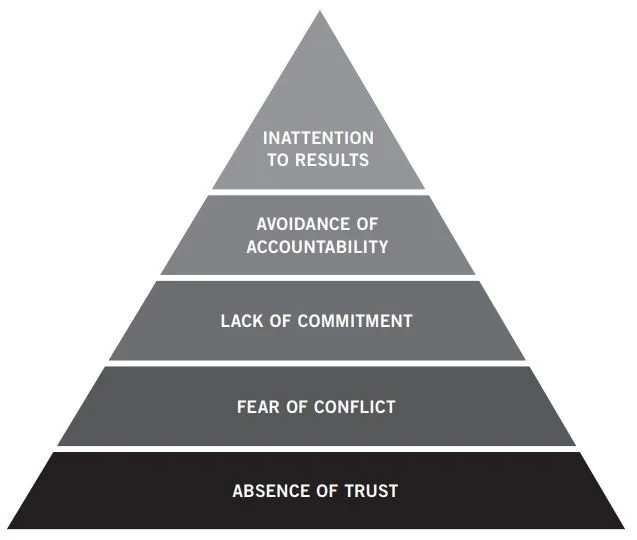
An Overview of the Model, page 187.
Genuine teamwork in most organizations remains as elusive as it has ever been.
Most organizations fail to achieve teamwork because they unknowingly fall prey to five natural but dangerous pitfalls.
These five dysfunctions can be mistakenly interpreted as five distinct issues that can be addressed in isolation from one another.
In reality, they form an interrelated model, making susceptibility to even one of them potentially lethal for the success of a team.
Like a chain with just one link broken, teamwork deteriorates if even a single dysfunction is allowed to flourish.
The Absence of Trust
The Absence of Trust stems from:
The unwillingness to be vulnerable within the group.
Team members who are unwilling to be open with one another about their mistakes and weaknesses.
Failure to build trust is damaging because it sets the tone for the second dysfunction of a team.
The Fear of Conflict
Teams that lack trust are incapable of engaging in an unfiltered and passionate debate of ideas.
Instead, they resort to vague discussions and guarded comments.
The lack of healthy conflict is a problem because it ensures the third dysfunction of a team.
The Lack of Commitment
Without having aired their opinions in the course of passionate and open conversation, team members rarely, if ever, buy-in and commit to decisions, though they may feign agreement during meetings.
Because of this lack of real commitment and buy-in, it becomes difficult for team members to uphold accountability.
The Avoidance of Accountability
Without committing to a clear plan of action, even the most focused and driven people often hesitate to call out their peers on actions and behaviors that seem counterproductive to the good of the team.
Failure to hold one another accountable creates an environment where the fifth dysfunction can thrive.
An Inattention to Results
This occurs when team members put their individual needs (such as ego, career development, or recognition) or even the needs of their divisions above the collective goals of the team.
The Opposite Approach
Members of truly cohesive teams…
Trust one another.
Engage in unfiltered conflict around ideas.
Commit to decisions and plans of action.
Hold one another accountable for delivering against those plans.
Focus on the achievement of collective results.
Bottom Line Up Front (BLUF)
The reality remains that teamwork ultimately comes down to practicing a small set of principles over a long period.
Success is not a matter of mastering subtle, sophisticated theory, but rather of embracing common sense with uncommon levels of discipline and persistence.
Team Health Assessment
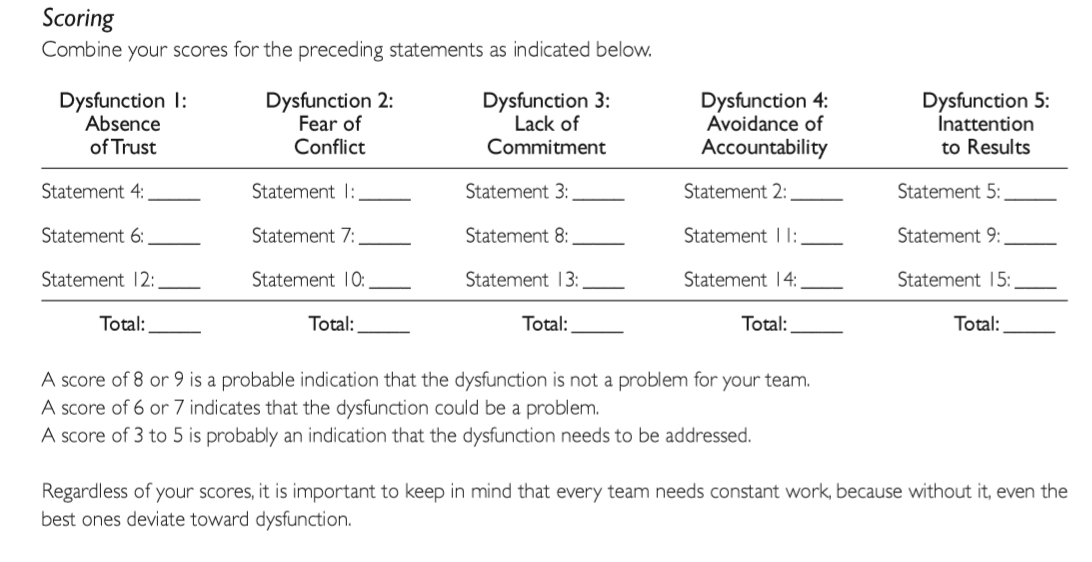
Team Health Assessment, page 191.
Measures a team’s susceptibility to the five dysfunctions.
Have all members of your team complete the diagnostic and review the results, discussing discrepancies in the responses and identifying any clear implications for the team.
Instructions
Use the scale below to indicate how each statement applies to your team.
It is important to evaluate the statements honestly in without overthinking your answers.
3 = Usually
2 = Sometimes
1= Rarely
Each question will be categorized based on which dysfunction it addresses.
Questions:
Team members are passionate and unguarded in their discussion of issues. (Conflict)
Team members call out one another’s deficiencies or unproductive behaviors. (Accountability)
Team members know what their peers are working on and how they contribute to the collective good of the team. (Commitment)
Team members quickly and genuinely apologize to one another when they say or do something inappropriate or possibly damaging to the team. (Trust)
Team members willingly make sacrifices (such as budget, turf, headcount) in their departments or areas of expertise for the good of the team. (Results)
Team members openly admit their weaknesses and mistakes. (Trust)
Team meetings are compelling and not boring. (Conflict)
Team members leave meetings confident that their peers are completely committed to the decisions that were agreed on, even if there was initial disagreement. (Commitment)
Morale is significantly affected by the failure to achieve team goals. (Results)
During team meetings, the most important – and difficult – issues are put on the table to be resolved. (Conflict)
Team members are deeply concerned about the prospect of letting down their peers. (Accountability)
Team members know about one another’s personal lives and are comfortable discussing them. (Trust)
Team members end discussions with clear and specific resolutions and calls to action. (Commitment)
Team members challenge one another about their plans and approaches. (Accountability)
Team members are slow to seek credit for their own contributions, but quick to point out those of others. (Results)
Scoring (by category)
A score of 8 or 9 is a probably indication that the dysfunction is not a problem for your team
A score of 6 or 7 indicates that the dysfunction could be a problem
A score of 3 or 5 is probably an indicator that the dysfunction needs to be addressed
Dysfunction 1: Absence of Trust
Dysfunction 1: Absence of Trust, page 195.
Unfortunately, the word trust is used –and misused– so often that has lost some of its impact and begins to sound like motherhood and apple pie.
In the context of building a team, trust is the confidence among team members that their peers’ intentions are good, and that there is no reason to be protective or careful around the group.
Teammates must be comfortable being vulnerable with one another and confident that their respective vulnerabilities will not be used against them.
These vulnerabilities include weaknesses, skill deficiencies, interpersonal shortcomings, mistakes, and requests for help.
It is only when team members are truly comfortable being exposed to one another that they begin to act without concern for protecting themselves.
Achieving vulnerability-based trust is difficult. This is because in the course of career advancement and education, most successful people learn to be competitive with their peers, and protective of their reputations.
It is a challenge for them to turn those instincts off for the good of a team, but that is exactly what is required.
Teams that lack trust waste inordinate amounts of time and energy managing their behaviors and interactions within the group.
Teams that lack trust dread team meetings, and are reluctant to take risks in asking for or offering assistance to others.
Members of Teams with an Absence of Trust…
Conceal their weaknesses and mistakes from one another.
Hesitate to ask for help or provide constructive feedback.
Hesitate to offer help outside their own areas of responsibility.
Jump to conclusions about the intentions and attitudes of others without attempting to clarify them.
Fail to recognize and tap into one another’s skills and experiences.
Waste time and energy managing their behavior for the effect.
Hold grudges.
Dread meetings and find reasons to avoid spending time together.
Members of Trusting Teams…
Admit weaknesses and mistakes.
Ask for help.
Accept questions and input about their areas of responsibility.
Give one another the benefit of the doubt before arriving at a negative conclusion.
Take risks and offer feedback and assistance.
Appreciate and tap into one another’s skills and experiences.
Focus time and energy on important issues, not politics.
Offer and accept apologies without hesitation.
Look forward to meetings and other opportunities to work as a group.
Suggestions for Overcoming Dysfunction One
Unfortunately, the vulnerability base trust cannot be achieved overnight.
Vulnerability-Based Trust requires:
Shared experiences over time.
Multiple instances of follow-through and credibility.
An in-depth understanding of the unique attributes of team members.
However, by taking a focused approach, a team can dramatically accelerate the process.
Tools for accelerating trust building:
Personal History‘s Exercise (60 minutes):
Go around the table during a meeting and have team members answer a short list of questions about themselves:
Number of siblings
Hometown
Unique challenges of childhood
Favorite hobbies
First job
Worst job
Team Effectiveness Exercise (60 minutes):
Go around the table during a meeting and have team members answer:
The single most important contribution that each of their peers makes to the team.
One area that each peer must either improve upon or eliminate for the good of the team.
The beginning focus should be directed toward the team leader.
Personality and Behavioral Preference Profiles (4 hours).
360 Degree Feedback.
Experiential Team Exercises.
The Role of the Leader
The most important action that the leader must take to encourage the building of trust is to demonstrate vulnerability first.
Team leaders must create an environment that does not punish vulnerability.
Displays of vulnerability on the part of the team leader must be genuine; they cannot be staged.
Connection to Dysfunction 2
By building trust, a team makes conflict possible. Team members do not hesitate to engage in passionate and sometimes emotional debate.
Dysfunction 2: Fear of Conflict
Dysfunction 2: Fear of Conflict, page 202.
All great relationships, the ones that last over time, require productive conflict in order to grow.
It is important to distinguish productive ideological conflict from destructive fighting and interpersonal politics.
Ideological conflict is limited to concepts and ideas and avoids personality–focused, mean-spirited attacks.
Teams that engage in productive conflict know that the only purpose is to produce the best possible solution in the shortest period of time.
Teams that avoid ideological conflict often do so to avoid hurting team members’ feelings. They then end up encouraging dangerous tension.
Team members that do not openly debate and disagree about important ideas often turn to back-channel personal attacks, which are far nastier and more harmful than any heated argument over issues.
Many people avoid conflict in the name of efficiency. However, healthy conflict is actually a time saver.
When we avoid conflict we often have to revisit issues again and again without resolution.
Teams That Fear Conflict
Have boring meetings.
Create environments where back–channel politics and personal attacks thrive.
Ignore controversial topics that are critical to team success.
Fail to tap into all the opinions and perspectives of team members.
Waste time and energy with posturing and interpersonal risk management.
Teams That Engage In Conflict
Have lively, interesting meetings.
Extract and exploit the ideas of all team members.
Solve real problems quickly.
Minimize politics.
Put critical topics on the table for discussion.
Suggestions for Overcoming Dysfunction 2
The first step for a team to begin developing the ability and willingness to engage in healthy conflict is acknowledging that conflict is productive.
Tools to achieve this include:
Mining:
Extract buried disagreements.
Call out sensitive issues.
Real-Time permission:
Team members need to coach one another on not retreating from healthy debate.
Interrupt those engaging in healthy debate to remind them that what they’re doing is necessary.
Personality style and behavior preference tools:
Allows team members to better understand one another.
Include descriptions of how different types deal with conflict.
Can be useful for helping people anticipate their approach or resistance to conflict.
The Role of the Leader
One of the most difficult challenges that a leader faces in promoting healthy conflict is the desire to protect members from harm.
Premature interruption of disagreements prevents team members from developing the conflict management and coping skills necessary for dealing with conflict themselves.
A leader’s ability to personally model appropriate conflict behavior is essential.
Connection to Dysfunction 3
By engaging and productive conflict in tapping into team members’ perspectives and opinions, a team can confidently commit and buy into a decision knowing that they have benefited from everyone’s ideas.
Dysfunction 3: Lack of Commitment
Dysfunction 3: Lack of Commitment, page 207.
In the context of a team, commitment is a function of two things: clarity and buy-in.
Great teams make clear and timely decisions and move forward with complete buy-in from every member of the team.
The two greatest causes of the lack of commitment are the desire for consensus and the need for certainty.
Consensus:
Great teams understand the danger of seeking consensus.
Great teams understand that reasonable human beings do not need to get their way in order to support a decision, but only need to know that their opinions have been heard and considered.
Certainty:
Great teams pride themselves on being able to unite behind decisions and commit to clear courses of action even when there is little assurance about whether the decision is correct.
Great teams realize that it is better to make a decision boldly and be wrong – and then change direction with equal boldness – than it is to waffle.
Dysfunctional teams try to hedge their bets and delay important decisions until they have enough data to feel certain that they are making the right decision.
Only when everyone has put their opinions and perspectives on the table can a team confidently commit to a decision knowing that it has tapped into the collective wisdom of the entire group.
One of the greatest consequences for an executive team that does not commit to clear decisions is unresolvable discord deeper in the organization.
More than any of the dysfunctions, this one creates dangerous ripple effects for subordinates.
A Team That Fails to Commit
Creates ambiguity among the team about direction and priorities.
Watches windows of opportunity close due to excessive analysis and unnecessary delay.
Breeds lack of confidence and fear of failure.
Revisit discussions and decisions again and again.
Encourages second-guessing among team members.
A Team That Commits
Creates clarity around direction and priorities.
Aligns the entire team around common objectives.
Develops an ability to learn from mistakes.
Takes advantage of opportunities before competitors do.
Moves forward without hesitation.
Changes direction without hesitation or guilt.
Suggestions for Overcoming Dysfunction 3
Cascading Messages:
At the end of every staff meeting or off-site, a team should explicitly review the key decisions made during the meeting, and agree on what needs to be communicated to employees.
Clear Deadlines for:
When decisions will be made.
When project milestones are due.
Final deadlines.
Contingency and Worst-Case Scenario Analysis:
A team that struggles with commitment (due to fear) can discuss contingency plans up front, or better yet, clarify the worst-case scenario for a decision they are struggling to make.
Low-Risk Exposure Therapy:
Practice/Demonstrate decisiveness in relatively low-risk situations.
The Role of the Leader
The leader must be comfortable with the prospect of making a decision that ultimately turns out to be wrong.
The leader must be constantly pushing the group for closure around issues.
The leader must constantly push the group to adhere to the schedules that the team has set.
Connection to Dysfunction 4
In order for teammates to call each other on their behaviors and actions they must have a clear sense of what is expected.
Even the most ardent believers in accountability usually balk at having to hold someone accountable for something that was never bought into or made clear in the first place.
Dysfunction 4: Avoidance of Accountability
Dysfunction 4: Avoidance of Accountability, page 212.
Accountability is the willingness of team members to confront their peers on performance or behaviors that are potentially detrimental to the team.
The dysfunction comes with the unwillingness of team members to tolerate the interpersonal discomfort that accompanies calling out a peer on his or her behavior, and the more general tendency to avoid difficult conversations.
Members of great teams overcome these natural inclinations, opting instead to “enter the danger” with one another.
Team members who are particularly close to one another sometimes hesitate to hold one another accountable precisely because they fear jeopardizing a valuable personal relationship.
Ironically, this only causes the relationship to deteriorate as team members begin to resent one another for not living up to expectations and for allowing the standards of the group to erode.
The most effective and efficient means of maintaining high standards of performance on a team is peer pressure.
There is nothing like the fear of letting down respected teammates that motivates people to improve their performance.
A Team That Avoids Accountability
Creates resentment among team members who have different standards of performance.
Encourages mediocrity.
Misses deadlines and key deliverables.
Places an undue burden on the team leader as the sole source of discipline.
Suggestions for Overcoming Dysfunction 4
Publication of Goals and Standards:
Clarify publicly the exact items that the team needs to achieve, who needs to deliver what, and how everyone must behave to be successful.
The enemy of accountability is ambiguity.
It is important to keep disagreements in the open so that no one can easily ignore them.
Simple and Regular Progress Reviews:
Give people regular feedback on their behavior and performance.
Team members should regularly communicate with one another, either verbally or in written form, about how they feel their teammates are doing against stated standards and objectives.
Team Rewards:
Shift rewards away from individual performance to team achievement.
The Role of the Leader
The most difficult challenge for a leader who wants to instill accountability in the team is to encourage and allow the team to serve as the first and primary accountability mechanism.
Sometimes strong leaders naturally create an accountability vacuum within the team.
This accountability vacuum creates an environment where team members assume that the leader is holding others accountable, and so they hold back even when they see something that isn’t right.
Once a leader has created a culture of accountability on a team, however, he or she must be willing to serve as the ultimate arbiter of discipline when the team itself fails.
Connection to Dysfunction 5
If teammates are not being held accountable for their contributions, they will be more likely to turn their attention away from collective results, towards their own needs, and to the advancement of themselves or their department.
Dysfunction 5: Inattention to Results
Dysfunction 5: Inattention to Results, page 216.
The ultimate dysfunction of a team is the tendency of members to care about something other than the collective goals of the group.
An unrelenting focus on specific objectives and clearly defined outcomes is a requirement for any team that judges itself on performance.
Every good organization specifies what it plans to achieve in a given period. These goals, more than the financial metrics that they drive, make up the majority of near–term, controllable results.
While profit may be the ultimate performance measure for a corporation, the intermediate objectives that executives set for themselves are a better representation of important organizational results. Ultimately, these intermediate objectives drive profit.
Common causes for inattention to results:
Focus on Team Status – The nobility of their mission is enough.
Focus on Individual Status – Enhancing one’s own position or career prospects at the expense of the team.
Lack of Desire to Win – Do not live and breathe a desire to improve, but only to exist doing the bare minimum.
A Team That is Not Focused on Results
Stagnates/fails to grow.
Rarely defeats competitors.
Loses achievement-oriented employees.
Encourages team members to focus on their own careers and individual goals.
Is easily distracted.
A Team That Focuses on Collective Results
Retains achievement-oriented employees.
Minimizes individualistic behavior.
Enjoys success and suffers failure acutely.
Benefits from individuals who subjugate their own goals/interests for the good of the team.
Avoids distractions.
Suggestions for Overcoming Dysfunction 5
Public Declaration of Results:
Teams that are willing to commit publicly to specific results are more likely to work with a passionate, even desperate desire to achieve those results.
Teams that say, “We’ll do our best,” are subtly, if not purposefully, preparing themselves for failure.
Results–Based Rewards:
An effective way to ensure that team members focus their attention on results is to tie their rewards, especially compensation, to the achievement of specific outcomes.
The Role of the Leader
Perhaps more than with any of the other dysfunctions, the leader must set the tone for a focus on results.
If team members sense that the leader values anything other than results, they will take that as permission to do the same.
Summary
The reality remains that teamwork ultimately comes down to practicing a small set of principles over a long period of time.
Success is not a matter of mastering subtle, sophisticated theory, but rather of embracing common sense with uncommon levels of discipline and persistence.