

Nonviolent Communication
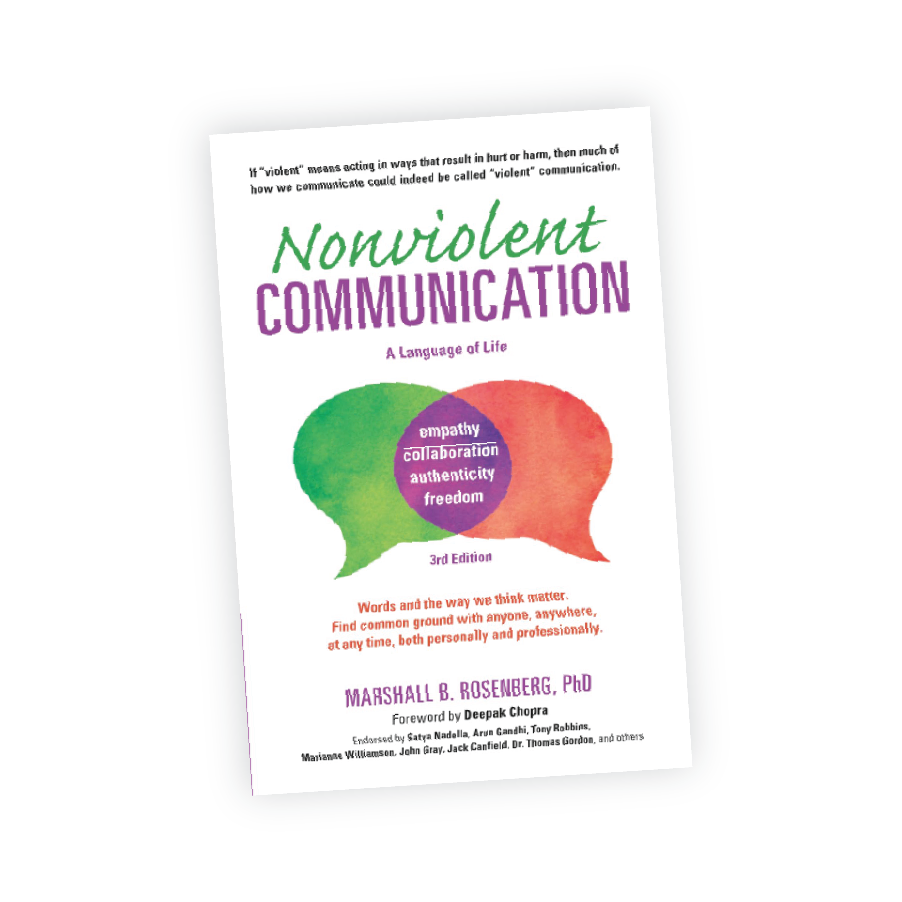
Number of Pages: 264
Estimated Read Time
Slow Reader: 14 Hour 30 Minutes
Average Reader: 7 Hour 30 Minutes
Fast Reader: 4 Hour 50 Minutes
Estimated Listen Time: 5 Hours 9 Minutes
Amazon Description
What if you could defuse tension and create accord in even the most volatile situations – just by changing the way you spoke? Over the past 35 years, Marshall Rosenberg has done just that, peacefully resolving conflicts in families, schools, businesses, and governments in 30 countries all over the world. On Nonviolent Communication, this renowned peacemaker presents his complete system for speaking our deepest truths, addressing our unrecognized needs and emotions, and honoring those same concerns in others. With this adaptation of the best-selling book of the same title, Marshall Rosenberg teaches in his own words:
Observations, feelings, needs, and requests – how to apply the four-step process of Nonviolent Communication to every dialogue we engage in.
Overcoming the blocks to compassion – and opening to our natural desire to enrich the lives of those around us.
How to use empathy to safely confront anger, fear, and other powerful emotions.
Chapter 1 – Giving From the Heart
Chapter 1 – Giving From the Heart, page 1.
Introduction
Believing that it is our nature to enjoy giving and receiving compassionately, I have been preoccupied most of my life with two questions:
What happens to disconnect us from our compassionate nature?
(And) Conversely, what allows some people to stay connected to their compassionate nature under even the most trying circumstances?
While studying the factors that affect our ability to stay compassionate, I was struck by the crucial role of language and our use of words.
I have since identified a specific approach to communicating – both speaking and listening – that leads us to give from the heart, connecting us with ourselves and with each other in a way that allows our natural compassion to flourish.
I call this approach Nonviolent Communication, using the term nonviolence as Gandhi used it – to refer to our natural state of compassion when violence is subdued from the heart.
A Way to Focus Attention
NVC guides us in reframing how we express ourselves and hear others.
Instead of habitual, automatic reactions, our words become conscious responses based firmly on awareness of what we are perceiving, feeling, and wanting.
We are led to express ourselves with honesty and clarity, while simultaneously paying others respectful and empathetic attention.
NVC trains us to observe carefully and to specify behaviors and conditions that are affecting us.
We learn to identify and clearly articulate what we are concretely wanting in any given situation.
We perceive relationships in a new light when we use NVC to hear our own deeper needs and those of others.
When we focus on clarifying what is being observed, felt, and needed rather than on diagnosing and judging, we discover the depth of our own compassion.
Although I refer to NVC as “a process language,” NVC is more than a process or a language. On a deeper level, it is an ongoing reminder to keep our attention focused on a place where we are more likely to get what we are seeking.
I developed NVC as a way to train my attention – to shine the light of consciousness – on places that have the potential to yield what I am seeking.
The use of NVC does not require that the persons with whom we are communicating be literate in NVC, or even motivated to relate to us compassionately.
The NVC Process
The four components of the NVC model:
First, we observe what is actually happening in a situation, articulating this observation without introducing any judgment or evaluation.
Next, we state how we feel when we observe this action.
Thirdly, we specify what need of ours is connected to the feelings we have identified.
Fourth, and last, we express what we are wanting from the other person that would enrich our lives.
The other part of this communication consists of receiving the same four pieces of information from others.
We connect with them by first sensing what they are observing, feeling, and needing.
Then we discover what would enrich their lives by receiving the fourth piece – their request.
As we keep our attention focused on the areas mentioned, and help others do likewise, we establish a flow of communication, back and forth, until compassion manifests naturally.
When we use this process, we may begin either by expressing ourselves or by empathetically receiving these four pieces of information from others.
NVC is not a set formula, but something that adapts to various situations.
The Four Components (Re)Summarized
The concrete actions we observe that affect our well-being.
How we feel in relation to what we observe.
The needs, values, desires, etc. that create our feelings.
The concrete actions we request in order to enrich our lives.
Summary
NVC helps us connect with each other and ourselves in a way that allows natural compassion to flourish.
It guides us to reframe the way we express ourselves and listen to others by focusing our consciousness on four areas: what we are observing, feeling, and needing, and what we are requesting to enrich our lives.
Some people use NVC to respond compassionately to themselves, some to create greater depth in their personal relationships, and others to build effective relationships at work.
Worldwide, NVC is used to mediate disputes and conflicts at all levels.
Chapter 2 – Communication That Blocks Compassion
Chapter 2 – Communication That Blocks Compassion, page 15.
Certain ways of communicating alienate us from our natural state of compassion.
Moralistic Judgements
One kind of life-alienating communication is the use of moralistic judgments that imply wrongness or badness on the part of people who don’t agree with our values.
When we speak this language, we judge others and their behavior.
Our attention is focused on classifying, analyzing, and determining levels of wrongness rather than on what we and others need and are not getting.
I believe that all such analyses of other human beings are tragic expressions of our own values and needs.
They are tragic because when we express our values and needs in this form, we increase defensiveness and resistance among the very people whose very behaviors are of concern to us.
Or, if people do agree to act in harmony with our values, they will likely do so out of fear, guilt, or shame because they concur with our analysis of their wrongness.
We all pay dearly when people respond to our values and needs out of fear, guilt, or shame. Sooner or later we will experience the consequences of diminished goodwill on the part of those who comply with our values out of a sense of either external or internal coercion.
It is important here not to confuse value judgments and moralistic judgments.
Value judgments reflect our beliefs of how life can best be served. We all make them.
We make moralistic judgments of people and behaviors that fail to support our value judgments.
Had we been raised speaking a language that facilitated the expression of compassion, we would have learned to articulate our needs and values directly, rather than to insinuate wrongness when they have not been met.
Making Comparisons
Another form of judgment is the use of comparisons.
In his book How to Make Yourself Miserable, Dan Greenburg suggests that if readers have a sincere desire to make life miserable for themselves, they might learn to compare themselves to other people.
Denial of Responsibility
Another form of life-alienating communication is the denial of responsibility.
We are each responsible for our own thoughts, feelings, and actions.
The use of the common term “have to,” illustrates how personal responsibility for our actions can be obscured in speech.
The phrase “you make me feel…” is another example of how language facilitates the denial of personal responsibility for our own feelings and thoughts.
We can replace language that implies a lack of choice with language that acknowledges choice.
We are dangerous when we are not conscious of our responsibility for how we behave, think, and feel.
Other Forms of Life-Alienating Communication
Communicating our desires as demands is yet another form of language that blocks communication.
A demand explicitly or implicitly threatens listeners with blame or punishment.
Learning to differentiate demands from requests is an important part of NVC.
The concept that certain actions merit reward while others merit punishment is also associated with life-alienating communication. This thinking is expressed in the word “deserve.”
I believe it is in everyone’s interest that people change, not to avoid punishment, but because they see the change as benefiting themselves.
Summary
It is our nature to enjoy giving and receiving compassionately.
We have, however, learned many forms of life-alienating communication that lead us to speak and behave in ways that injure others and ourselves.
Examples of life-alienating communication: Moralistic Judgements and Comparisons.
Life-alienating communication also obscures our awareness that we are each responsible for our own thoughts, feelings, and actions.
Communicating our desires in the form of demands is yet another characteristic of language that blocks compassion.
Chapter 3 – Observing Without Evaluating
Chapter 3 – Observing Without Evaluating, page 25.
The first component of NVC entails the separation of observation from evaluation.
We need to clearly observe what we are seeing, hearing, or touching that is affecting our sense of well-being, without mixing in any evaluation.
When we combine observation with evaluation, we decrease the likelihood that others will hear our intended message.
Instead, they are apt to hear criticism and thus resist what we are saying.
NVC does not mandate that we remain completely objective and refrain from evaluating. It only requires that we maintain a separation between our observations and our evaluations.
NVC is a process language that discourages static generalizations. We can create many problems for ourselves by using static language to express or capture an ever-changing reality.
The Highest Form of Human Intelligence
The Indian philosopher J. Krishnamurti once remarked that observing without evaluating is the highest form of human intelligence.
For most of us, it is difficult to make observations, especially of people and their behavior, that are free from judgment, criticism, or other forms of analysis.
Sometimes is useful to practice by creating a list identifying specific behaviors, and reviewing the list, making sure it is free of evaluations.
The words always, never, ever, whenever, frequently, and seldom can contribute to confusing observation with evaluation. When these words are used as exaggerations, they often provoke defensiveness rather than compassion.
Chapter Summary
The first component of NVC entails the separation of observation from evaluation.
When we combine observation with evaluation, others are apt to hear criticism and resist what we are saying.
NVC is a process language that discourages static generalizations.
Instead, observations are to be made specific to time and context, for example, “Hank Smith has not scored a goal in twenty games,” rather than “Hank Smith is a poor soccer player.”
Chapter 4 – Identifying and Expressing Feelings
Chapter 4 – Identifying and Expressing Feelings, page 37.
The first component of NVC is to observe without evaluating; the second component is to express how we are feeling.
“The mature person is able to differentiate feelings into as many nuances, strong and passionate experiences, or delicate and sensitive ones as in the different passages of music in a symphony.” – Rollo May (Psychoanalyst)
For many of us, however, our feelings are, as May would describe it, “limited like notes on a bugle call.”
The Heavy Cost of Unexpressed Feelings
Our repertoire of words for calling people names is often larger than our vocabulary of words to clearly describe our emotional states.
Growing up, we are trained to be “other-directed” rather than to be in contact with ourselves. We learn to be “up in our head,” wondering, “What is it that others think is right for me to say or do?”
When we follow the “feel” with the word “that” we are expressing an opinion but not revealing our feelings.
This difficulty in identifying and expressing our feelings is common.
Many professions (military, police, lawyers, engineers, corporate managers, etc.) discourage employees from expressing their emotions.
I have often heard people say they cannot imagine ever expressing feelings at their workplace.
The benefits of strengthening our feelings vocabulary are evident not only in intimate relationships but also in the professional world.
Often, simply expressing our vulnerability can help resolve conflict.
Feelings versus Non-Feelings
A common confusion, generated by the English language, is our use of the word feel without actually expressing a feeling.
Often the words “I feel” could be more accurately replaced with the words “I think.” This helps us distinguish feelings from thoughts.
In general, feelings are not being clearly expressed when the word “feel” is followed by:
Words such as that, like, as if:
“I feel that you…”
“I feel like…”
“I feel as if…”
The pronouns, I, you, he, she, they, it:
“I feel I am…”
“I feel it is…”
Names or nouns referring to people:
“I feel Amy…”
“I feel my boss is…”
It is helpful to differentiate between words that describe what we think others are doing around us, and words that describe actual feelings.
The following are examples of statements that are easily mistaken as expressions of feelings:
“I feel unimportant to the people with whom I work.” The word “unimportant” describes how I think others are evaluating me, rather than an actual feeling, which in this situation might be “I feel sad” or “I feel discouraged.”
“I feel misunderstood.” Here the word “misunderstood” indicates my assessment of the other person’s level of understanding rather than a feeling. In this situation, I may be feeling anxious or annoyed.
“I feel ignored.” This is more of an interpretation of the actions of others than a clear statement of how we are feeling. No doubt there have been times we thought we were being ignored and our feeling was relief because we wanted to be left to ourselves. No doubt there were other times, however, when we felt hurt when we thought we were being ignored because we wanted to be included.
Words like ignored express how we interpret others, rather than how we feel. Here are a sample of such words:
Abandoned
Attacked
Betrayed
Bullied
Cheated
Distrusted
Interrupted
Let down
Misunderstood
Overworked
Pressured
Rejected
Taken for granted
Threatened
Unappreciated
Unheard
Unseen
Unsupported
Building a Vocabulary of Feelings
In expressing our feelings, it helps to use words that refer to specific emotions, rather than words that are vague and general.
For example, if we say, “I feel good about that,” the word good could mean happy, excited, relieved, or a number of other emotions.
Words such as good and bad prevent the listener from connecting easily with what we might actually be feeling.
Please see the corresponding “Feelings Sheet” for a list of emotions compiled to help you increase your power to articulate feelings and clearly describe a whole range of emotional states.
Summary
The second component necessary for expressing ourselves is feelings.
By developing a vocabulary of feelings that allows us to clearly and specifically name or identify emotions, we can connect more easily to one another.
Allowing ourselves to be vulnerable by expressing our feelings can help resolve conflicts.
NVC distinguishes the expression of actual feelings from words and statements that describe thoughts, assessments, and interpretations.
Chapter 5 – Taking Responsibility for Our Feelings
Chapter 5 – Taking Responsibility for Our Feelings, page 49.
What others do may be the stimulus for our feelings, but not the cause.
The third component of NVC is the acknowledgment of the root of our feelings.
NVC heightens our awareness that what others say and do may be the stimulus, but never the cause, of our feelings.
Our feelings result from how we choose to receive what others say and do and from our particular needs and expectations at that moment.
The third component will lead us to accept responsibility for our role in generating our own feelings.
Hearing a Negative Message: Four Options
When someone gives us a negative message, whether verbally or nonverbally, we have four options as to how to receive it:
Blame Ourselves
One option is to take it personally by hearing blame or criticism.
We choose this option at great cost to our self-esteem, for it inclines us toward feelings of guilt, shame, and depression.
Blame Others
A second option is to fault the speaker.
When we receive messages this way, and blame the speaker, we are likely to feel anger.
Sense Our Own Feelings and Needs
The third option, when receiving negative messages, is to shine the light of consciousness on our own feelings and needs.
By focusing attention on our own feelings and needs, we become conscious that our current feeling of hurt derives from a need for the recognition of our efforts.
We accept responsibility for our feelings, rather than blame other people, by acknowledging our own needs, desires, expectations, values, and thoughts.
Sense Others’ Feelings and Needs
Finally, a fourth option for receiving a negative message is to shine the light of consciousness on the other person’s feelings and needs as they are currently expressed.
It is helpful to recognize several common speech patterns that tend to mask accountability for our own feelings:
Use of impersonal pronouns such as it and that: “It really infuriates me when…”
The use of the expression “I feel (emotion) because…” followed by a person or personal pronoun other than I: “I feel hurt because you…”
Statements that mention only the actions of others: “When you don’t (action), I feel (emotion).”
In each of these instances, we can deepen our awareness of our own responsibility by substituting the phrase, “I feel… because I need…”
The Needs at the Roots of Feelings
Judgments, criticisms, diagnoses, and interpretations of others are all alienated expressions of our needs.
When we express our needs indirectly through the use of evaluations, interpretations, and images, others are likely to hear criticism.
When people hear anything that sounds like criticism, they tend to invest their energy in self-defense or counterattacks.
Instead, the more directly we can connect our feelings to our own needs, the easier it is for others to respond to us compassionately.
Unfortunately, most of us have never been taught to think in terms of needs. We are accustomed to thinking about what’s wrong with other people when our needs aren’t being fulfilled.
It has been my experience over and over again that from the moment people begin talking about what they need rather than what’s wrong with one another, the possibility of finding ways to meet everybody’s needs is greatly increased.
From Emotional Slavery to Emotional Liberation
In our development toward a state of emotional liberation, most of us experience three stages in the way we relate to others. These stages are:
Stage 1: Emotional Slavery
We believe ourselves responsible for the feelings of others.
We must strive to keep everyone happy.
If they don’t appear happy, we feel responsible and compelled to do something about it.
This can easily lead us to see the very people who are closest to us as burdens.
Taking responsibility for the feelings of others can be very detrimental to relationships.
Stage 2: The Obnoxious Stage
In this stage, we become aware of the high costs of assuming responsibility for others’ feelings and trying to accommodate them at our own expense.
When we notice how much of our lives we’ve missed and how little we have responded to the call of our soul, we may get angry.
I refer jokingly to this stage as the obnoxious stage because we tend toward obnoxious comments like, “That’s your problem! I’m not responsible for your feelings!” when presented with another person’s pain.
We are clear about what we are not responsible for, but have yet to learn how to be responsible to others in a way that is not emotionally enslaving.
As we emerge from the stage of emotional slavery, we may continue to carry remnants of fear and guilt around having our own needs. Thus it is not surprising that we end up expressing our needs in ways that sound rigid and unyielding to the ears of others.
In the obnoxious stage, we have yet to grasp that emotional liberation entails more than simply asserting our own needs.
Stage 3: Emotional Liberation
In the third stage, emotional liberation, we respond to the needs of others out of compassion, never out of fear, guilt, or shame.
We accept full responsibility for our own intentions and actions, but not for the feelings of others.
At this stage, we are aware that we can never meet our own needs at the expense of others.
Emotional liberation involves stating clearly what we need in a way that communicates that we are equally concerned that the needs of others be fulfilled.
NVC is designed to support us in relating at this level.
Summary
The third component of NVC is the acknowledgment of the needs behind our feelings.
What others say and do may be the stimulus for, but never the cause of, our feelings.
When someone communicates negatively, we have four options as to how to receive the message:
Blame ourselves.
Blame others.
Sense our own feelings and needs.
Sense the feelings and needs hidden in the other person’s negative message.
Judgments, criticisms, diagnoses, and interpretations of others are all alienated expressions of our own needs and values.
When others hear criticism, they tend to invest their energy in self-defense and counterattack.
The more directly we can connect our feelings to our needs, the easier it is for others to respond compassionately.
In the course of developing emotional responsibility, most of us experience three stages:
Emotional Slavery – Believing ourselves responsible for the feelings of others.
The Obnoxious Stage – Refusing to admit to caring what anyone else feels or needs.
Emotional Liberation – Accepting full responsibility for our feelings but not the feelings of others, while being aware we can never meet our own needs at the expense of others.
Chapter 6 – Requesting That Which Would Enrich Life
Chapter 6 – Requesting That Which Would Enrich Life, page 67.
We have now covered the first three components of NVC, which address what we are observing, feelings, and needing.
We have learned to do this without criticizing, analyzing, blaming, or diagnosing others, and in a way likely to inspire compassion.
The fourth and final component of this process addresses what we would like to request of others to enrich our lives.
When our needs are not being fulfilled, we follow the expression of what we are observing, feeling, and needing with a specific request: we ask for actions that might fulfill our needs.
Using Positive Action Language
First of all, we express what we are requesting rather than what we are not requesting.
Two problems are commonly encountered when requests are worded in the negative:
People are often confused as to what is actually being requested.
Negative requests are likely to provoke resistance.
In addition to using positive language, we want to word our requests in the form of concrete actions and avoid vague, abstract, or ambiguous phrasing.
Often, the use of vague and abstract language can mask oppressive interpersonal games.
Making requests in clear, positive, concrete action language reveals what we really want.
Vague language contributes to internal confusion.
Making Requests Consciously
When we simply express our feelings, it may not be clear to the listener what we want them to do.
Often, we are simply not conscious of what we are requesting when we speak.
We talk to or at others without knowing how to engage in a dialogue with them. We toss out words, using the presence of others as a wastebasket. In such situations, the listener, unable to discern a clear request in the speaker’s words, may experience a kind of distrust.
Requests may sound like demands when unaccompanied by the speaker’s feelings and needs.
It is common for people to talk without being conscious of what they are asking for.
I believe that, whenever we say something to another person, we are requesting something in return. It may simply be an empathetic connection – a verbal or nonverbal acknowledgment.
The clearer we are on what we want back from the other person, the more likely it is that our needs will be met.
Asking for Reflection
As we know, the message we send is not always the message that’s being received.
We generally rely on verbal cues to determine whether the message has been understood to our satisfaction.
If, however, we’re uncertain that it has been received as intended, we need to be able to clearly request a response that tells us how the message was heard so as to be able to correct any misunderstanding.
On some occasions, a simple question like, “Is that clear?” will suffice.
At other times, we need more than, “Yes, I understood you,” to feel confident that we’ve been truly understood.
At such times, we might ask others to repeat our message back to us in their own words.
We then have the opportunity to restate parts of our message to address any discrepancy or omission we might have noticed in their reflection.
Be sure to express appreciation when your listener tries to meet your request for a reflection.
When we first begin asking others to reflect back what they heard us say, it may feel awkward and strange because such requests are rarely made.
Be sure to empathize with the listener who doesn’t want to reflect back.
To prevent awkward exchanges, we can explain to people ahead of time why we may sometimes ask them to reflect back our words. We make clear that we’re not testing their listening skills, but checking out whether we’ve expressed ourselves clearly.
Requesting Honesty
After we’ve openly expressed ourselves and received the understanding we want, we’re often eager to know the other person’s reaction to what we’ve said.
Usually, the honesty we would like to receive takes one of three directions:
Their Feelings
Sometimes we’d like to know the feelings that are stimulated by what we’ve said, and the reasons for those feelings.
We might request this by asking, “I would like you to tell me how you feel about what I just said, and your reasons for feeling as you do.”
Their Thoughts
Sometimes we’d like to know something about our listener’s thoughts in response to what they just heard us say.
For example, we might say, “I’d like you to tell me if you predict my proposal would be successful, and if not, what you believe would prevent its success.”
When we don’t specify which thoughts we would like to receive, the other person may respond at great length with thoughts that aren’t the ones we are seeking.
Their Willingness
Sometimes we’d like to know whether the other person is willing to take certain actions that we’ve recommended.
Such a request may sound like this, “I’d like you to tell me if you would be willing to postpone our meeting for one week.”
Making Requests to a Group
It is especially important when we are addressing a group to be clear about the kind of understanding or honesty that we want back after we’ve expressed ourselves.
When we are not clear about the response we’d like, we may initiate unproductive conversations that end up satisfying no one’s needs.
In a group, much time is wasted when speakers aren’t certain what response they’re wanting.
Requests versus Demands
Our requests will be received as demands when others believe they will be blamed or punished if they do not comply.
When people hear a demand, they see only two options: submission or rebellion.
The more we have in the past blamed, punished, or “laid guilt trips” on others when they haven’t responded to our requests, the higher the likelihood that our requests will now be heard as demands.
To tell if it’s a demand or a request, observe what the speaker does if the request is not complied with.
The more we interpret noncompliance as rejection, the more likely our requests will be heard as demands. This leads to a self-fulfilling prophecy, for the more people hear demands, the less they enjoy being around us.
We demonstrate that we are making a request rather than a demand by how we respond when others don’t comply.
If we are prepared to show an empathetic understanding of what prevents someone from doing what we asked, then by definition, we have made a request, not a demand.
Choosing to request rather than demand does not mean we give up when someone says no to our request. It does mean we don’t engage in persuasion until we have empathized with what’s preventing the other person from saying yes.
Defining Our Objective When Making Requests
Expressing genuine requests also requires an awareness of our objective.
If our objective is only to change people and their behavior or to get our way, then NVC is not an appropriate tool.
When others trust our primary commitment is to the quality of the relationship, and that we expect this process to fulfill everyone’s needs, then they can trust that our requests are true requests and not camouflaged demands.
A consciousness of this objective is difficult to maintain for those whose work centers around influencing people and obtaining behavioral results.
Sometimes, however, even when we’re conscious of our intent and express our request with care, people may still hear a demand. This is particularly true when we occupy positions of authority and are speaking with those who have had past experiences with coercive authority figures.
When making a request, it is helpful to scan out minds for the sort of thoughts that automatically transform requests into demands:
He should be cleaning up after himself.
She’s supposed to do what I ask.
I deserve to get a raise.
I’m justified in having them stay later.
I have a right to more time off.
When we frame our needs with these thoughts, we are bound to judge others when they don’t do as we request.
Summary
The fourth component of NVC addresses the question of what we would like to request of each other to enrich each of our lives.
We try to avoid vague, abstract, or ambiguous phrasing, and remember to use positive action language by stating what we are requesting rather than what we are not.
Each time we speak, the clearer we are about what we want back, the more likely we are to get it.
Since the message we send is not always the message received, we need to learn how to figure out if our message has been accurately heard.
Requests are received as demands when listeners believe that they will be blamed or punished if they do not comply.
The objective of NVC is not to change people and their behavior to get our way; it is to establish relationships based on honesty and empathy that will eventually fulfill everyone’s needs.
Chapter 7 – Receiving Emphatically
Chapter 7 – Receiving Emphatically, page 91.
The last four chapters described the four components of NVC: what we are observing, feeling, and needing, and what we would like to request to enrich our lives.
Now we will apply these same four components to hearing what others are observing, feeling, needing, and requesting.
We refer to this part of the communication process as Receiving Empathetically.
Presence: Don’t Just Do Something, Stand There
“True empathy requires listening with the whole being. Listening demands the emptiness of all faculties. And when the faculties are empty, then the whole being listens. There is then a direct grasp of what is right there before you that can never be heard with the ear or understood with the mind.” – Chuang-Tzu (Chinese philosopher)
Empathy is a respectful understanding of what others are experiencing.
Empathy with others occurs only when we have successfully shed all preconceived ideas and judgments about them.
The presence that empathy requires is not easy to maintain.
“The capacity to give one’s attention to a sufferer is a very rare and difficult thing; it is almost a miracle; it is a miracle,” asserts French philosopher Simone Weil.
Instead of offering empathy, we tend instead to give advice or reassurance and to explain our own position or feeling.
Empathy, on the other hand, requires us to focus full attention on the other person’s message.
We give others the time and space they need to express themselves fully and feel understood.
The following are behaviors that prevent us from being sufficiently present to connect empathetically with others:
Advising: “I think you should…” “How come you didn’t…?”
One-Upping: “That’s nothing: wait till you hear what happened to me.”
Educating: “This could turn into a very positive experience for you if you just…”
Consoling: “It wasn’t your fault; you did the best you could.”
Story-telling: “That reminds me of a time…”
Shutting down: “Cheer up. Don’t feel so bad.”
Sympathizing: “Oh, you poor thing…”
Interrogating: “When did this begin?”
Explaining: “I would have called but…”
Correcting: “That’s not how it happened.”
Believing we have to “fix” situations and make others feel better prevents us from being present.
The key ingredient of empathy is presence: we are wholly present with the other party and what they are experiencing. This quality of presence distinguishes empathy from either mental understanding or sympathy.
Listening for Feelings and Needs
In NVC, no matter what words people use to express themselves, we listen for their observations, feelings, needs, and requests.
Listen to what people are needing rather than what they are thinking.
Paraphrasing
After we focus our attention and hear what others are observing, feeling, needing, and what they are requesting to enrich their lives, we may wish to reflect back by paraphrasing what we have understood.
If we have accurately received the other party’s message, our paraphrasing will confirm this for them.
If, on the other hand, our paraphrase is incorrect, we give the speaker an opportunity to correct us.
NVC suggests that our paraphrasing take the form of questions that reveal our understanding while eliciting any necessary corrections from the speaker. These questions should ask:
What other’s are observing: “Are you reacting to (observation)?
What others are feeling: “Are you feeling (feeling) because you would like more (need)?”
What others are requesting: “Are you wanting me to (request)?”
These questions require us to sense what’s going on within other people while inviting their correction, should we have sensed incorrectly.
There are no infallible guidelines regarding when to paraphrase, but as a rule of thumb, it is safe to assume that speakers expressing intensely emotional messages would appreciate our reflecting these back to them.
All criticism, attack, insults, and judgments vanish when we focus attention on hearing the feelings and needs behind a message.
Simple Truth: Behind all the messages we have allowed ourselves to be intimidated by are just individuals with unmet needs appealing to us to contribute to their well-being.
Therefore, a difficult message becomes an opportunity to enrich someone’s life.
Some people resist paraphrasing as a waste of time, but studies in labor-management negotiations demonstrate that the time required to reach conflict resolution is cut in half when each negotiator agrees, before responding, to accurately repeat what the previous speaker had said.
Sustaining Empathy
I recommend allowing others the opportunity to fully express themselves before turning our attention to solutions or requests for relief.
When we proceed too quickly to what people might be requesting, we may not convey our genuine interest in their feelings and needs; instead, they may get the impression that we’re in a hurry to either be free of them or to fix their problems.
An initial message is often like the tip of an iceberg; it may be followed by as yet unexpressed, but related – and often more powerful – feelings.
What evidence is there that we’ve adequately empathized with the other person?
First, when an individual realizes that everything going on within has received full empathetic understanding, they will experience a sense of relief.
We can become aware of this phenomenon by noticing a corresponding releaser of tension in our own body.
A second, and even more obvious sign is that the person will stop talking.
When pain Blocks Our Ability to Empathize
It is impossible for us to give something to another if we don’t have it ourselves.
If we find ourselves unable or unwilling to empathize despite our efforts, it is usually a sign that we are too starved for empathy to be able to offer it to others.
We need empathy to give empathy.
If we openly acknowledge that our own distress is preventing us from responding empathetically, the other person may come through with the empathy we need.
At other times, it may be necessary to provide ourselves with some “emergency first aid” empathy by listening to what’s going on in ourselves with the same quality or presence and attention that we offer to others.
If we become skilled at giving ourselves empathy, we often experience in just a few seconds a natural release of energy that then enables us to be present with the other person.
Summary
Empathy is a respectful understanding of what others are experiencing.
We often have a strong urge to give advice or reassurance and to explain our position or feeling.
Empathy, however, calls on us to empty our minds and listen to others with our whole being.
In NVC, no matter what words others may use to express themselves, we simply listen for their observations, feelings, needs, and requests.
Then we may wish to reflect back, paraphrasing what we have understood.
We stay with empathy and allow others the opportunity to fully express themselves before we turn our attention to solutions or requests for relief.
We need empathy to give empathy.
When we sense ourselves being defensive or unable to empathize, we need to:
Stop, breathe, and give ourselves empathy.
Scream non-violently.
Remove ourselves from the situation and take a time out.
Chapter 8 – The Power of Empathy
Chapter 8 – The Power of Empathy, page 113.
“When someone really hears you without passing judgment on you, without trying to take responsibility for you, without trying to mold you, it feels damn good!” – Carl Rogers
When we work in a hierarchically structured institution, there is a tendency to hear commands and judgments from those higher up in the hierarchy.
While we may easily empathize with our peers and with those in less powerful positions, we may find ourselves being defensive or apologetic, instead of empathetic, in the presence of those we identify as “superiors.”
It’s harder to empathize with those who appear to possess more power, status, or resources.
Empathy and the Ability to Be Vulnerable
Because we are called to reveal our deepest feelings and needs, we may sometimes find it challenging to express ourselves in NVC.
Self-expression becomes easier, however, after we empathize with others.
The more we connect with the feelings and needs behind their words, the less frightening it is to open up to other people.
The situations where we are the most reluctant to express vulnerability are often those where we want to maintain a “tough image” for fear of losing authority or control.
Using Empathy to Defuse Anger
The ability to offer empathy to people in stressful situations can defuse potential violence.
When we listen for feelings and needs, we no longer see people as monsters.
It may be difficult to empathize with those who are closest to us.
Empathy in Hearing Someone’s “No!”
Because of our tendency to read rejection into someone else’s “no” and “I don’t want to…,” these are important messages for us to be able to empathize with.
If we take their “No!” personally, we may feel hurt without understanding what’s actually going on within the other person.
When we shine the light of consciousness on the feelings and needs behind someone else’s no,” however, we become cognizant of what prevents them from responding as we would like.
Empathy to Revive a Lifeless Conversation
We have all found ourselves in the midst of a lifeless conversation.
Vitality drains out of a conversation when we lose connection with the feelings and needs generating the speaker’s words and with the requests associated with those needs.
This effect is common when people talk without consciousness of what they are feeling, needing, or requesting.
Instead of being engaged in an exchange of life energy with other human beings, we see ourselves becoming wastebaskets for their words.
How and when do we interrupt a dead conversation to bring it back to life? I’d suggest the best time to interrupt is when we’ve heard one more word than we want to hear. The longer we wait, the harder it is to be civil when we do step in.
Our intention in interrupting is not to claim the floor for ourselves, but to help the speaker connect to the life energy behind the words being spoken.
So, to bring a conversation back to life, interrupt with empathy.
Another way to bring a conversation back to life is to openly express our desire to be more connected and to request information that would help us establish that connection.
I have discovered that conversations that are lifeless for the listener are equally so for the speaker.
Speakers prefer that listeners interrupt rather than pretend to listen.
Summary
Our ability to offer empathy can allow us to stay vulnerable, defuse potential violence, hear the word no without taking it as a rejection, revive a lifeless conversation, and even hear the feelings and needs expressed through silence.
Chapter 9 – Connecting Compassionately With Ourselves
Chapter 9 – Connecting Compassionately With Ourselves, page 129.
We have seen how NVC contributes to relationships with friends and family, at work and in the political arena.
Its most crucial application, however, may be in the way we treat ourselves.
When we are internally violent toward ourselves, it is difficult to be genuinely compassionate toward others.
Translating “Have to” to “Choose to”
Step 1: List on a piece of paper all the things that you tell yourself you have to do.
Step 2: After completing your list, clearly acknowledge to yourself that you are doing these things because you choose to do them, not because you have to.
Step 3: After having acknowledged that you choose to do a particular activity, get in touch with the intention behind your choice by completing the statement, I choose to…because I want to…
With every choice you make, be conscious of what need it serves.
Ask yourself if there are alternative strategies to get the same need met.
Cultivating Awareness of the Energy Behind Our Actions
As you explore the statement, “I choose to…because I want…” you may discover the important values behind the choices you’ve made.
I am convinced that after we gain clarity regarding the need being served by our actions, we can experience those actions as play even when they involve hard work, challenge, or frustration.
For some items on your list, however, you may uncover one or several of the following motivations:
For Money
Money is a major form of extrinsic reward in our society.
Choices prompted by a desire for reward are costly: they deprive us of the joy in life that comes with actions grounded in the clear intention to contribute to a human need.
Money is not a “need” as we define it in NVC; it is one of the countless strategies that may be selected to address a need.
For Approval
Like money, approval from others is a form of extrinsic reward.
We are addicted to getting a smile, a pat on the back, and people’s verbal judgments that we are a “good person,” “good parent,” “good citizen,” “good worker,” “good friend” and so forth.
We do things to get people to like us and avoid things that may lead people to dislike or punish us.
To Escape Punishment
To Avoid Shame
There are some tasks we choose to do just to avoid shame.
If we do something stimulated solely by the urge to avoid shame, we will generally end up detesting it.
To Avoid Guilt
In other instances, we may end up feeling guilty for failing to fulfill other people’s expectations of us.
There is a world of difference between doing something for others to avoid guilt and doing it out of a clear awareness of our own need to contribute to the happiness of other human beings.
To Satisfy a Sense of Duty
When we use language that denies choice (for example, words such as should, have to, ought, must, can’t, supposed to, etc.), our behaviors arise out of a vague sense of guilt, duty, or obligation.
I consider this to be the most socially dangerous and personally unfortunate of all the ways we act when we’re cut off from our needs.
When we speak a language that denies choice, we forfeit the life in ourselves for a robotlike mentality that disconnects us from our own core.
I believe that to the degree that we engage moment by moment in the playfulness of enriching life – motivated solely by the desire for enriching life – to that degree are we being compassionate with ourselves.
Summary
The most crucial application of NVC may be in the way we treat ourselves.
When we make mistakes, instead of getting caught up in moralistic judgments, we can use the process of NVC mourning and self-forgiveness to show us where we can grow.
By assessing our behaviors in terms of our own unmet needs, the impetus for change comes not out of shame, guilt, anger, or depression, but out of the genuine desire to contribute to our own and other’s well-being.
We also cultivate self-compassion by consciously choosing in daily life to act only in service to our own needs and values rather than out of duty, for extrinsic rewards, or to avoid guilt, shame and punishment.
Chapter 10 – Expressing Anger Fully
Chapter 10 – Expressing Anger Fully, page 141.
The expression of anger clearly demonstrates the difference between NVC and other forms of communication.
I would like to suggest that hitting, blaming, and hurting others – whether physically or emotionally – are all superficial expressions of what is going on within us when we are angry.
If we are truly angry, we would want a much more powerful way to fully express ourselves.
This understanding comes as a relief to many who want to increase their power to effect change.
This process does not encourage us to ignore, squash, or swallow anger, but rather to express the core of our anger fully and wholeheartedly.
Distinguishing Stimulus From Cause
The first step to fully expressing anger in NVC is to divorce the other person from any responsibility for our anger.
We are never angry because of what others say or do.
We can identify the other person’s behavior as the stimulus, but it is important to establish a clear separation between stimulus and cause.
The first step in the process of fully expressing our anger is to realize that what other people do is never the cause of how we feel.
So what is the cause of anger?
The cause of anger lies in our own thinking – in thoughts of blame and judgment.
It is not the behavior of the other person but our own need that causes our feeling.
When we are connected to our need we are in touch with our life energy. We may have strong feelings, but we are never angry.
Anger is a result of life-alienating thinking that is disconnected from needs. It indicates that we have moved up to our heads to analyze and judge somebody rather than focusing on which of our needs are not getting met.
All Anger Has a Life-Serving Core
I see all anger as a result of life-alienating, violence-provoking thinking.
At the core of all anger is a need that is not being fulfilled.
Thus anger can be valuable if we use it as an alarm clock to wake us up – to realize we have a need that isn’t being met and that we are thinking in a way that is unlikely to be met.
To fully express anger requires full consciousness of our needs.
In addition, energy is required to get the needs met.
Anger, however, co-opts our energy by directing it toward punishing people rather than meeting our needs.
Instead of engaging in “righteous indignation,” I recommend connecting empathetically with our own needs or those of others.
This may take extensive practice, whereby over and over again, we consciously replace the phrase “I am angry because they…” with “I am angry because I am needing…”
All violence is the result of people tricking themselves into believing that their pain derives from other people and that consequently, those people deserve to be punished.
I would like to suggest that when our heads are filled with judgments and analyses that others are bad, greedy, irresponsible, lying, cheating, polluting the environment, valuing profit more than life, or behaving in other ways they shouldn’t, very few of them will be interested in our needs.
We may be successful in using such judgments to intimidate people into meeting our needs.
If they feel so frightened, guilty, or ashamed that they change their behavior, we may come to believe that it is possible to “win” by telling people what’s wrong with them.
With a broader perspective, however, we realize that each time our needs are met in this way, we not only lose, but we have contributed very tangibly to violence on the planet.
We may have solved an immediate problem, but we have created another one.
The more people hear blame or judgment, the more defensive and aggressive they become and the less they will care about our needs in the future.
Four Steps to Express Anger
Let’s look at what the process of fully expressing our anger requires in concrete form:
Stop. Breathe.
The first step is to stop and do nothing except breathe.
Refrain from making any move to blame or punish the other person.
Simply stay quiet.
Identify Your Judgmental Thoughts
Then we identify the thoughts that are making us angry.
We sense anger, stop, and recognize the thoughts stirring in our heads.
Connect With Your Needs
We know that all judgments are tragic expressions of unmet needs, so we take the next step and connect to the needs behind those thoughts.
Express Your Feeling and Unmet Needs
To fully express ourselves, we now open our mouth and speak the anger – but the anger has been transformed into needs and need-connected feelings.
Offering Empathy First
In most cases, however, another step needs to take place before we can expect the other party to connect with what is going on in us.
Because it will often be difficult for others to receive our feelings and needs in such situations, if we want them to hear us we would need first to empathize with them.
The more we empathize with what leads them to behave in ways that are not meeting our needs, the more likely it is that they will be able to reciprocate afterward.
The more we hear them, the more they’ll hear us.
When we hear another person’s feelings and needs, we recognize our common humanity.
Taking Our Time
Probably the most important part of learning how to live the process we’ve been discussing is to take our time.
We may feel awkward deviating from the habitual behaviors that our conditioning has rendered automatic, but if we intend to consciously live life in harmony with our values, then we’ll want to take our time.
For those of you wishing to apply NVC, especially in challenging situations of anger, I would suggest the following exercise:
List the judgments that float most frequently in your head.
Collect all the negative judgments in your head and then ask yourself, “When I make that judgment of a person, what am I needing and not getting?”
In this way, you train yourself to frame your thinking in terms of unmet needs rather than in terms of judgments of other people.
To practice NVC, we need to proceed slowly, think carefully before we speak, and often just take a deep breath and not speak at all.
Learning the process and applying it both take time.
Summary
Blaming and punishing others are superficial expressions of anger.
If we wish to fully express anger, the first step is to divorce the other person from any responsibility for our anger
Instead, we shine the light of consciousness on our own feelings and needs.
By expressing our needs, we are far more likely to get them met than by judging, blaming, or punishing others.
The four steps to expressing anger are
Step 1: Stop and breathe
Step 2: Identify our judgmental thoughts
Step 3: Connect with our needs
Step 4: Express our feelings and unmet needs
Pro Tip: Sometimes, in between steps 3 and 4, we may choose to empathize with the other person so that he or she will be better able to hear us when we express ourselves in step 4.
Chapter 11 – Conflict Resolution and Mediation
Chapter 11 – Conflict Resolution and Mediation, page 161.
Now that you are familiar with the steps involved in NVC, I want to address how to apply them in resolving conflicts.
These could be conflicts between yourself and someone else, or you may be asked to – or choose to – involve yourself in a conflict between others.
Whatever the situation may be, resolving conflicts involves all the principles I outlined previously in this book:
Observing, identifying, and expressing feelings.
Connecting feelings with needs.
Making doable requests of another person using clear, concrete, positive action language.
Human Connection
In NVC-style conflict resolution, creating a connection between people who are in conflict is the most important thing.
It’s not until you have forged that connection that each side will seek to know exactly what the other side is feeling and needing.
The parties also need to know from the start that the objective is not to get the other side to do what they want them to do.
Once the two sides understand that, it becomes possible to have a conversation about how to meet their needs.
A Different Value System
With NVC we are trying to live a different value system.
What’s most important is that every connection along the line mirrors the kind of world we’re trying to create.
How we ask for change reflects the value system we’re trying to support.
Instead of simply trying to get a person to do what we want, we work to create that quality of mutual concern and respect where each party thinks their own needs matter and they are conscious that their needs and the other person’s well-being are interdependent.
When I’m asked to resolve a conflict, I work to lead the two sides to this caring and respectful connection.
I then help both sides create strategies that will resolve the conflict to both sides’ satisfaction.
I use the word satisfaction instead of compromise.
Most attempts at resolution search for compromise, which means everybody gives something up and neither side is satisfied. NVC is different; our objective is to meet everyone’s needs fully.
NVC Conflict Resolution versus Traditional Mediation
Most mediators educate themselves about the issues involved in the conflict and then mediate with those issues as the focus instead of focusing on creating a human connection.
In typical third-party mediation, the conflicting parties may not even be in the same room.
Many mediators define their role as a “third head” trying to think of a way to get everybody to agree.
In my experience, connecting people at this level is the core of mediation because when you make this connection, the problem solves itself most of the time.
Instead of a third head asking, “What can we agree to here?”, a clear statement of each person’s needs will then uncover what can be done to get everybody’s needs met. These become the strategies the parties agree to implement after the mediation session concludes.
NVC Conflict Resolution Steps – A Quick Overview
Five Steps to Conflict Resolution:
First, we express our own needs.
Second, we search for the real needs of the other person, no matter how they are expressing themselves.
Third, we verify that each party accurately recognizes the other person’s needs. If not, we continue to seek the needs behind their words.
Fourth, we provide as much empathy as is required for us to mutually hear each other’s needs accurately.
And fifth, having clarified each party’s needs in the situation, we propose strategies for resolving the conflict, framing them in positive action language.
Throughout the process, we’re listening to each other with utmost care, avoiding the use of language that implies wrongness on either side.
On Needs, Strategies, and Analysis
Fundamentally, needs are the resources life requires to sustain itself.
I believe that all people have the same needs regardless of nationality, religion, gender, income, education, etc.
It is important, when resolving conflicts, that we can clearly recognize the difference between needs and strategies
In order not to confuse needs and strategies, it is important to recall that needs contain no reference to anybody taking any particular action.
On the other hand, strategies, which may appear in the form of requests, desires, wants, and “solutions,” refer to specific actions that specific people may take.
Sensing Others’ Needs, No Matter What They’re Saying
To resolve conflicts using NVC, we need to train ourselves to hear people’s needs regardless of how they express them.
If we really want to be of assistance to others, the first thing to learn is to translate any message into an expression of a need.
We hone our skills to hear the need within every message, even if at first we have to rely on guesses.
Once we sense what the other person needs, we can check in with them, and then help them put their needs into words.
If we are truly able to hear their need, a new level of connection is forged – a critical piece that moves the conflict toward a successful resolution.
Empathy to Ease the Pain That Prevents Hearing
When people are upset, they often need empathy before they can hear what is being said to them.
Especially if there is a long history of pain, it is important to offer enough empathy so that the parties feel reassured that their pain is being recognized and understood.
Just as we are not trained to express our own needs, most of us have not been trained in hearing the needs of others.
Using Present and Positive Action Language to Resolve Conflict
Once both parties have connected with each other’s needs, the next step is to arrive at strategies that meet them.
By fully hearing each other’s needs before addressing solutions, parties in conflict are much more likely to adhere to the agreements they make with each other.
The process of resolving conflict has to end with actions that meet everybody’s needs.
It is the presentation of strategies in clear, present, positive action language that moves conflicts toward resolution.
A present language statement refers to what is wanted at this moment.
The use of a present language request that begins with “Would you be willing to …” helps foster a respectful discussion.
If the other side answers that they are not willing, it invites the next step of understanding what prevents their willingness.
The clearer we are regarding the response we want right now from the other party, the more effectively we move the conflict toward resolution.
Using Action Verbs
In situations of conflict, it is especially important to focus on what we do want rather than what we do not want.
Talking about what one doesn’t want can easily create confusion and resistance among conflicting parties.
Action language requires the use of action verbs, while also avoiding language that obscures, or language that can readily be inferred as an attack.
Instead of using vague words like “listen” to express strategies, I suggest the use of action verbs to capture something that we can see or hear happening – something that can be captured with a video camera.
“Listening” occurs inside a person’s head: another person cannot see whether it is happening or not.
One way to determine that someone is actually listening is to have that person reflect back what had been said.
Translating “No”
When we express a request, it’s very important to be respectful of the other person’s reaction, whether or not they agree to our request.
Listening carefully to the message behind the “no” helps us understand the other person’s needs: when they say “no,” they’re saying they have a need that keeps them from saying “yes” to what we are asking.
If we can hear the need behind a “no,” we can continue the conflict resolution process – maintaining our focus on finding a way to meet everybody’s needs – even if the other party says “no” to the particular strategy we presented them.
Your Role, and Trust in the Process
When entering a conflict process as a mediator, a good place to start might be to assure the people in conflict that we are not there to take sides, but to support them in hearing each other, and to help guide them to a solution that meets everyone’s needs.
We may also want to convey our confidence that, if the parties follow the steps of NVC, both of their needs will be met in the end.
Remember: It’s Not About Us
In NVC, the objective is not to get the other person to do what we want them to do.
This also applies to mediating someone else’s conflict.
As mediators, we need to remember that we are not here to accomplish our own goals.
The mediator’s role is to create an environment in which the parties can connect, express their needs, understand each other’s needs, and arrive at strategies to meet those needs.
Emergency First-Aid Empathy
Often, when I express empathy toward one side, it is not unusual for the other side to immediately accuse me of favoritism.
At this time, what’s called for is emergency first-aid empathy.
Once the empathy has been expressed, I remind them that everyone will have the opportunity to be heard, and their turn will be next.
Keep Track: Follow the Bouncing Ball
When we are mediating, we have to “keep score” by paying careful attention to what has been said, making sure both parties have the opportunity to express their needs, listen to the other person’s needs, and make requests.
We also need to “follow the bouncing ball”: being conscious of where one party left off so we can return to what that party said after the other party has been heard.
This can be challenging, especially when things get heated.
In such situations, I often find it helpful to use a whiteboard or flip chart to capture the essence of what was spoken by the last speaker who had the opportunity to express a feeling or need.
This form of visual tracking can also serve to reassure both parties that their needs will be addressed.
In this way, everyone can more easily offer their full attention to what is being expressed in the current moment.
Keep the Conversation Present
Another important quality to bring to mediation is awareness of the moment: Who needs what right now? What are their present requests?
Maintaining this awareness requires a lot of practice being present in the moment, which is something most of us have never been taught to do.
In mediation, we will likely hear a lot of discussion about what happened in the past and what people want to happen differently in the future.
However, conflict resolution can only happen right now, so now is where we need to focus.
Interrupting
Sometimes mediations get heated with people shouting at or talking over one another.
To keep the process on track under such circumstances, we need to get comfortable with interrupting.
When we are grabbing attention, we have to be quick.
If the person reacts with anger when we interrupt, we can sense that they are in too much pain to hear us, this is the time for emergency first-aid empathy.
Informal Mediation: Sticking Our Nose in Other People’s Business
Informal mediation is a polite way to mediate in situations where we’ve not been invited to do so.
In so many words, we’re sticking our nose in other people’s business.
When we witness behaviors that raise concerns in us, the first thing to do is to empathize with the needs of the person who is behaving in the way we dislike.
To be truly helpful to people in whose business we are sticking our nose, we need to have developed an extensive literacy regarding needs, and be well practiced at hearing the need in any message.
We need to practice verbal empathy so that people sense that we are connected with their needs.
We refrain from mentioning our own needs regarding the person’s behavior until it is clear to them that we understand and care about his or her needs.
Unless we make sure that both sides are aware of their own as well as each other’s needs, it will be hard for us to succeed.
Summary
The use of NVC to resolve conflict differs from traditional mediation methods; instead of deliberating over issues, strategies, and means of compromise, we concentrate foremost on identifying the needs of both parties and only then seek strategies to fulfill those needs.
We start by forging a human connection between the parties in conflict.
Then we ensure that both parties have the opportunity to fully express their needs, that they carefully listen to the other person’s needs, and that once the needs have been heard, they clearly express doable action steps to meet those needs.
When one party is in too much pain to hear the needs of the other, we extend empathy.
Only after all needs have been mutually heard, do we progress to the solutions stage: making doable requests using positive, action language.
Chapter 12 – The Protective Use of Force
Chapter 12 – The Protective Use of Force, page 185.
When two disputing parties have each had the opportunity to fully express what they are observing, feeling, needing, and requesting, a resolution can usually be reached that meets the needs of both sides. At the very least, the two can agree, in goodwill, to disagree.
In some situations, however, the opportunity for such dialogue may not exist, and the use of force may be necessary to protect life or individual rights.
The Thinking Behind the Use of Force
The intention behind the protective use of force is to prevent injury or injustice.
The intention behind the punitive use of force is to cause individuals to suffer for their perceived misdeeds.
When we exercise the protective use of force, we are focusing on the life or rights we want to protect, without passing judgment on either the person or the behavior.
The assumption behind the protective use of force is that people behave in ways injurious to themselves and others due to some form of ignorance.
The corrective process is therefore one of education, not punishment.
Ignorance includes:
A lack of awareness of the consequences of our actions.
An inability to see how our needs may be met without injury to others.
The belief that we have the right to punish or hurt others because they “deserve” it.
Delusional thinking that involves, for example, hearing a voice that instructs us to kill someone.
The Costs of Punishment
When we submit to doing something solely to avoid punishment, our attention is distracted from the value of the action itself.
Instead, we are focusing on the consequences, on what might happen if we fail to take that action.
If a worker’s performance is prompted by fear or punishment, the job gets done, but morale suffers; sooner or later, productivity will decrease.
Fear of punishment diminishes self-esteem and goodwill.
The more we are seen as agents of punishment, the harder it is for others to respond compassionately to our needs.
Two Questions That Reveal the Limitations of Punishment
Two questions help us see why we are unlikely to get what we want by using punishment to change people’s behavior:
“What do I want this person to do that is different from what he or she is currently doing?”
“What do I want this person’s reason to be for doing what I’m asking?”
If we ask only the first question, punishment may seem effective.
However, with the second question, it becomes evident that punishment isn’t likely to work.
We seldom address the latter question, but when we do, we soon realize that punishment and reward interfere with people’s ability to do things motivated by the reasons we’d like them to have.
I believe it is critical to be aware of the importance of people’s reasons for behaving as we request.
Summary
In situations where there is no opportunity for communication, such as instances of imminent danger, we may need to resort to the protective use of force.
The intention behind the protective use of force is to prevent injury or injustice, never to punish or to cause individuals to suffer, repent, or change.
The punitive use of force tends to generate hostility and reinforce resistance to the very behavior we are seeking.
Punishment damages goodwill and self-esteem and shifts our attention from the intrinsic value of an action to external consequences.
Blaming and punishing fail to contribute to the motivations we would like to inspire in others.
Chapter 13 – Liberating Ourselves and Counseling Others
Chapter 13 – Liberating Ourselves and Counseling Others, page 195.
Freeing Ourselves From Old Programming
We’ve all learned things that limit us as human beings.
Passed down through generations, much of this destructive cultural learning is so ingrained in our lives that we are no longer conscious of it.
Pain engendered by damaging cultural conditioning is such an integral part of our lives that we can no longer distinguish its presence.
It takes tremendous energy and awareness to recognize this destructive learning and to transform it into thoughts and behaviors that are of value and service to life.
This transformation requires a literacy of needs and the ability to get in touch with ourselves.
Not only have we never been educated about our needs, we are often exposed to cultural training that actively blocks our consciousness of them.
By encouraging us to separate observation and evaluation, to acknowledge the thoughts or needs shaping our feelings, and to express our requests in clear language, NVC heightens our awareness of the cultural conditioning influencing any given moment.
Resolving Internal Conflicts
We can apply NVC to resolve the internal conflicts that often result in depression.
Ernest Becker attributes depression to “cognitively arrested alternatives.”
This means that when we have a judgmental dialogue going on within, we become alienated from what we are needing and cannot then act to meet those needs.
Depression is indicative of a state of alienation from our own needs.
Try restating your internal dialogue with: “When a, I feel b, because I am needing c. Therefore I now would like d.
This will allow you to get beneath the alienating messages you are repeating to yourself and offer yourself empathy.
The ability to hear our feelings and needs and empathize with them can free us from depression.
Caring for Our Inner Environment
When we are entangled in critical, blaming, or angry thoughts, it is difficult to establish a healthy internal environment.
NVC helps us create a more peaceful state. Of mind by encouraging us to focus on what we are truly wanting rather than on what is wrong with others or ourselves.
We can create a less stressful situation for ourselves by simply becoming aware of what we are feeling and needing rather than blaming others.
We can also defuse our stress by empathizing with others.
Summary
NVC enhances inner communication by helping us translate negative internal messages into feelings and needs.
Our ability to distinguish our own feelings and needs and to empathize with them can free us from depression.
By showing us how to focus on what we truly want rather than on what is wrong with others or ourselves, NVC gives us the tools and understanding to create a more peaceful state of mind.
Chapter 14 – Expressing Appreciation in Nonviolent Communication
Chapter 14 – Expressing Appreciation in Nonviolent Communication, page 215.
The Intention Behind Appreciation
“You did a good job on that report.” “Great presentation!”
Such statements are typically uttered as expressions of appreciation in life-alienating communication.
Notice that appreciation expressed in this form reveals little of what is going on inside the speaker; it establishes the speaker as someone who sits in judgment.
I define judgments – both positive and negative – as life-alienating communication.
The Three Components of Appreciation
NVC clearly distinguishes three components in the expression of appreciation:
The actions that have contributed to our well-being.
The particular needs of ours that have been fulfilled.
The pleasure feelings engendered by the fulfillment of those needs.
If we want to ensure that our appreciation has been fully received, it is valuable to develop the eloquence to express all three components verbally.
Saying “thank you” in NVC: “This is what you did; this is what I feel; this is the need of mine that was met.”
Receiving Appreciation
For many of us, it is difficult to receive appreciation gracefully.
NVC encourages us to receive appreciation with the same quality of empathy we express when listening to other messages.
We hear what we have done that has contributed to others’ well-being; we hear their feelings and needs that were fulfilled.
We take into our hearts the joyous reality that we can enhance the quality of others’ lives.
Receive appreciation without feelings of superiority or false humility.
The Hunger for Appreciation
Paradoxically, despite our unease in receiving appreciation, most of us yearn to be genuinely recognized and appreciated.
What appreciation might someone give you that would leave you jumping for joy?
Often we are continuously searching for improvements, while barely stopping to celebrate things that are going well.
Summary
Conventional compliments often take the form of judgments, however positive, and sometimes intended to manipulate the behavior of others.
NVC encourages the expression of appreciation solely for celebration.
We state:
The action that has contributed to our well-being.
The particular need of ours that has been fulfilled.
The feelings of pleasure engendered as a result.