

Free to Focus
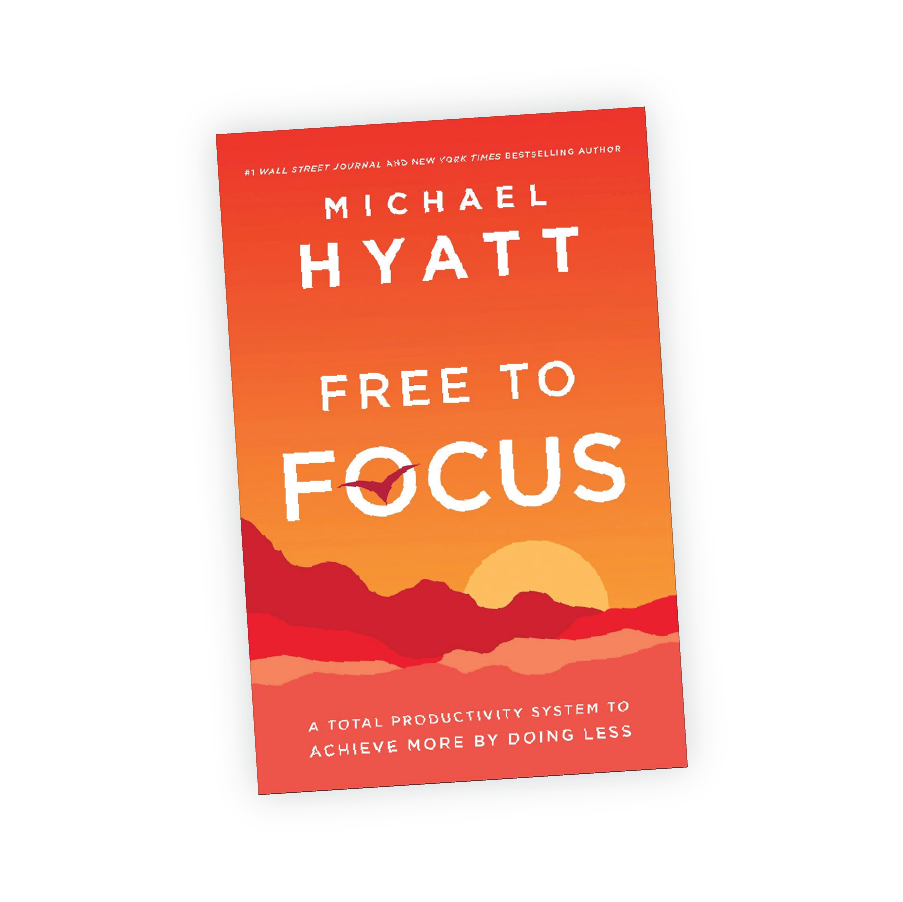
Number of Pages: 256
Estimated Read Time
Slow Reader: 13 Hour 54 Minutes
Average Reader: 6 Hour 54 Minutes
Fast Reader: 4 Hour 36 Minutes
Estimated Listen Time: 4 Hours 50 Minutes
Amazon Description
The revolutionary productivity system trusted by more than 25,000 professionals. Get more done and get your life back.
Many professionals work as many as 70 hours a week, leaving little time for rest, exercise, family, and friends. Work is invading their personal life. The common understanding of productivity has failed these professionals.
Most think productivity is just about getting more done at a faster speed. But it’s not. Productivity is about getting the right things done.
New York Times best-selling author Michael Hyatt has created a total productivity system that’s much more than endless box checking. Proven by more than 25,000 professionals, this system helps overwhelmed leaders achieve what matters most so they can succeed at both work and life.
In his latest audiobook, Free to Focus, you’ll discover how to:
Redefine your work so it works for you.
Filter your tasks and commitments .
Cut out the nonessentials .
Eliminate interruptions and distractions.
Set boundaries that protect your focus and drive results.
Leverage your time and energy for maximum productivity.
Build momentum for a lifetime of success .
In Free to Focus, you’ll learn the three-step system to achieve more while doing less.
Introduction
Stepping into Focus, page 11.
“What will your life have been, in the end, but the sum total of everything you spent it focusing on?” – Oliver Burkeman
Life in the Distracted Economy
Focusing on everything means focusing on nothing.
It’s almost impossible to accomplish anything significant when you’re racing through an endless litany of tasks and emergencies.
Nobel Prize-winning Economist, Herbert Simon, warned that the growth of information could become a burden. Why is this?
“Information consumes the attention of its recipients,” he explained, and “a wealth of information creates a poverty of attention.”
Information is no longer scarce. But attention is.
Collectively, we send over two hundred million emails every minute. Professionals start the day hundreds deep with hundreds more on the way. But don’t stop there. Toss in the data feeds, phone calls, texts, drop-in visits, instant messages, nonstop meetings, and surprise problems that flood our phones, computers, tablets, and workplaces.
Research shows that we get interrupted or distracted every three minutes on average.
Most of us just jam our day with the buss and grind of low-value activity. We don’t invest our time in big and important projects. Instead, we are tyrannized by tiny tasks.
As a result, we are failing to advance our organizations.
Formulate: Decide What You Want
Formulate: Decide What You Want, page 25.
We are overwhelmed with emails, texts, phone calls, reports, presentations, meetings, or deadlines – an endless conveyor belt full of new things to do, fix, or think about.
Therefore, we shove the extra tasks into our nights and fill our weekends with projects that we can’t finish during the workweek.
It all piles up on the assembly line in our minds, claiming our emotional and physical energy.
That’s what drives us to explore productivity tips and hacks – to find ways to shave a few minutes off each of the million tasks demanding our attention.
This is the wrong approach because it does not get to the underlying problem. To find the root issue, let’s finally stop and ask:
What do we want from our productivity?
What’s the purpose?
What are the objectives?
What do we truly want?
This chapter will help you formulate your own vision for productivity.
To get to the heart of the problem, we’ll explore three objectives.
Objective 1: Efficiency
There is an assumption that working faster is inherently better.
In reality, however, people try to work faster just so they can cram even more things into their already-packed day.
Most of us aren’t factory workers; we’re knowledge workers who are hired for our mental output rather than our physical labor.
The goal of manufacturing is to find ways to work faster. When you apply that to the knowledge economy, however, the work never seems to end. There’s always a new idea to consider or a problem to solve. When we do a good job and complete our work, we’re rewarded with – you guessed it – more work.
The important question is not, “Can I do this job faster, easier, or cheaper?” It’s, “Should I be doing this job at all?”
New technology solutions may enable us to work faster, but that efficiency brings with it the temptation and expectation to work more.
Objective 2: Success
If efficiency isn’t the best goal for our productivity efforts, what about increasing our success?
It seems reasonable to assume that improved productivity would lead to greater success, right?
The problem is, most of us have never stopped to define what success means.
With no clear destination, how will we ever know when we’ve arrived?
If our goal in increasing productivity is to achieve some vague notion of “success,” we aren’t doing it right.
Success is a powerful motivator – but only if you understand what success truly means to you.
Objective 3: Freedom
If productivity isn’t fundamentally about improving efficiency and increasing success, then what is the goal? Why should we even bother?
That brings us to the real objective, and Free to Focus’s underlying foundation: Productivity should free you to pursue what’s most important to you.
The goal, the true objective of productivity, should be freedom. I define freedom in four ways:
Freedom to Focus
If you want to master your schedule, increase your efficiency and output, and create more margin in your life for the things you care about, you’ve got to learn how to focus.
Focus is the ability to zero in and do the deep work that creates a significant impact. Focus produces work that moves the needle in a big way, solving real issues.
Exercise: Think back over the last couple of weeks. How much of your time were you free to focus – truly concentrate – on your work? This is time in which you were able to sit down and attack one task with absolute attention: no distractions, no calls or texts or emails.
This entire system is designed to bring you the time that you’ve been missing.
Freedom to Be Present
How many date nights have you spent thinking about, talking about, or worrying about work?
How often do you check your work email or messages when you’re out with your family or friends?
I’m not interested in efficiency which only gives me more time to work longer hours or success that drives me to work when I should be playing.
I’m after productivity, not efficiency, which means ensuring a significant margin that enables me to be fully present wherever I am.
Freedom to Be Spontaneous
So many of us have our lives meticulously planned out to the last minute, and we don’t tolerate any interruptions or deviations. That doesn’t sound like an enjoyable way to go through life.
Spontaneity only happens when we create margin in our life, and that is the byproduct of real productivity.
When you know that you have the most important tasks covered and prevent yourself from taking on more than you can comfortably handle, you’ll discover the freedom to be spontaneous.
Freedom to Do Nothing
Our “always on” culture undermines our productivity.
Americans usually feel guilty doing nothing.
Our brains aren’t designed to run nonstop.
Most of your breakthrough ideas in your business or personal life come when you’re relaxed enough to let your mind wander.
Creativity depends on times of disengagement. The implication of this means that doing nothing from time to time is a competitive advantage.
Getting the Right Things Done
The first action on the path to becoming freer to focus is clarifying your objective(s).
Productivity is not about getting more things done; it’s about getting the right things done.
That’s what this book is all about – to help you achieve more by doing less.
We want to cut away all the tasks that currently eat up your time that you are not passionate about, that are not important to you, and that, frankly, you’re not good at.
Amazing things happen when you start focusing primarily on what you do best and eliminate or delegate the rest.
We should design our lives first, and then tailor our work to meet our lifestyle objectives.
What’s Your Vision?
Why start by stopping to discuss our productivity vision?
Because jumping to tips, hacks, and apps won’t address the most basic issue.
We think we can solve our problems by moving to a new app or device, but we’re simply dragging our core productivity problems along with us.
Doing something different, something better, requires rethinking productivity.
My most productive coaching clients pursue the third objective: Freedom.
They have a specific vision for what that looks like in their lives.
They start with a picture of what they want their lives to look like before they try to fit their jobs into it.
The endgame is different for everyone, but I at least hope that you’re starting to formulate a vision for what fewer, more productive work hours could make possible.
Once you complete the following Productivity Vision exercise, you’ll be ready for the next chapter.
Exercise: Create Your Productivity Vision
Formulating a new vision for your life is going to require some serious thinking on your part.
You need to be able to picture it in your head and get crystal clear on what you want your life to look like and why it matters to you.
To get started, complete the Productivity Vision at FreeToFocus.com/tools.
Start by defining what your productivity ideal looks like.
Then, break it down into powerful, memorable words.
Finally, clarify the stakes by outlining exactly what you stand to gain if you achieve that vision and what you will lose if you don’t.
Evaluate: Determine Your Course
Evaluate: Determine Your Course, page 43.
In Chapter 1, you began to chart where you want to go.
Because you completed the Productivity Vision exercise, you have already developed a compelling vision for yourself.
Now that you know where you want to go, you need to figure out where you are right now.
For that, you are going to need a special kind of compass – the Freedom Compass.
The Freedom Compass is your productivity guide that will prevent you from heading off in the wrong direction.
It helps you evaluate tasks, activities, and opportunities based on two key criteria: passion and proficiency (you need both or your energy and performance will suffer).
By passion, I’m talking about the work you love, work that energizes you.
Proficiency means you’re not only skilled at something, you’re also generating results that other people can measure and reward.
Some people confuse aptitude with proficiency. Aptitude signals skills alone, while proficiency signals skills plus contribution.
Four Zones of Productivity
Let’s look at the mechanics of the Freedom Compass.
Picture a grid with Proficiency running across the x-axis and Passion running up the y-axis.
These two criteria will help you identify and understand the four different zones that you normally operate in:
Zone 4: The Drudgery Zone
The Drudgery Zone is made up of tasks for which you have no passion and no proficiency.
These are things that you hate doing and aren’t any good at anyway.
This is the worst kind of work for you to do.
It’s a grind.
Just keep in mind, though, that just because something falls into your Drudgery Zone doesn’t mean it falls into everyone’s Drudgery Zone.
Zone 3: The Disinterest Zone
The Disinterest Zone is made up of things that you’re proficient at, but not passionate about.
You can do these tasks – maybe better than anyone else in your office – but they drain your energy.
Most of us naturally avoid Drudgery Zone tasks, but we often get stuck in a rut of doing Disinterest Zone activities simply because we are good at them.
If we’re not careful, we can get stuck in the Disinterest Zone for years, maybe decades, simply because it’s what pays the bills.
Zone 2: The Distraction Zone
In this zone, life starts to get a lot more tolerable.
The Distraction Zone is made up of things that you are passionate about but have little proficiency for.
These activities aren’t draining your energy, but if you aren’t careful, they can be massive time-wasters.
The problem is that you aren’t proficient at them, which prevents you from making significant contributions in these areas.
Here’s the problem with the Distraction Zone: your passion can mask your lack of proficiency – but only to yourself.
Our proficiency is best seen by other people. This means that we may be the last to know that we’re wasting an enormous amount of time doing subpar work on something we enjoy.
Zone 1: The Desire Zone
The Desire Zone is the point where your passion and proficiency intersect.
It’s where you can unleash your unique gifts and abilities to make the most significant contributions to your business, family, community and maybe even world.
If your destination is freedom, this is where you’ll experience it.
The rest of the book will be focused on getting you into the Desire Zone and helping you stay there.
Zone X: The Development Zone
The Development Zone is a fifth zone with no fixed place on the grid.
It’s how to gauge work that is outside your Desire Zone but moving toward it.
Maybe you’re high-proficiency/low-passion, but you’re developing passion.
Or, you’re low-proficiency/high-passion, but you’re building proficiency.
Many of the tasks in your Desire Zone today may have started in your Development Zone and migrated there over time.
Research has shown that practice and eventual mastery can influence the joy we feel in a task.
Finding Your True North
The Freedom Compass is simply the passion-and-proficiency grid rotated so the Desire Zone occupies the top position.
Zone 1 is now True North.
As a navigation compass can save your life if lost in the wilderness, the Freedom Compass can guide you through the jungle of meaningless, unproductive work.
True productivity is about doing more of what is in your Desire Zone and less of everything else.
The more time you spend in your Desire Zone, the more good you do not only for yourself but also for the world around you.
Limiting Beliefs, Liberating Truths
The biggest obstacle in our efforts to become productive may be our mindset.
Our limiting beliefs limit our potential by establishing false, constricting boundaries that prevent us from accomplishing bigger and better things.
The Seven Limiting Beliefs that impact our efforts to become more productive are:
“I just don’t have enough time.”
The most common limiting belief.
It’s a universal truth: we all feel too busy.
Liberating Truth: I have all the time I need to accomplish what matters most.
“I’m not that disciplined.”
We reserve the word discipline for those things that we don’t want to do.
If you design your life so that you spend most of your time working on things that you are passionate about and proficient at, the discipline to do those things comes easily.
Liberating Truth: Working in my Desire Zone doesn’t require much discipline.
“I’m not really in control of my time.”
Not everyone is a CEO, self-employed, or even management.
You are not a passive object floating through life, completely at the mercy of outside forces.
Pockets of time may be under someone else’s control, but you still have control over the rest.
Liberating Truth: I have the ability to make better use of the time I do control.
“Highly productive people are just born that way.”
When we say this we are trying to let ourselves off the hook.
These highly productive people were not born with these abilities.
They simply found ways to develop their own potential – and you can too.
Liberating Truth: Productivity is a skill I can develop.
“I tried before, and it didn’t work.”
This is not something high-achievers say.
High-achievers never given up because one solution failed.
They keep looking for what will work, and they don’t stop until they find it.
Liberating Truth: I can get better results by trying a different approach.
“My circumstances won’t allow it right now, but they’re only temporary.”
This is the deadliest of all limiting beliefs.
Though this belief seems reasonable and hopeful for the future, it can wreck any chance you have of ever becoming more productive.
What is temporary will eventually become permanent unless you change something now.
These busy seasons keep redrawing the boundary lines around our time, and things will never go “back to normal.”
Liberating Truth: I don’t have to wait until my circumstances change to get started and make progress.
“I’m not good with technology or complicated systems.”
Liberating Truth: True productivity doesn’t require complex technology or systems. It’s more about aligning my daily activities with my priorities, and I can do that.
Exercise: Free to Focus Task Filter
Use the Task Filter and Freedom Compass worksheet at FreeToFocus.com/tools.
List your regular tasks and activities on the Task Filter.
Evaluate each item on your list by passion and proficiency.
Then use that insight to determine which zone each task belongs (ignore the Eliminate, Automate, and Delegate columns for now).
Once you’ve categorized your tasks, take an extra minute to transfer them to your Freedom Compass, listing each task in the appropriate zone.
Post your completed Freedom Compass where you’ll see it often and use it as a reminder to focus on Desire Zone activities as much as possible.
Rejuvenate: Reenergize Your Mind and Body
Rejuvenate: Reenergize Your Mind and Body, page 65.
The Rule of Fifty
Jack Nevison, the founder of New Leaf Project Management, crunched the numbers from several different studies on long work hours and found that there’s a ceiling to the number of productive work hours someone can work in a given week.
Push past fifty hours of work in a week and there’s no productivity gain for the extra time. In fact, it goes backward.
The more you work beyond a fifty-hour threshold, according to his research, the less productive you become.
Productivity Myth
Energy is fixed, but time can flex. You can get a consistent return on your effort while expanding your hours.
Said differently, you are just as smart, strong, and engaged at 100 hours as you are at 50 hours.
In reality, however, time is fixed, but energy can flex.
Every day contains the same number of hours, while your energy swings up and down depending on multiple variables, including rest, nutrition, and emotional health.
Personal energy is a renewable resource, replenished by seven basic practices.
Seven Basic Energy Renewal Practices
Practice 1: Sleep
Nightly rejuvenation is the foundation of productivity.
Sufficient sleep keeps us mentally sharp and improves our ability to remember, learn, and grow.
It refreshes our emotional state, reduces stress, and recharges our bodies.
Going without sleep makes it harder to stay focused, solve problems, make good decisions, or even play nice with others.
Sleep-deprived people come up with fewer original ideas and tend to stick with old strategies that may not continue to be effective.
Rejuvenating comes down to two things: quantity and quality:
Adults require seven to ten hours of sleep a night to perform at their peak.
You can also increase the quantity of sleep by adding a short 20-30 minute nap to your daily schedule.
As for quality, there are several ways to improve that as well:
Turn off all screens one hour before bed.
Blackout shades.
Lower the room temperature.
Use white noise.
Practice 2: Eat
The food we eat makes an immediate, long-lasting, and powerful impact on our energy levels.
Just one in five employees get away from the desk for lunch.
40% of workers and managers eat lunch “only from time to time” or “seldom, if ever.”
Eating a healthy lunch can pay big dividends in expanding our energy.
Leaving our desks for lunch also pays creative dividends. “Creativity and innovation happen when people change their environment, and especially when they expose themselves to nature-like environments.”
Staying inside, in the same location, is detrimental to the creative process.
Missing lunch means you’re sacrificing breakthrough moments that could take your organization to the next level.
Practice 3: Move
Too often we tell ourselves we don’t have enough energy to exercise, but exercise itself is an energizer.
Few things have as direct an impact on our energy levels as a decent workout.
If you get moving early, it will pay huge dividends all day long.
A single workout can immediately boost higher-order thinking skills, making you more productive and efficient as you slog through your workday.
According to Harvard Business Review, “New research demonstrates a clear relationship between physical activity that is planned, structured, repetitive, and purposive and one’s ability to manage the intersection between work and home.”
Exercise reduces stress, and lower stress makes the time spent in either realm more productive and more enjoyable.
Exercise creates a greater sense of self-efficacy, the confidence we have in our ability to get things done.
Maintaining an exercise regimen despite often-overwhelming demands on your time forces you to sharpen your self-discipline and increase your capacity for self-sacrifice.
An exercise regimen also helps you hone your efficiency, dedication, planning, and focus to juggle competing interests and opportunities.
Practice 4: Connect
We can’t talk about managing energy without talking about the effect that other people have on our energy level.
The people around us have the power to dramatically boost or drain our energy faster than almost anything else.
You can get plenty of sleep, eat a healthy diet, and work out every day, but if you’re keeping yourself locked away from other people, not taking the time to invest in quality relationships – or worse, hanging out with energy vampires – you’re missing out on one of the most powerful energizers of all.
Managing your social energy sources goes beyond your organization to include your full social circle. You’re coworkers, colleagues, customers, and clients all play a part in your energy management.
Consider taking a Social Audit where you ask yourself, “Am I surrounding myself with energy producers or energy drains?”
Even if circumstances force you into a relationship with negative people, recognizing their effect can prevent the worst of it from rubbing off.
Practice 5: Play
You know the old saying, “All work and no play makes Jack a dull boy?” It also makes Jack ineffective, uncreative, unfocused, and unproductive.
Never discount the power of play in your life, no matter how many other serious things demand your time.
You’ll always have problems to solve, deadlines to hit, and tasks to finish.
How do I define Play? It’s activity for its own sake, for fun, for connection with others, or for expressing your own creativity.
When you’re not working toward something, you’re free to be inefficient, which means you can step back and experiment, try new things, and imagine the world differently than it appears to be.
Play nurtures a supple mind, a willingness to think in new categories, and an ability to make unexpected associations.
The spirit of play not only encourages problem-solving but fosters originality and clarity.
Taking a break from the busyness of life to engage with nature, even for a few minutes, can bring positive effects on our mental stamina and our cognitive performance.
The time [in nature] doesn’t have to be long. Short “micro-breaks” with nature have discernable benefits for our minds. But long, immersive stretches in nature offer big benefits for our creativity and problem-solving skills.
Nature is a stress killer, which offers a cascade of other benefits, including:
Rejuvenated physical activity
Reduced anxiety
Reduced muscle tension
Decreased stress hormones
Lower heart rates
Decreased blood pressure
Many of these benefits rebound our mental health, forming a virtuous circle.
We’re hardwired to spend time playing, relaxing, and resting, especially in natural environments.
If you want to stay sharp, you need regular injections of recreation, exercise, and outright play into your busy schedule.
Practice 6: Reflect
Rejuvenation could take many forms, but most often it’s something like reading, journaling, introspection, meditation, prayer, or worship.
We need to spend time intentionally rejuvenating our minds and hearts.
It’s easy for busy people like us to rush through life at warp speed, taking action and making decisions without ever stopping to figure out where we’re going, who we’re affecting, and what all these actions and decisions are adding up to.
It’s possible to skip along the surface of life and never go deeper.
We’ll never fully rejuvenate unless we slow down and contemplate our life and the way we move through the world.
Strive to make time for reflection every day
What ideas really matter to you?
What are you feeling?
Reflect on recent decisions you’ve made.
Reflect on recent wins, losses, ideas, and insights.
Reflect on what made this day unique and special.
Daily reflection ensures you’re connected to a bigger “Why” and that you don’t get lost in the minutiae of life.
Staying firmly connected to your “Why” will give you the energy and strength you need to complete your work and finish the race – every day.
Practice 7: Unplug
Next to getting ample sleep, unplugging might be the most challenging of the seven practices.
Since unplugging is a struggle for so many, I recommend creating several rules to help you disconnect during nights, weekends, and vacations.
Here are four I use, but feel free to create your own and share them with anyone who will help you implement them:
Don’t think about work.
Put it out of your mind.
Be both physically and mentally present.
Be mindful of worry creep.
Don’t do any work.
This includes staying in touch and up to date.
Set your technology to “Do Not Disturb.”
“Hide” your technology from yourself.
Don’t talk about work.
Avoid spending downtime discussing work-related items.
Encourage people to call foul when you drift into work speak.
Don’t read about work.
This includes work-related books, magazines, blogs, podcasts, and videos.
Cultivate other interests and use your free time to develop passions that aren’t work-related.
Exercise: Rejuvenation Self-Assessment
Download a copy of the Rejuvenate Self-Assessment from FreeToFocus.com/tools.
Rank yourself according to assessment questions and tally your score.
This tool will identify specific areas that may need more urgent attention.
Retake the assessment after a few months to see how you’re improving and what areas still need attention.
Next, download a copy of the Rejuvenation Jumpstart.
Reflect on a goal for each of the seven practices.
Pick two goals you want to focus on in the next month.
Keep your goals in front of you (Note on the mirror, time on the calendar, the background of your phone, etc.).
Eliminate: Flex Your “No” Muscle
Eliminate: Flex Your “No” Muscle, page 91.
Between work, family, social activities, church/community, and a million other types of commitments, we freely give up our precious energy to practically anyone who asks.
We know we can’t say yes to everyone, but we still take on far more than we should.
Why do we do this to ourselves?
For many, it’s a lack of courage.
We may hate conflict, feel guilty about disappointing people, or worry about missing out on new opportunities.
Get Comfortable Saying “No”
The trick is to remember what is at stake.
You’ve already done the work to figure out your “Why.” Now you must keep your why in front of you at all times.
This doesn’t mean simply saying no to a lot of bad ideas; it also means turning down a ton of good and worthwhile ideas.
Staying overworked and overcommitted is easy. The hard work comes in saying no to requests that aren’t important and eliminating unimportant tasks that are eating up your time and energy.
Some people like to focus on their to-do list. I’d rather focus our energy on the road less traveled: the “Not-to-Do” List.
Understanding Time Dynamics
Time is a zero-sum game. There’s only so much to go around.
If time, and therefore your calendar, is a zero-sum game, we must realize saying yes to one thing means saying no to something else.
Even if we hate saying no, we must understand that every yes inherently contains a no.
Eventually, all of our little yesses and nos add up and we find ourselves with a packed schedule.
We get to the point where we can’t add one more thing without eliminating something else.
That means we must make choices, and these choices are often not between something good and something bad, but between competing opportunities that are good, better, and best.
Acknowledging Trade-Offs
Yes and no are the two most powerful words in productivity.
We must realize there is a trade-off baked into each one. Every time we say yes to one thing, we’re saying no to something else.
Start thinking about the trade-offs you’re making when you’re confronted with an opportunity.
Count the cost of saying yes by answering some tough questions:
What will I have to give up by saying yes to this opportunity?
Will saying no to this allow me to say yes to something better?
Filter Your Commitments
When examining trade-offs in our commitment decisions, we need a filter, something that will enable us to process an invitation, request, or opportunity and determine whether we should say yes or no.
Like a real compass, your Freedom Compass (Ch. 2) will point you in the right direction. It will remind you of your true north, your Desire Zone, whenever you get lost or start veering off in the wrong direction.
Everything outside your Desire Zone is a possible candidate for elimination.
True productivity isn’t about squeezing more things into your packed schedule, it’s about doing the right things. By cutting away the nonessentials, you create space for the important things.
Create a Not-to-Do List
The biggest obstacle is your mindset.
People focus on what they might lose, not what they’ll gain.
Too often, we operate with a scarcity mentality that drives us to hold on to things we should abandon simply because we’re afraid of another opportunity.
There are always more opportunities to be had, and we can’t let the fear of missing out lead us into overextension.
So, don’t be afraid to grab a chisel and get to work. You’ll never truly thrive as long as you’re carrying around the dead weight of your Drudgery, Disinterest, and Distraction Zones.
Saying No to New Requests
Get comfortable saying no a lot.
Learning how to say no is a critical piece of your productivity puzzle.
“No” is rarely a popular response, but that doesn’t mean it must be rude, undignified, or ungraceful.
There are two common situations where you’ll need to decline graciously:
New requests you haven’t answered yet. Those are easier.
Things you’ve already committed to that you now know are outside of your Desire Zone.
No matter how great your productivity system is, nothing can prevent people from making new requests of you.
In fact, as you become more productive and efficient, you may develop a reputation for being the go-to person.
That’s why you must develop a bullet-proof strategy for gracefully saying no to new requests that are outside your Desire Zone.
5 tips for a tactful “No”
Acknowledge that your resources are finite
To avoid total burnout, begin to budget your time and energy much like you’d budget your finances.
Whether it’s time or money, careful budgeters go into the month with a plan for where every dollar will go.
You need to budget for your high-priority items first.
Determine who needs access to you and who doesn’t
While an open-door policy sounds like a good idea in theory, in practice, it can ensure that you never get your own work done.
Being a good leader doesn’t mean jumping whenever someone calls. It instead means focusing on your most important priorities while having systems in place to make sure everything else gets done without you.
If you are the go-to person for every project and problem, your system is fundamentally broken.
Let your calendar say no for you
One of the best ways to say no is to blame your calendar.
You can do this through what’s called time blocking, and it requires a little intentionality on the front end.
Block chunks of time off for specific high-priority activities.
These blocks appear to others as meetings, because they are. You are scheduling meetings with yourself.
When a request comes in that doesn’t fit your criteria and interrupts your scheduled activities, simply say you have another commitment – which is absolutely true.
Do this even when you are in your office by yourself working on high-priority tasks you have assigned yourself or have accepted from others.
Adopt a strategy for responding to requests
The best time to plan how to respond to a request is before that request ever hits your desk.
Adopt a strategy in advance, which will make it much easier to follow through in the moment.
In his book, The Power of a Positive No, Harvard professor William Ury outlines four strategies for dealing with demands on our time:
Accommodation
We say yes, although we really want to say no.
This happens often when we value the relationship with the person making the request more than we value our own interests.
Attack
This is where we say no poorly.
Here we value our own interests more than we value the importance of the relationship with the other person.
Our response to the request is often an overreaction born out of irritation, resentment, fear, or pressure.
Avoidance
We simply ignore the request altogether or wait a long time before we respond, hoping the situation will resolve itself without us having to get involved.
This usually happens because we’re afraid of offending the other party, but we do not want to do what they’re asking.
We ignore the problem and hope it goes away. Sadly, it rarely does.
Affirmation
This is the response that works, usually creating a win-win for everyone without causing us to sacrifice either the relationship or our own priorities.
This healthy response is what Ury calls a “positive no,” and it’s built around a simple formula with three parts: yes-no-yes. It works like this:
Yes.
Say yes to yourself to protect what is important to you.
Include affirming the other person. You don’t want to shame others for thinking of you as a possible solution to their problem.
No.
The answer continues with a matter-of-fact no that is clear and sets boundaries.
Do not leave any wiggle room or ambiguity, and do not leave open the possibility that you might be able to do it another time.
Yes.
End the response by affirming the relationship again and by offering another solution to the person’s request.
Accept the fact that you’ll be misunderstood
It is important to prepare yourself for negative responses.
Sometimes people will express their disappointment with you directly. When that happens, I politely reply by expressing empathy, but also by restating my no.
Disappointing some people in life is inevitable, so make sure you’re not disappointing the ones who matter most.
Getting Out of Existing Commitments
Chances are, you had a long list of existing commitments before you picked up this book, and now you’re scratching your head wondering what to do with those things that fall outside your Desire Zone.
Let me be clear here: people of integrity keep their word.
If you’ve already committed to doing something, even if it doesn’t fit into your new framework, you should find a way to honor your commitment.
That said, there is nothing wrong with attempting to negotiate out of the commitment.
Four Tips for Negotiating Out of an Existing Commitment:
Take responsibility for making the commitment.
Reaffirm your willingness to honor your commitment.
Explain why honoring your commitment is not the best outcome for the other party.
Offer to help solve the problem with them.
Do not shift the burden off your back by dumping it onto theirs. Instead, offer to help find an alternative solution.
Celebrate the Pruning Process
The whole point of this chapter has been to get you comfortable cutting as many things as possible from your calendar.
The process of elimination may leave you in an unexpected predicament: you might end up feeling guilty about the time you’re freeing up. This is a trap!
If cutting out unnecessary, or undesirable tasks leaves you with free time or margin, that is something you should celebrate!
Don’t give into the pressure of finding a thousand other things to replace the ones you said no to.
You aren’t making a one-to-one swap as you strike things off your list.
The goal of productivity should be achieving more by doing less. You won’t get there if you can’t get comfortable doing less.
Your best actions and best thinking come when you’re well-rested and you’ve given yourself the befit of free time.
Exercise: Build Your Own Not-To-Do List
Start with your Task Filter worksheet and mark obvious candidates for elimination.
Download and use the Not-to-Do List from FreetoFocus.com/tools.
Use the worksheet to record the tasks you should never do.
List other meetings, relationships, and opportunities you should never pursue.
Automate: Subtract Yourself from the Equation
Automate: Subtract Yourself from the Equation, page 114.
If you’re like most professionals in the modern world, your days are filled with a million demands and distractions.
Our attention is both finite and valuable.
We can never give any person or thing our full attention, and sometimes we can’t give them any.
If you want to maximize productivity, you must identify exactly what does and does not require your attention.
If something does deserve your attention, you must figure out how much of your attention it deserves.
If something is not in your Desire Zone or one of your high-priority tasks, it doesn’t deserve much of your brain power.
One method of taking care of critical tasks with little investment of attention is automation.
Four main types of Automation:
Self-automation
Template Automation
Process Automation
Tech Automation
Self-Automation
This involves implementing routines, rituals, and habits to make it easier and more efficient for you to follow through on your highest priorities.
Understanding Rituals
A ritual is any practice or pattern of behavior regularly performed in a set manner.
Rituals offer three key benefits:
Rituals liberate creativity
The goal is to avoid reinventing the wheel every time.
Instead, focus your creative energy on something once, put a system in place, and then you are free to focus your creativity on other things.
Rituals speed up your work
Once you design a ritual, you know exactly what comes next at every step.
You simply don’t have to stop and think as much, making you much more efficient.
Rituals correct your mistakes
Designing rituals allows you to anticipate different points of failure and build safety nets for each step of the process.
Four Foundational Rituals
Morning
Starts the moment you wake up and carries you into the office each morning.
Everyone’s morning and evening rituals will be different.
Workday Startup
Marked on your calendar.
The first 5 things you need to do every day to get the day off to a good start.
The list and order of activities will vary by person, but look something like this:
Empty email inbox.
Answer urgent correspondence.
Preview key daily tasks.
Review Big Three (See Chapter 8).
Preview day’s schedule.
Workday Shutdown
Marked on your calendar.
The list and order of activities will vary by person, but look something like this:
Empty email inbox.
Answer urgent correspondence.
Review progress on key daily tasks.
Review progress on Big Three.
Set tomorrow’s key daily tasks.
Preview tomorrow’s schedule.
Evening
Similar to the morning ritual, except that it helps you wind down and get ready for sleep
Template Automation
For common requests, spend a little time crafting the perfect response, and use that response over and over again.
Automation means solving a problem once, then putting the solution on autopilot.
To make templates work, you have to develop a template mindset. Every time you work on a project, ask yourself, “What components of this project will I use again?”
Even though it takes a little extra effort on the front end, it will save you an enormous amount of time overall.
The most common type of templates I use in my everyday work are email templates.
An email template doesn’t have to be cold and impersonal, quite the opposite. Each email template is a thoughtful, personal response to the question and requests my team is most likely to receive on any given day.
To get started, go back through your old emails and find ones that could be crafted into a template.
Process Automation
A written, easy-to-follow set of instructions for performing a job or sequence.
In most cases, each step of the process is carefully detailed and written, ensuring anyone who can follow directions can successfully accomplish the goal.
Here are five steps to wrangling those annoying, common tasks into one killer process:
Notice
The first step in creating a workflow is to pay attention to what you’re already doing each week and identify areas where a workflow could help.
Ask yourself:
What actions are key to your business?
Which are repetitive by nature?
What tasks do you always have to teach someone before you leave town?
What questions have others called to ask you while you were out of the office?
What tasks have caused projects to stall because you weren’t personally available?
What are the rhythms of our business and obvious pain points that need documentation?
For your first workflow, start with something simple.
Once you’ve picked a simple process to start with, think through the entire procedure from start to finish. Visualize everything.
Document
Once you know the process you need and you’ve thought through each part, it’s time to write it down.
Be sure to capture every step required to complete the task.
Your goal is to document every little thing on paper so someone who knows nothing about the process could execute it flawlessly.
You can document a workflow in many different ways, and it’s a good idea to experiment with different formats and tools until you find the ones that work best for you.
Optimize
If you didn’t cut corners or leave anything out in your documentation, the first draft of your workflow is probably wordier than you’d like.
Review what you’ve written down and ask yourself three questions:
Which of these steps can be eliminated?
Which of these steps can be simplified?
Which of these steps should be done in a different order?
You want to give the person following this workflow as much information as they need to do the job, but not so much that they’ll skip steps simply because the workflow is too wordy.
Test
This step is critical. This is where most failed workflows break down.
The workflow didn’t work because the person creating it didn’t take the time to test it properly.
Be your own guinea pig. Test exactly what you wrote down. Don’t cheat!
Make notes as you go, correcting the workflow until you have a perfect, functioning process document.
lastly, ask someone on your team to test the workflow.
Share
Once you know the process document works, it’s time to share it and make sure anyone who might need it someday knows where to find it.
Don’t be surprised if the people using the workflow find gaps.
Encourage them to make additional refinements.
Tech Automation
Automation is at the heart of why we use technology to begin with; we want to offload the heavy lifting and repetitive tasks to a piece of software, thereby freeing our minds to tackle other challenges.
One quick warning: don’t get married to a particular app.
Technology can be counted on, but individual tools cannot.
Focus on the type of tool you need more than which tool you use.
Four main types of apps can send your productivity soaring:
Email Filtering Software
Good email filtering software helps manage your inbox by automatically sorting through all your messages and filing them into folders based on criteria you set.
This keeps them nicely organized from the start rather than adding them to the bottomless pit of a typical inbox.
Most common email services, such as Gmail, Outlook, and Apple Mail, have some filtering functionality built-in.
Macro-Processing Software
This is software that allows you to batch several small actions into a sequence.
Text-Expansion Software
This is a service that turns small, defined snippets of text into longer and more complex text.
For example, “;mhco” inserts “Michael Hyatt and Company.”
Screencast Utilities
Screencast utilities record what’s happening on your computer or tablet screen and save it as a video file you can edit and share with others.
This type of software is a key piece of my process workflows.
Exercise: Streamline Your Tasks
First, download the Daily Rituals worksheet at FreeToFocus.com/tools.
Using the template, design your own four foundational rituals.
Total the times of each activity to see how long it will take to execute your rituals.
Next, go back to your Task Filter worksheet, mark candidates for automation, and pick one to tackle today.
Lastly, download and complete the Workflow Optimizer at FreeToFocus.com/tools.
Delegate: Clone Yourself – or Better
Delegate: Clone Yourself – or Better, page 137.
“I purposed to never do anything that others could or would do when there was so much of importance to be done that others could or would not do.” – Dawson Trotman
Researchers use the term “Time Famine” to describe the feeling of having more tasks than time.
Researchers at Harvard Business School found the trick to overcoming time famine and improving feelings of well-being and life satisfaction was simple – buy more time.
How’s that possible?
After you’ve eliminated and automated as much as possible, you’re left with a shorter list of critical tasks that must be done by someone.
The question is, does that someone have to be you?
You can’t buy happiness, but you can buy back your time by offloading tasks you deem stressful or unlikable.
Researchers found that “spending money to buy time” was linked to greater life satisfaction.
Wait, Wait, Hold On…
Delegation means focusing primarily on the work only you can do by transferring everything else to others who are more passionate about the work or more proficient in the tasks.
Sometimes this is hard for high achievers. Especially if you’re cursed with being halfway decent at wearing all the hats in your business. I say “cursed” because this is not a compliment. Would you ever knowingly hire someone only halfway decent?
Delegation does require us to slow down long enough to get a new person up to speed. But in the long run, training and trusting others frees up time in our Desire Zone. It’s like buying time!
The hours you spend on Desire Zone tasks will always be more profitable than the time you’re wasting anywhere else, so the cost of delegation pays for itself – and then some.
The most depressing excuse for not delegating is, “I’ve tried delegation, and it didn’t work.”
Everything good in our lives is the result of extensive, exhaustive trial and error.
If you’re letting one or two failures keep you from implementing a major productivity solution, you’ve got bigger problems than an out-of-control to-do list.
The Delegation Hierarchy
Run through your Freedom Compass in reverse order, looking for key Desire Zone activities that only you can and should be doing.
The remaining activities are all candidates for Delegation.
The Delegation Process
Many people think delegation is simply a matter of handing someone a task and some instructions. Not usually.
Delegation is a process and requires an investment of your time.
Your goal is to develop passionate, proficient team members whom you can trust with the most delicate tasks, and this will happen only when you walk them through a trust-and-skill-building process:
Decide what to delegate
Start with the tasks in your Drudgery Zone.
Next move to the tasks in your Disinterest and Distraction Zones.
Select the best person
Try to find someone with passion and proficiency for the task (their Desire Zone).
To become a master delegator, you must develop the patience and attentiveness to match the task to the person.
Communicate the workflow
If you have a documented workflow, show them how to use it.
If you don’t have a documented workflow (yet), walk through what you need to be done and the outcome you’d like to see.
Depending on the person you chose and the complexity of the task, you may let them try to document the workflow themselves.
Provide the necessary resources
Carefully think through every step of the process and make sure that you are handing off everything they’ll need to win (logins, software, keys, tools, authorization, etc.).
Specify the delegation level
Clearly communicate your expectations, beyond simply relaying the step-by-step tactical instructions.
Be clear about what level of authority you are giving them.
Give them room to operate
This is where delegation breaks down for a surprising number of people.
Sometimes we can’t make the emotional leap that enables us to get out of the other person’s way.
Be careful, this is where micromanagers are born.
Check-in and provide feedback as needed
While you don’t want to micromanage, it’s a mistake to think you’re completely out of the process once you hand the task to someone else.
Delegation is not abdication. The outcome is still your responsibility.
The Five Levels of Delegation
Level 1
When you want the person to do exactly what you’ve asked them to do – no more, no less.
You have already researched the options and determined what needs to be done.
This level is perfect for new hires, entry-level positions, contractors, or virtual assistants.
Level 2
This is where you want a person to examine or research a topic and report back to you on their findings. That’s it.
Clarify what you mean by research: Google, online survey, call customers, solicit bids from vendors, etc.
Have a conversation to discuss their findings.
You make the decision.
Level 3
Starting with #3, you’re giving the person more room to operate and participate in the problem-solving process, but you’re still reserving the final decision for yourself.
Have the other person research the topic, outline the options (with Pros and Cons), and then make a recommendation.
They shouldn’t expect you to agree with their decision without first giving you the chance to see inside their thought process and explain why they made the decision they did.
If you agree with their decision, give the final approval and authorize them to move forward.
This is a great option for delegating to future leaders you’re mentoring because it gives you a safe opportunity to judge their decision-making skills without any risk.
This is the level where you start to outsource your decision-making. You can make a well-informed decision on a complex topic in one simple meeting. What may have taken you a full week can now be knocked out in an hour.
Level 4
At Level 4 you want the person to evaluate the options, make a decision on their own, execute the decision, and then give you an update after the fact.
Sometimes you might want them to keep you apprised of their progress.
Keeping you informed is not about second-guessing their decision, but about keeping you aware and providing you insight into the quality of their decisions, which is good to know for future delegation.
If requesting progress updates along the way, be specific about how often and through what channel you would like your updates.
Level 4 is great for growing leaders, assignments that aren’t mission-critical, and assignments where you don’t have a strong preference regarding the outcome.
Level 5
Level 5 is perfect for when you have complete confidence in the person to whom you’re delegating.
Level 5 is also perfect for assignments that need to be handled but you really don’t care how it’s resolved.
Next Steps
I suggest implementing the Five Levels of Delegation by walking your entire team through the five levels and explaining how you’re going to approach delegation from now on.
Incorporate the level by name into your company’s vocabulary.
All of this will create a much safer, clearer environment in which everyone knows what responsibility they have in a delegation situation.
Buy Back Your Time
People often don’t delegate because they think it’s faster or easier to do the job themselves.
They’re right. It is easier to do a single task one time than it is to teach someone else how to do it and walk them through the delegation process and levels.
But the thing is, most tasks are not one-time occasions.
Time is fixed, but you can buy more. And you’ll simply never become free to focus on the things that really matter – your top priorities, key relationships, your most important projects – until you learn how and why to delegate.
Exercise: Project Vision Caster
It’s time to finish the Task Filter worksheet you’ve been working on.
By now you’ve listed and categorized your daily tasks and marked which you can eliminate and automate.
Now, what can you delegate?
First, pick at least one task to delegate today.
Next, download the Project Vision Caster at FreeToFocus.com/tools.
The Project Vision Caster will help you translate your vision for a project or task to paper so your team can see it clearly and execute it with excellence.
Use the Project Vision Caster to prepare a team member for the responsibility, and carefully choose a Delegation Level that is appropriate.
Hand it off.
Consolidate: Plan Your Ideal Week
Consolidate: Plan Your Ideal Week, page 161.
The human brain cannot multi-task. Switching from task to task comes at a heavy cost.
Your attention doesn’t immediately follow one task to the next – a residue of your attention remains stuck thinking about the original task.
One study found workers average twenty-five minutes to resume a task after an interruption.
By breaking our focus, switching also slows our processing ability.
If you multiply the impact of attention residue and irrelevant activity over an entire day of interruptions, the costs add up.
We stay busy, but we lose ground on the few things that matter most.
The solution is to design our work to focus on just one thing at a time.
The Power of MegaBatching
Most of us have heard of batching. It’s the process of lumping similar tasks together and doing them in a dedicated block of time.
Some examples of MegaBatching:
Set aside time each morning and afternoon to empty all your inboxes.
Save a week’s worth of proposals or reports to review all at once.
Record a whole series of podcasts or training videos over a couple days.
Batching is one of the best ways I know to stay focused and blast through tasks.
Megabatching works with meetings too.
Try to batch as many meetings as possible into the fewest number of days.
This leaves more days open for intense, focused work without having to stop what you’re doing to run off to someone else’s meeting.
Cal Newport argues that we need extended periods of uninterrupted time to do our best thinking. This is what he calls Deep Work.
You can also MegaBatch collaborative time with your teams.
Team MegaBatching allows teams to stick with challenges long enough to get the breakthroughs they need to deliver results.
Planning Your Ideal Week
It’s time to harness the power of MegaBatching with a tool called the Ideal Week.
The Ideal Week allows you to schedule your time the way that you want to spend it.
“Plans are worthless, but planning is everything.” – Dwight Eisenhower
A plan might not survive the first engagement with the enemy, but having planned, you’ll be better able to recover and find your footing.
The premise behind the Ideal Week is that you can either live on purpose (proactive), according to a plan you set. Or you can live by accident (reactive), responding to the demands of others.
It is a whole lot easier to accomplish what matters most when you are proactive and begin with the end in mind.
The Ideal Week is like a financial budget. The only difference is that you plan how you will spend your time rather than your money.
How to Build Your Ideal Week
Start with an empty calendar for each day of the week. A blank slate.
Next, decide which days of the week will be Front Stage (Customer Facing, aka what you were hired to do), and which days will be Backstage (internal meetings, planning, organizing, email, research, learning and development).
Next, indicate what types of activities (self, work, rejuvenation, etc.) you’ll do on individual days during certain blocks of time.
You can’t bring your best to the rest of the day unless you schedule time to refresh.
The point here is to give shape to your day, with hard starts and stops.
Once you’ve identified stages and themes, it’s time to group the individual activities that will fall into those themes.
I have found that the exact time and variance are immaterial if you’re intentional about batching as much as possible.
Resist the temptation to think you can go without breaks.
The last thing you do after drafting your Ideal Week is to selectively share it with team members, supportive supervisors, and others you are close to outside of work.
You’re going to need everyone’s input, buy-in, and cooperation to make it
A More Productive Rhythm
Keep in mind that your Ideal Week is just that – ideal.
It won’t happen every week. In fact, it won’t happen most weeks. When emergencies pop up, you’ll need to pivot.
The Ideal Week keeps you from getting disoriented in the process; you’ll know exactly how to get back on track because you already planned it.
Exercise: Plan Your Ideal Week
Download your Ideal Week template at FreeToFocus.com/tools.
Sketch out your Ideal Week before moving on.
Designate: Prioritize Your Tasks
Designate: Prioritize Your Tasks, page 183.
Just because something is important doesn’t mean that it is important right now.
The trick is to systematically decide what deserves your attention now, what deserves your attention later, and what doesn’t deserve your attention at all.
Design Your Week: The Weekly Preview
Leaders and professionals rarely have big initiatives that are accomplished in a single week.
Rather, we face complex projects that take several weeks, even months, to complete.
Despite our best efforts to stay focused over the long haul, it’s easy to let the beast get away.
The good news is that you can design your week to keep visibility on your major tasks and review your progress as you go.
The trick is to break down your major goals and initiatives into manageable next steps. Then you can map those steps onto your week.
The Weekly Preview consists of six steps that will enable you to keep track of all the tasks whizzing overhead and establish a sense of control over your time.
The best times I’ve found are Friday afternoon, Sunday evening, or Monday morning.
Be sure to schedule it as a recurring appointment on your calendar, starting with thirty minutes.
The process is an opportunity to get ahead of the chaos.
The Weekly Preview
Step 1: List Your Biggest Wins
Take a moment to reflect on your biggest wins from the past week. High achievers too often focus on their shortcomings.
Focusing on wins instead generates feelings of gratitude, excitement, and personal efficacy and sets you up to tackle big things in the coming week.
Step 2: Review the Prior Week
Perform a mini After-Action Review.
Carefully go through your prior week to recall any lessons you learned and adjustments you should make to see improvement in the near future. Ask yourself three questions:
How far did you get on your major tasks from the prior week (aka your Weekly Big 3)?
What worked and what didn’t?
Were there interruptions or distractions you hadn’t counted on?
What were they?
Who caused them?
Could you have avoided them?
What about your plan? Was it good? Did you budget your time well?
What will you keep, improve, start, or stop doing based on what you just identified?
The goal here is to note what strategies or tactics were effective and identify anything wrong so that you can upgrade your performance the next week.
People who can learn from their experiences to make positive changes in their behavior will advance quickly.
Step 3: Review Your Lists and Notes
Review your task lists and daily notes so that they don’t get out of hand.
I advise keeping your task lists in one place.
Make sure to review the tasks you’ve delegated to others.
Use your review time to take one of the four following actions:
Eliminate tasks that are no longer relevant.
Schedule tasks on your calendar that you will tackle later.
Prioritize tasks for the week, what I call your Weekly Big 3.
Defer tasks, keeping some on the back burner and considering them again during your next review.
Step 4: Check Goals, Projects, Events, Meetings, and Deadlines
Review any goals you are pursuing and reconnect with your key motivation.
Use this time to review key projects and deliverables.
Check your calendar for the coming week (or the next several). Ask:
Do I have any conflicts?
Do I need to cancel or reschedule anything?
Do I need to prepare for anything?
Can I delegate anything?
Step 5: Designate Your Weekly Big 3
It’s time to get proactive and establish your Weekly Big 3.
Your Weekly Big 3 are the three most important things you need to accomplish in the coming week to keep making progress toward your major goals and projects.
One helpful filter is the time-tested Eisenhower Priority Matrix popularized by Stephen Covey.
A simple grid divided into four quadrants in which the horizontal axis corresponds to urgency, the vertical to importance.
Quadrant 1 includes tasks that are both important and urgent. These should get the first claim to your time.
Quadrant 2 includes tasks that are important but not urgent. These tasks are often neglected.
Quadrant 3 includes tasks that are time sensitive and important to others, but not necessarily to you.
This is where many of us run around each week.
If you aren’t careful, you’ll allow other people’s priorities to supersede your own.
If you say yes, you are putting Quadrant 1 and/or 2 items at risk.
Quadrant 4 items are neither important nor urgent to you. These tasks should never make it to your calendar or task lists.
Question. Why do Quadrant 4 items keep making it to your calendar and task lists?
Confusion. We simply don’t stop to evaluate the activity or task.
Guilt. We feel like we should do it, even if we know it’s not our responsibility.
Fear of missing out. We’re scared of saying no.
If you want to be free to focus, you need to set a goal of spending 95 percent of your time on Quadrant 1 and Quadrant 2 activities.
Step 6: Plan Your Rejuvenation
Remember the seven practices of rejuvenation (Chapter 3): sleep, eat, move, connect, play, reflect, unplug.
Take time here to schedule them into your nights and weekends.
Design Your Day: Your Daily Big 3
Great days don’t just happen; they are caused.
I spent years going to the office each day with no real plan in place, simply reacting to whatever happened or filling my time with whatever meeting request or interruption popped up.
If that’s how you start each day, you are doomed to fail
Your plan can’t be to allow everyone else to steer your day or you’ll never get anything done that matters to you.
Most of our workdays are filled with two types of activities:
Meetings
Meetings represent nondiscretionary time.
You can cancel or excuse yourself, of course, but dropping out of meetings at the last minute will cost you relationship capital and put your reputation at risk.
That’s why it’s critical to cover these in your Weekly Preview.
Tasks
I always shoot for three, and only three, key tasks each day. I call these my Daily Big 3.
If you want to stop chronic overwork, make a change: prioritize three and only three tasks.
How do you choose your Daily Big 3?
To start with, refer to your Weekly Big 3. These are the top three outcomes you must achieve for the week.
These should first be tasks in your Desire Zone and other tasks that are in Quadrants 1 and 2 of the Priority Matrix. Try not to let Quadrant 3 tasks sneak in.
Listing only three tasks for an entire workday may seem like a cop-out, but it requires more discipline and effort than you realize.
It takes much more effort to look at the twelve things you could do and zero in on the three that really matter.
Fix the Bounds on Your Time
“It is not that we have a short time to live, but that we waste a lot of it. Life is long if you know how to use it.” -Seneca
“Men do not let anyone seize their estates, but they allow others to encroach on their lives – why, they themselves invite in those who take over their lives.” – Seneca
The difficulty is that time is amorphous, and the future doesn’t have fixed bounds.
The solution is to designate the what and when of our schedules, starting with the week and then the day.
The Weekly Preview, Weekly Big 3, and Daily Big 3 ensure we not only keep visibility on all the potential tasks we have, but they also set hard boundaries around our time.
This is a step toward defending your time against interruptions.
Exercise: Design Your Week and Day
Using the guidelines in this chapter, take the time right now for your first Weekly Preview, including your Weekly Big 3.
You can download a copy at FreeToFocus.com/tools.
Once you’re done, set a weekly recurring calendar appointment with yourself to conduct your Weekly Preview every week going forward.
Next, use your Weekly Big 3 and build your Daily Big 3. Identify the top 3 tasks you must accomplish today, and make sure you secure time to do them on your schedule.
Activate: Beat Interruptions and Distractions
Activate: Beat Interruptions and Distractions, page 205.
We live under a barrage of messages and inputs.
The trend towards open-concept offices and cubical farms has worsened this situation for some.
What we supposedly gain in collaboration and cost savings, we lose in concentration.
The Distraction Economy wants nothing more than to take our minds off what we need to do today.
Every ping that pulls our eyes away and every notification we take note of subtracts from our productive value and gives it to someone else.
Interruptions: Breaking In
Interruptions represent an external input that breaks your concentration. Often, they’re drop-in visits, phone calls, emails, or team messages that pull us away from the work we’re supposed to be doing.
These are more than mere annoyances. They’re cancers gnawing at meaningful work.
Two actions can help you create a virtual isolator to help you maximize your productivity:
Limit Instant Communication.
Proactively Set and Enforce Boundaries.
Limit Instant Communication
We have confused speed with importance.
This mistake has amplified the pace of our communication and the number of our interruptions.
You can’t delve into extended periods of meaningful work if you’re constantly shifting your focus when one of seventeen apps or devices alerts you about an incoming message, comment, tag, or desired action.
A study by Hewlett Packard and the University of London found that when we divert our attention to incoming calls and messages, it dings our IQ by 10 percent.
The only answer is to opt for delayed communication whenever possible.
Turning off notifications is a critical part of limiting instant communication.
By limiting your instant communication, you’ll experience less stress, more focus, and periods of deep work that will move the needle on your most important tasks and projects.
Proactively Set and Enforce Boundaries
By opting for delayed communication, you’re limiting others’ access to you.
The trick is to proactively set their expectations by letting them know.
Inform relevant people you’re going to be offline for a period to focus.
Don’t wait for them to come find you; tell them in advance. Proactively communicating about your availability puts you in charge.
An open-door policy sounds nice, but you’ll never get any meaningful work done.
Warning: people will not respect your boundaries if you don’t.
Distractions: Busting Out
While an interruption is an external force that demands our attention, a distraction is anything internal that disables or destroys concentration.
We are usually our own worst enemy.
When we are bored or when the work we’re doing is especially tough, we escape.
Every time we bounce off task, we train our brains to become even more distracted and shorten our attention spans.
We are our own disturbers more than 50% of the time.
We can blame all the noise and stimuli out there – or we can take the necessary responsibility to change our behavior by proactively fighting interruptions and distractions.
Focus Tactics
If we want to get free to focus, we need tactics to help us regain, retain, and ultimately retrain our focus.
You’re already getting enough sleep (chap. 3) and disengaging from instant communication. Both of those help. Here are some additional suggestions:
Use technology to manage technology.
Listen to the right music.
Optimize your current workspace for focus.
Declutter your workspace:
Refers to both physical and digital workspace.
When your environment is cluttered, the chaos restricts your ability to focus.
Clutter also limits your brain’s ability to process information as well as you do in an uncluttered, organized, and serene environment.
Increase your frustration tolerance:
The longer you can sit with the challenge of important, yet difficult, tasks – and the difficult emotions that come with them – the more effective you’ll be and the more likely you’ll be to finish your projects and achieve your goals.
The first step is to notice when the impulse to bail comes. If you notice it, you can choose to ignore it.
The more you choose to stick with the difficult task, the stronger your frustration tolerance will become.
You’re training yourself to focus.
How do you notice? Few things work as well as cultivating mindfulness.
No Isolator Needed
Taking charge of your day may not only be challenging; it can be terrifying.
If all you’ve ever known is jumping from one fire to another all day, the idea of cutting yourself off from interruptions may leave you to wonder, “Who will put out all those fires if I don’t?”
I’ve learned over the years that high achievers become the go-to problem-solvers for everyone around them.
As we all know, fixing someone else’s problem practically guarantees they’ll bring you more problems in the future.
If you want to become free to focus, you can’t spend your whole day working on someone else’s priorities.
Exercise: A Plan to Minimize Disruptions
It’s time to use the strategies and practices in this chapter to develop your action plan for minimizing disruptions in your day.
Download a copy of your Focus Defense Worksheet at FreeToFocus.com/tools.
Your first goal is to eliminate interruptions. Practice the following:
Start by creating an Activation Trigger. This is just a simple reminder of your intention.
It could be something like hanging a Do Not Disturb sign on your door.
Next, list obstacles you think could get in your way.
Then predetermine your response – your Anticipation Tactic.
Repeat this same process for distractions.
Put Your Focus to Work
Here’s a start-to-finish success path you can follow beginning right now:
Clear the decks
Carve out some margin so you can focus on implementing Free to Focus.
Triage your calendar and make whatever arrangements you need to buy yourself some time.
Set your baseline
Use the Free to Focus Productivity Assessment to establish your baseline.
Clarify your objective
Get clear on your goal for productivity.
Find true north
Use the Task Filter and Freedom Compass to identify what’s working for you now and what’s not.
Schedule margin
Reserve mornings, evenings, and weekends for rejuvenation so you’ve got the mental and emotional energy to maximize your focus.
Prune the overgrowth
Create a Not-to-Do List using your Freedom Compass.
Start eliminating everything you can from your calendar and task list.
Stop thinking about it
Establish rituals.
Identify three necessary tasks or processes you can automate, starting right away.
Offload everything you can
Using the Delegation Hierarchy, start offloading tasks to other members of your team.
The more time you spend in your Desire Zone, the greater the contribution you’ll make.
Plan an Ideal Week
The future is fuzzy. Give it some firm lines by establishing when you want to do what.
Design your week and day
Use the Weekly preview along with the Weekly and Daily Big 3 to keep track of your goals and key projects.
Beat interruptions and distractions
Follow the suggestions in Chapter 9, Activate.
Staying on Track
Stop
No one makes smart decisions in a frenzy of activity.
Instead, press pause. Step away. Take a walk outside. Get a good night’s sleep.
Do whatever it takes to clear your head. Then evaluate. Reflect on your true objectives.
Consider any changes you need to make to your strategy in order to achieve it.
Cut
Odds are that you don’t just feel as if you have too much to do. You actually have too much to do.
Use what you’ve learned to eliminate, automate, and delegate as many of these tasks as possible.
Act
Starting is half the battle, so identify the next steps that will give you a quick sense of momentum.
The other half of the battle is staying focused.