

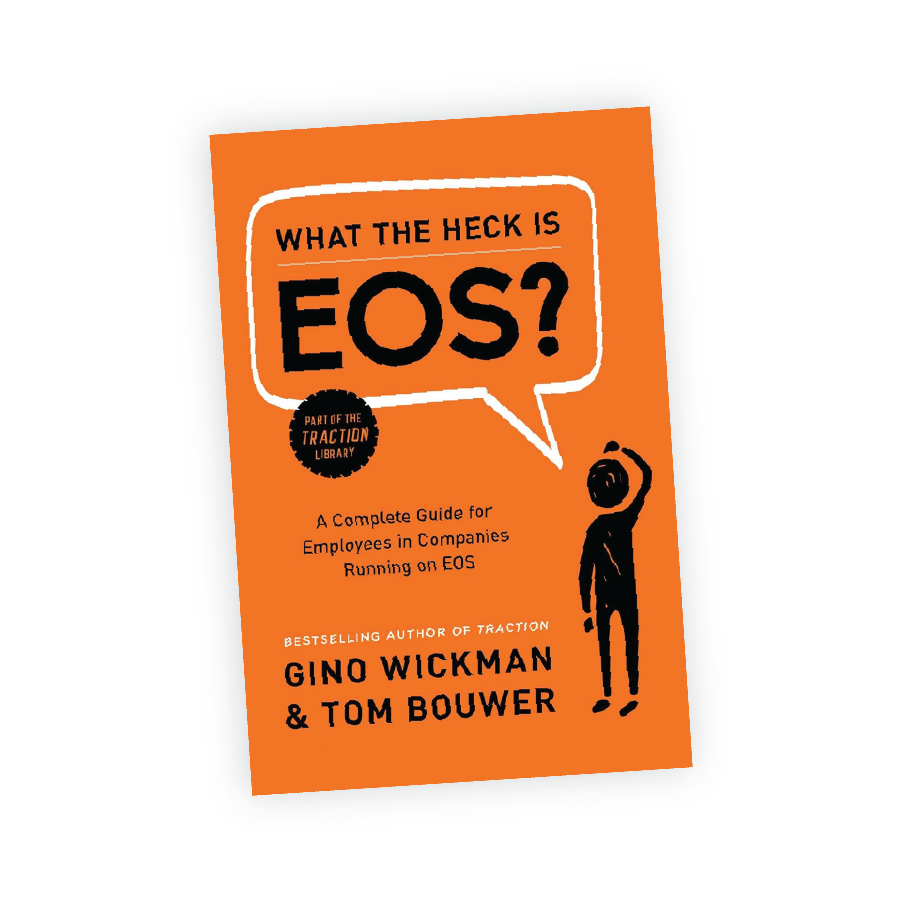
What the heck is EOS?
Number of Pages: 157
Estimated Read Time
Slow Reader: 8 Hours 47 Minutes
Average Reader: 4 Hours 23 Minutes
Fast Reader: 2 Hour 59 Minutes
Estimated Listen Time: 2 Hours 16 Minutes
Amazon Description
Has your company struggled to roll EOS out to all levels of your organization? Do your employees understand why EOS is important or even what it is?
What the Heck is EOS? is for the millions of employees in companies running their businesses on EOS (Entrepreneurial Operating System). An easy and fast read, this book answers the questions many employees have about EOS and their company:
• What is an operating system?
• What is EOS and why is my company using it?
• What are the EOS foundational tools and how do they impact me?
• What’s in it for me?
Designed to engage employees in the EOS process and tools, What the Heck is EOS? uses simple, straightforward language and provides questions about each tool for managers and employees to discuss, creating more ownership and buy-in at the staff level. After reading this book, employees will not only have a better understanding of EOS but they will be more engaged, taking an active role in helping achieve your company’s vision.
Chapter 1 – What the Heck is EOS? page 1.
Chapter 1 – What the Heck is EOS? page 1.
Every company has an operating system, whether they name it or not.
That system is the way a company organizes all its human energy.
It’s the way people in the organization:
Meet
Solve Problems
Plan
Prioritize
Follow Processes
Communicate
Measure
Structure
Clarify Roles
Lead and Manage
Sometimes it’s hard to understand the operating system of a company because the leadership teams aren’t consistent in how they do the things listed above.
This inconsistency leads to poor communication, dysfunction, and employee frustration and confusion about what the priorities are.
When this happens, a company can never reach its full potential.
Why should every company have one, and only one, operating system? Because if you have 50 people doing everything in 50 different ways, the increased complexity leads to mass chaos.
Simply put, you can’t build a great company on multiple operating systems – you must choose one.
Why EOS?
More than 100K companies all over the world run on EOS.
It gives the employees of those companies a well-defined structure in which they can grow, feel more fulfilled in their work, and achieve their personal goals.
It helps employees feel more “in the know” about what’s going on.
When employees understand what the priorities are, it helps them play their part in achieving them.
EOS saves time. EOS eliminates unhealthy and time-wasting activities due to miscommunication.
EOS and You
EOS will help employees work more effectively, with less frustration and a clearer understanding of the connection between their efforts and the success of the company.
You may be thinking that implementing EOS in your organization sounds rigid, will stifle creativity, and will rob you of your uniqueness.
Just the opposite happens. Just as a computer’s operating system is an underlying framework that helps you be more productive, EOS will do the same for your organization.
Its underlying framework will magnify your unique contribution and help you be more productive.
EOS is not a project with a specific end date. Implementing EOS in your [growing] company is an ongoing, lifelong effort.
Chapter 2 – How Does EOS Work? page 9.
Chapter 2 – How Does EOS Work? page 9.
Every company is comprised of 6 Key Components:
Vision
People
Data
Issues
Processes
Traction
The Vision Component
Have you ever been given direction from your manager only to be told something different by a leader from a different department?
This stems from a lack of organizational alignment.
Each manager or department has different priorities and different modes of operation.
As a result, employees get pulled in different directions, wasting a lot of energy.
Now imagine all the people in an organization are 100% aligned around just a few goals and each department and employee knows the role that they are playing to help achieve those goals.
That’s being 100% strong in the Vision Component
Fewer frustrations, fewer mistakes; more done in less time.
The EOS tool used to strengthen the Vision component is called the Vision/Traction Organizer (V/TO).
The V/TO ensures everyone in the organization has the same answers to 8 simple questions (see Ch. 3).
The People Component
The People Component helps build great teams. It puts the Right People in the Right Seats.
The Right People means:
People who just fit.
People you like to work with.
People who want to accomplish something every day.
People who sacrifice so the team can win.
People who act according to your company’s Core Values.
The Right Seat Means:
Getting everyone in a role where they can best contribute.
Getting everyone into a job where they can be successful.
A clearly defined, necessary job that the organization needs.
Now imagine a company with 100% Right People in the Right Seats:
Work is done more efficiently.
There are fewer fires to put out.
Mistakes are rare.
Communication is better.
The company is growing, creating more opportunities for everyone.
For the People Component, companies use two EOS tools:
Accountability Chart (see Ch. 4).
People Analyzer (see Ch. 4).
The Data Component
Would you ever get on a plane with no control panel? No gauges, and no radar? Probably not.
The Data Component is designed to help you objectively see where you are going – both as an individual and as a company.
It eliminates assumptions, subjective opinions, emotions, and egos.
The two EOS tools that will help your company become 100% strong in the Data Component are Scorecards and Measurables.
Scorecards:
A handful of numbers that, at a glance, tell you how you are doing and where you are going.
Reviewed by your leadership team weekly, providing them a pulse on the business, and allowing them to identify issues early.
Your department or team should also have a Scorecard with Measurables:
Measurables are numbers for which someone is accountable.
Every employee in the company should have a measurable and goal for that number.
Measurables let employees:
Objectively know how they are doing (good or bad).
Identify small problems before they become major crises.
Your role to is look objectively at your job and department and come up with the most important numbers to use as measurables.
By using Scorecards and Measurables, you’ll know if you’re on track to achieve your goals.
The Issues Component
By now you’ve probably thought of a few things that need to be improved, fixed, or changed to make your company better.
These are called issues. They include anything unresolved that needs to be discussed, such as problems, opportunities, or new and better ways to do things.
Many companies discuss issues…and discuss them…and then discuss them some more…but never solve them.
The Issues Component is designed to help your organization bring issues to the surface and to solve them, once and for all.
The two EOS tools that strengthen the Issues Component are the Issues List and the Issues Solving Track.
Going forward, your role is to bring up the issues you see – and to help solve them.
The Process Component
The Process Component creates, at a high level, a consistent way of performing all of the company’s operations.
Following the same processes saves an incredible amount of time and eliminates a lot of frustration.
Processes help employees perform their job with fewer mistakes, delays, and expenses.
As part of implementing EOS, your company’s leadership team will document the company’s Core Processes.
These processes will create consistency and efficiency, helping your company grow in a manageable way.
Your company will systemize all of the predictable and redundant tasks so you can use your creativity to solve problems.
Your role is to learn how to follow your company’s Core Processes as well as to objectively ask:
How are things done each day?
What are you doing that is unnecessary?
What is the best and most efficient way to do your job?
The Traction Component
Are people in the company Accountable? Do things get done on time? Does your company take on too much?
Picture in your mind, an organization where:
Projects get completed on time.
People who commit to a deadline hit it.
Meetings begin and end on time.
Unproductive people can’t hide.
Everyone focuses on a few priorities.
All priorities are clearly tied back to company goals.
Strengthening the Traction Component is about discipline, execution, and accountability.
The 2 EOS tools used to strengthen the Traction Component are Rocks and Weekly Level 10 Meetings:
Rocks are 90-day priorities – the most important things you need to get done.
The Weekly Level 10 Meeting lays down an agenda so you solve issues and stay connected as a team.
Your role is to:
Set Rocks with your manager every quarter and complete them on time.
Be fully engaged and actively participate in your Weekly Level 10 Meeting.
Short Recap
Most companies take a minimum of 24 months to strengthen each of the 6 Key Components
Questions to Ask Your Manager
What is our weakest component, and how can I help strengthen it?
What is our strongest component, and why do you think that?
What is the first thing you want me to do to help implement EOS at our company?
Ch. 3 Do You See What They Are Saying?
Chapter 3 – Do You See What They Are Saying? page 33.
Great companies have leaders who communicate a crystal-clear vision to the entire company.
A company’s vision, simply put, is a matter of defining who you are, where you are going, and how you will get there.
When the Vision is not written down, it is difficult for a leadership team to know if they are on the same page – not to mention sharing it with everyone else in the company.
This leads to poor communication, confusion, and wasted effort.
The EOS tool that helps your leadership team define, document, agree on, and share the company Vision is called the Vision/Traction Organizer or V/TO.
The V/TO aligns your leadership team around the answers to 8 essential questions.
The V/TO helps the team get their vision out of their heads and down on paper so it can be shared.
Question 1: What Are Your Core Values?
Core Values are a timeless set of guiding principles.
Companies typically have just 3-7 Core Values.
They define:
What are the behaviors you expect from each other?
Your culture – who fits and who doesn’t?
What makes your company unique and different?
Your company will use its Core Values to hire, fire, and review.
When you work with people who share the same Core Values, communication is easier, things get done faster, and the work environment is more fun.
Question 2: What is Your Core Focus?
Core Focus defines what you are and keeps the company and its employees focused on the areas where your business excels.
Core Focus keeps a company from getting distracted.
It comes from an intersection of why your company exists and what you do in the world.
Your why is:
Known as your Purpose, Cause, or Passion.
It is the thing that makes you want to get out of bed every day.
Your what is
Known as a niche.
It defines the space in which you do business.
It identifies what you do better than anyone else.
Once these two truths are clarified and put together, you have your Core Focus.
Your Core Focus serves as a filter that allows your organization to say no to good ideas and yes to great ones.
As a result, all efforts, people, systems, processes, and even products will be designed and aligned to keep you true to what you do best.
Question 3: What is Your 10-Year Target?
The 10-Year target is your long-term, larger-than-life goal.
It unites everyone around one common objective.
It gets everyone asking the right questions, like:
What does your company need to start doing differently to reach our 10-Year Target?
What do we need to change?
What could we do better?
A clear 10-Year Target that is shared by all will direct your organization’s energy, resources, and decisions to help you grow faster and reach your target.
Question 4: What is Your Marketing Strategy?
Defining your Marketing Strategy requires crystallizing who your ideal customer is and clarifying the message that is most appealing to them.
Doing this will create a laser-like focus for your sales and marketing efforts.
Many companies waste thousands of dollars trying to be everything to everyone.
The Marketing Strategy will help you stay focused, sell to the most receptive customers, and spend less organizational time servicing.
Your Marketing Strategy is made up of 4 key elements:
Target Market
Identifies the characteristics of your best customers.
Who they are.
Where they are.
How they think.
Allows you to focus your energy and resources on those customers.
3 Uniques
The three things that make you better than the competition.
The three reasons why your customers buy from your company.
Proven Process
A visual of what you do, time and time again, to deliver value to your customer over the life of the relationship.
It creates a picture of what your customers will experience when they work with you.
Guarantee
Designed to take away your customers’ biggest fear when it is time for them to buy.
Question 5: What is Your 3-Year Picture?
A picture of what your company will look like in 3 short years.
Helps everyone see the same image 3 years down the road.
Contains just a handful of numbers: Revenue, Profit, and Key Measurables.
In addition, it contains 5 to 15 bullets that help “paint” the picture.
Once everyone in the organization sees the same Vision, it is more likely to happen.
Once clear, it will give you the context in which to set goals for the next 12 months.
Question 6: What is Your 1-Year Plan?
Your 1-Year Plan defines your objectives for the year.
It identifies and crystallizes your revenue target, profit target, and key measurables, along with 3 to 7 goals for the year.
Why only 3 to 7 goals? Because:
When companies try to get too many things done, they lose focus and, as a result, accomplish very few of them.
With too many goals, organizations spread resources too thin, failing to complete many of their objectives.
Once your 1-Year Plan is clear, you’ll know exactly what you need to accomplish over the next 12 months to put you on a path to reach your 3-Year Picture and ultimately achieve your 10-Year Target.
Question 7: What are Your Rocks?
Rocks are the 3 to 7 most important objectives the company must get done in the next 90 days to achieve your 1-Year Plan.
Why 90 days? Because:
At the beginning of the year, energy is high, but even with the best intentions, life gets in the way.
People get distracted easily.
Energy is lost and plans start to unravel.
Deadlines get pushed back, and priorities get lost in the hustle and bustle.
By November we have lost all momentum and our goals for the year are off-track.
Rocks help solve this problem by breaking down annual goals into smaller, manageable chunks with short-term goals along the way.
Human beings tend to lose focus, get off-track, and fray about 90 days into any project. Rocks get everyone refocused right on the 90th day as the unraveling begins, maximizing everyone’s efforts and energy.
By setting Rocks every quarter, everyone will know the most important priorities for the company every 90 days.
Question 8: What are Your Issues?
To achieve your company’s Vision, it is vital to openly admit all of your company’s obstacles to the opportunities that lie before you.
This is simply a list of all the things that could prevent your company from reaching its Vision, or things that will help it get there faster.
All organizations have issues. The problem is when no one admits them, or when they do and everyone just talks about them but does nothing.
Putting all of the issues (and opportunities) on one list will help your company get a handle on them.
Once your issues are listed, your company can start to prioritize and work on them one at a time.
Questions to Ask Your Manager
How can our department help achieve the company Vision?
What role do I play in this?
What is our greatest challenge in achieving our Vision?
Chapter 4 – Who’s Doing What?
Chapter 4 – Who’s Doing What? page 67.
Picture an organization with 35 people where…
Roles and responsibilities are unclear.
No one is quite sure who is accountable for what.
People are tripping over each other and/or balls are being dropped.
Goals, deadlines, and opportunities are missed.
Everyone is working hard but accomplishing very little despite all the effort.
Frustration is high and everyone is blaming everyone else.
This is the picture of an organization lacking an Accountability Chart.
Great organizations define and implement the right structure that will most effectively help them reach their Vision.
The right structure will:
Clarify roles and responsibilities.
Create clear reporting lines.
Facilitate efficient decision-making and problem-solving.
Help people know who to work with to get things done.
Enable communication flow.
Identify all the available seats in the organization.
The Need for Structure
When companies start out and only have a few people (10 or fewer), the all-for-one-and-one-for-all approach is okay.
However, as companies mature (more than 10), they reach a tipping point when this all-for-one approach becomes a roadblock to growth.
Why? Because no one knows who’s responsible for what, and no one is held accountable for anything.
People don’t know who to go to with questions or concerns or to solve issues.
It is pure chaos, communication is a mess, and everyone is frustrated.
The Accountability Chart
The Accountability Chart is the tool EOS companies use to illustrate the right structure.
It clarifies the roles and responsibilities of everyone in the company.
It eliminates complex and confusing reporting lines between managers and employees.
It establishes clear ownership and accountability for everything that must get done in your company.
When the Accountability Chart is complete, every seat in the company will be defined with clear roles and responsibilities.
Scalability
The purpose of the Accountability Chart is not to show all the names of people in an organization but, instead, all the functions, or “seats” as EOS likes to call them.
The intention is to show how different job functions can be scaled.
Evolution
The Accountability Chart is a dynamic tool that is always evolving.
It is intended to help your company anticipate the structural changes needed to get to the next level.
As companies grow, structures, roles, and responsibilities will need to change.
Communication
Your Accountability Chart does not define communication structures.
In no way should the Accountability Chart create silos or divisions within your company.
Communication should flow freely across all lines and departments.
The Accountability Chart should help people know who they need to go to or work with to get the job done.
Questions to Ask Your Manager
What seat am I in, and what are my 5 roles and/or responsibilities?
Am I in the Right Seat, where I can contribute the most to the organization?
What are your 5 roles and/or responsibilities, and how can I help you?
Chapter 5 – What Is Important Right Now?
Chapter 5 – What Is Important Right Now? page 79.
The term “Rock” comes from a simple science experiment made popular by Stephen R. Covey in his book First Things First.
Link – Stephen Covey’s Rocks Video
The 90-Day World
Why set rocks every 90 days?
The human mind tends to lose focus and become distracted after about 90 days into any project.
Rock-setting gets everyone refocused right on the 90th day as the unraveling begins.
How does it work in practice?
Every 90 days you will get together with your team and review the previous Rocks you set to assure they were accomplished.
You will then set new Rocks for the next 90 days.
In your 90-Day World, you and your team will be focused on the most important priorities (Rocks) necessary to move the company forward.
Everything else – the things you don’t have the capacity to do or are not that important or urgent – get pushed to the next 90-day period.
Your Rocks
Each employee should have 1-3 Rocks every 90 days.
Your Rocks should be aligned with your company’s or manager’s Rocks.
Rocks are not above and beyond your day-to-day responsibilities.
Rocks are a crucial part of your job.
Often Rocks will be tied directly to your personal development.
SMART
Another thing about Rocks is that they need to be SMART. To be SMART, the Rock needs to be able to answer a series of SMART questions:
Specific – What specifically is your Rock going to deliver? What’s in-scope and out-of-scope?
Measurable – How will you measure the completion of your Rock? What does “Done” look like?
Attainable – What support will you need to complete your Rock? What are your obstacles?
Relevant – How is your Rock relevant to the Company and/or Department V/TO?
Timely – Why is it critical that you complete this Rock in the next 90 days? Why now?
The problem with non-SMART Rocks is that they are open to interpretation and/or don’t have a specific outcome.
Non-SMART Rocks lead to murky and frustrating conversations when your Rock review is held at the end of 90 days, which leads to diminished accountability.
Reviewing Rocks Weekly
While Rocks are set every 90 days, you will check in with the team during your weekly meeting.
You’ll report the status of your Rocks by publicly stating to your team if they are “on track” or “off track.”
Rocks vs. Measurables
If you have a measurable that is consistently not being met, it can be a Rock.
Rock Completion
The minimum standard for a team’s Rock completion is 80%.
Questions to Ask Your Manager
When will we start setting Rocks?
Do you believe my Rocks are the right ones for me?
What are your Rocks, and how can I help you with them?
Chapter 6 – Why Do We Have To Have Meetings?
Chapter 6 – Why Do We Have To Have Meetings? page 91.
Meetings are not a waste of time.
It’s what you do in meetings that is a waste of time.
If all you do is talk endlessly without solving issues, then yes, you are wasting your time.
The unfortunate reality is that your team can’t fully function at its best without productive meetings.
Imagine a meeting where:
It starts and ends on time.
You contribute to solving the most important issue(s).
Your entire team walks out committed to solving the issue(s) once and for all.
That one meeting eliminates the need for other meetings that week.
End Procrastination
Most human beings by nature procrastinate; they wait until the last minute to get things done.
People delay acting until the last minute – until just before the next meeting.
If you only meet once a month, you will only get one spike of activity per month.
Therefore, to the degree you increase the meeting frequency, you create that spike of activity more often.
Weekly Meeting Pulse
We recommend a weekly meeting pulse.
That way you get a spike of activity 52 times per year (as opposed to 12 times with monthly meetings).
We’ve found the best interval and length of meeting pulse for most teams is a 90-minute meeting every week.
These weekly meetings:
Are on the same day at the same time.
Have the same agenda.
Start on time, End on time.
This type of meeting is called a Level 10 Meeting or “L10” for short.
Level 10 Meetings
The L10 is designed to be a time management tool that saves you time by helping the right hand know what the left hand is doing – avoiding train wrecks and bottlenecks that slow things down.
It also helps by ending interruptions during the week from issues that can be solved in the meeting.
Two important things:
During this meeting, you will be creating an Issues List:
A place to put all unresolved issues that need to be discussed.
These are any ideas, opportunities, problems, concerns, or barriers.
You address these issues during the IDS (Identify, Discuss, and Solve) section of the agenda.
The meeting must always:
Take place on the same day at the same time each week.
Start and end on time.
Level 10 Meeting Agenda
Segue (5 min)
Scorecard (5 min)
Rock Review (5 min)
Customer/Employee Headlines (5 min)
To-Do List (5 min)
IDS (60 min)
Conclude (5 min)
Segue
A chance for your team to transition from working “in the business” to “on the business.”
Each person on the team shares one piece of both personal and professional good news from the past week.
Allows team members to get to know one another and start the meeting off with a positive vibe.
Scorecard
A chance to make sure your Measurables are on track for the goals you’ve set.
You review each Measurable as a team and confirm if they are on track or off track.
During the review of the Scorecard, there should be no questions, no color commentary, no excuses. Fight the urge to discuss anything.
If a Measurable is off track or if anyone on the team has a question, it gets dropped down to the Issues List.
Rock Review
Here you are making sure each team member’s Rocks are on track for the quarter.
All Rock owners will take a turn simply saying “on track” or “off track.”
During the Rock Review, there should be no questions, no color commentary, no excuses.
If a Rock is off track or if anyone on the team has a question, it gets dropped down to the Issues List.
Customer/Employee Headlines
The 5-minute section allows anyone to bring up good or bad news about customers, employees, or both.
These should be quick, 1 to 2-sentence headlines. If anything is more than that, drop it down to the Issues List.
To-Dos
These are the commitments you made to each other in your last L10 meeting.
Usually, these are actions you agreed to complete based on how you decided to solve an issue.
The team will review each To-Do to make sure they are “To-Done.”
To-Dos are typically 7-day action items.
The goal is to complete 90% of them each week.
IDS (Identify, Discuss, Solve)
This is the meat of the L10 meeting; this is where the magic happens.
Start by reviewing your Issues List, which you’ve been building during the first part of the meeting, as well as any issues that carried over from last week’s L10 Meeting.
3 Types of Issues on an Issues List:
Decisions
Information to Share
Information Needed
From the Issues List, pick the top 3 that need to be resolved this week.
When issue number 1 is solved, move to number 2 and then to number 3. If you still have time left, pick the next 3 most important issues and repeat.
The goal is to solve the most important issues well, not to solve all the issues.
The goal is to solve an issue once and for all – so it never comes back.
IDS’ing
The process you go through to solve an issue is called IDS’ing:
Identify – Look beyond the symptom to the real issue underneath; find the root cause.
Discuss – Everyone gives their input on the issue.
Solve – Once all the views are on the table, you must move to solve.
The reason most meetings are a waste of time is that teams spend all their time discussing an issue, never identifying the root cause, and as a result, never solving the issue.
Conclude
With 5 minutes left in the meeting, stop whatever you are doing – even if you are in the middle of an issue.
You still need to do 3 things and end the meeting on time:
Recap the new To-Dos that came out of the meeting:
Make sure everyone is clear on their To-dos.
Make sure everyone is committed to their To-Dos.
Decide if there are any Cascading Messages:
Important messages to communicate to others inside or outside the company.
Quickly decide who is going to communicate the message.
Rate the meeting:
Everyone rates the quality of the meeting on a scale of 1 to 10.
Rate the meeting on the following criteria:
Did it start and end on time?
Did you follow the agenda?
Is everyone on the Same Page?
Did 90% or more of the To-Dos get done?
Did you solve the most important issues?
Rating the meeting will help the team improve
If someone rates the meeting below an 8, ask, “What would have made the meeting a 10 for you?”
Questions to Ask Your Manager
Will I be punished for bringing up any issues in the L10?
Will you get mad if I give the meeting a low score?
Can we watch the L10 Video and discuss how we can improve our L10?
Chapter 7 – What’s My Number?
Chapter 7 – What’s My Number? page 115.
Imagine yourself playing a sport and you can’t see the scoreboard:
You don’t know how much time is left.
The referees won’t tell you when you commit a penalty.
You don’t know if you’re winning or losing.
When employees have no idea about how they are doing, it leads to:
Frustration
Confusion
Fear
Lack of motivation
Poor performance
In contrast, imagine a company where:
Key numbers are being tracked weekly.
Issues are solved early.
You know exactly how you are doing.
Your department knows exactly how it is doing.
The company knows exactly how it is doing.
Accountability is high.
Everyone is hitting their targets.
What is a Scorecard?
It contains a handful of numbers (typically 5-15).
It tells you if you are on track or off track to hit your goals.
It helps you identify issues early, before they become major disasters.
Eliminates guesswork, assumptions, emotions, and egos in day-to-day conversations.
Designing the Scorecard
A typical leadership team scorecard…
Contain 5-15 activity-based leading indicators, measuring the current activities that will produce future results.
Is reviewed weekly.
Must have 4 key columns:
Who – The person accountable for the number.
Measurable – Key numbers you are tracking weekly.
Goal – The number that must be hit every week to reach your quarterly target.
Date – The week on which you are reporting.
Must display 13 weeks of data at a glance. Doing this:
Helps identify patterns and trends.
Prevents overreaction to one bad week.
Identifies chronic issues.
A scorecard requires hard work, discipline, and consistency to manage.
The leader must take ultimate responsibility for the completion and accuracy of the scorecard.
Everyone Having a Number
When EOS is fully implemented in your company, each person should have at least one Measurable they are accountable for.
8 Reasons every employee should want a Measurable:
Numbers cut through murky, subjective communication between manager and employee.
Numbers create clear expectations and accountability.
Right People appreciate numbers.
Numbers create clarity and commitment.
Numbers create competition.
Numbers produce results (what gets watched gets improved).
Numbers create teamwork.
Numbers solve problems faster (solve problems proactively).
Questions to Ask Your Manager
Does our department Scorecard contain the right numbers and goals?
Is this a good measurable for me? (Bring 2-3 suggestions)
What is your measurable, and how do I help you hit it?
Chapter 8 – How Am I Doing?
Chapter 8 – How Am I Doing? page 129.
Great organizations are built by having the Right People in the Right Seats – 100% across the organization.
The People Analyzer is a simple tool that pulls Core Values (Right People) and the Accountability Chart (Right Seat) together to help your organization identify if they have the Right People in the Right Seats.
Step 1
On the People Analyzer, list a person in the left-hand column and then your company’s Core Values across the top.
Starting with the Core Values, the person is rated on how they live or don’t live each Core Value with a plus, plus/minus, or a minus:
(+) Lives the Core Values most of the time.
(+/-) Sometimes they do and sometimes they do not live the Core Values.
(-) Most of the time they do not live the Core Values.
“The Bar” is the minimum score a company will accept from the People Analyzer. It is some combination of pluses, minuses, and plus-minuses.
Step 2
Determine if each person is in the Right Seat.
Using the Accountability Chart, each person is evaluated against their seat’s roles and responsibilities using criteria called “GWC.” “GWC” stands for:
Get It: Do they “get” the job?
Do they understand the ins and outs of the position?
Do they understand how their job relates to and affects others?
Do all the neurons in their brain connect for that job?
Want It: Do they “want” the job?
Do they genuinely want to do the job?
Do they get up every morning wanting to do it?
Do they show passion for it?
Capacity: Do they have the “capacity” to do the job?
Do they have the emotional, intellectual, and physical ability to do the job?
Do they have the time to do the job?
The answer to each GWC question is a yes or a no. There are no “maybes.”
The minimum standard, or “The Bar,” for GWC is 3 yeses
Step 3
Apply the People Analyzer to yourself.
Wrong Fit – Don’t Panic
If you’re the wrong person, it doesn’t mean you’re a bad person. It only means you might be a better fit in a different company culture.
If you’re in the wrong seat, it just means you need to find a seat that better fits your talents and skills – a seat where you can be more successful.
The Quarterly Conversation
Imagine being able to sit down with your manager every 90 days and have a real, open, and honest discussion about how you are doing.
The Quarterly Conversation is:
60 minutes every 90 days.
An informal, face-to-face meeting.
2-way discussion.
A time to discuss what’s working and not working.
A time to clarify expectations.
A time to make course corrections.
When preparing for your Quarterly Conversation, ask yourself:
What’s Working?
What am I most proud of accomplishing in the last quarter?
What changes did I make to better accomplish my job?
What did I do well to hit my Rocks and Measurable(s)?
Am I working on projects in a role that matters?
How have I demonstrated the company’s Core Values?
Did my manager provide the necessary tools and direction for me to do my job well?
What’s Not Working?
What makes my job more difficult?
What processes and procedures are broken?
Have I identified the root cause of any issues I’m having?
What could I have done differently in the last quarter?
How have I not demonstrated the company’s Core Values?
What could I have done differently to hit my Rocks and Measurable(s)?
How could my manager have helped me be more successful?
What’s not working for your manager? (If you don’t know, ask.)
The Quarterly Conversations should complement the Annual Performance Review.
A good or bad Annual Performance Review should never be a surprise.
Don’t wait for your manager to come to you. If you don’t already have a Quarterly Conversation scheduled on your calendar, go to your manager and ask them when would be a good time to start.
Questions to Ask Your Manager
What was your analysis of me, using the People Analyzer?
When will we start having Quarterly Conversations?
What do you think is working and not working?
Chapter 9 – What Do I Do Next?
Chapter 9 – What Do I Do Next? page 143.
Recap Of What You Have Learned
EOS is your new operating system.
Your goal is to become 100% strong in each of the 6 Key Components:
Vision
People
Data
Issues
Process
Traction
When you are 100% strong:
Everyone will be aligned around the same short-term and long-term goals.
There will be less chaos.
There will be fewer fires to fight.
You will have 100% Right People in the Right Seats.
Everyone’s roles will be clearly defined.
Issues will be identified sooner and solved more quickly.
Decisions will be made faster and with better results.
Everyone will know how they are doing against their Measurable targets.
You’ll be living in a 90-day world and completing 80%+ of your Rocks.
Meetings will be more engaging and more productive.
Organizational Checkup
To determine how your company is doing running EOS, complete the following organizational checkup:
Most companies score below 8 when they are getting started with EOS.
EOS and You
Your company cannot become 100% strong in all 6 Key Components without you.